
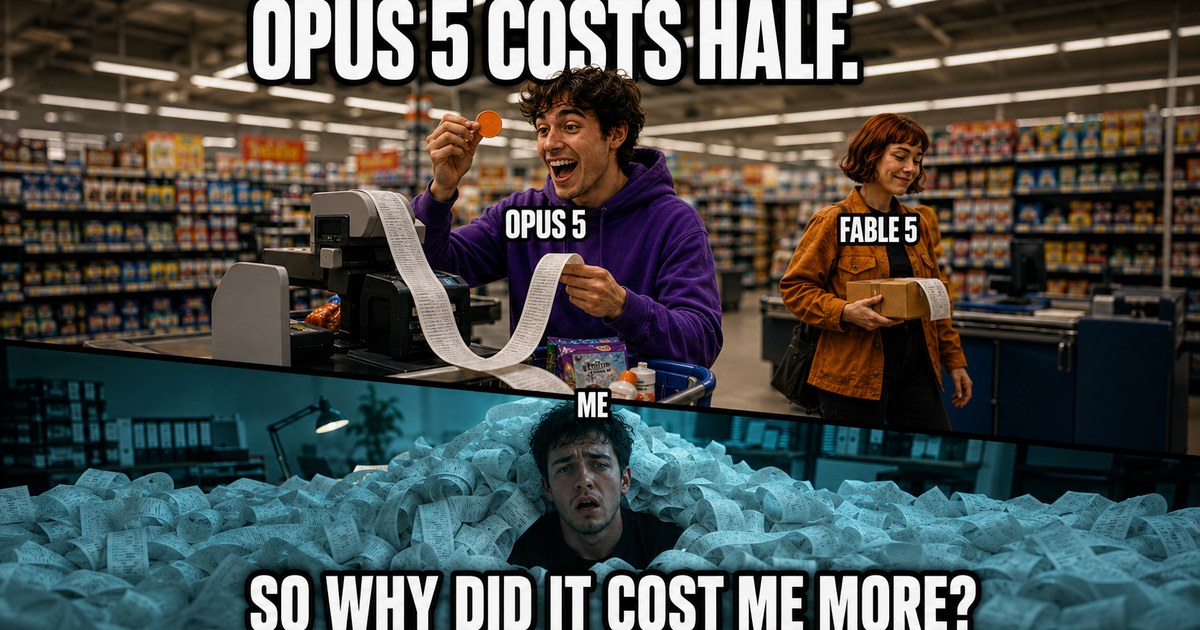
Last week I posted that Opus 5 should cost half of Fable 5, and then I explained the catch. I had spent three days running both models on real build work, and the cheaper option per token turned into the most expensive line in my month. The numbers were blunt. Opus took 127 turns to finish a session where Fable took 67.
Every message ran about 29 percent longer. That worked out to 2. 46 times the output for the same job, 15,728 characters written back to me per session against Fable's 7,726. The post collected 106,737 impressions and 587 reactions, and the comments all said a version of the same thing.
People felt the gap between the price on the page and the cost on the invoice. That gap is exactly what most teams get wrong about ai sales prospecting, and it quietly decides whether the tools you bought this year actually paid for themselves.
 in
in
“Opus 5 should cost half of Fable 5, but there's a catch. I tested it for 3 days. Here's where the money went:”
What AI Sales Prospecting Actually Costs
A pricing page for any ai sales prospecting tool shows you one number. It might be per seat, per enrichment credit, per verified email, or per thousand sends. That number is not the cost. It is the entry fee. The real cost is what you spend to produce one booked meeting, and it hides in places no pricing page lists.
It is the credits burned enriching contacts who left the company months ago. It is the rep who spends Monday morning exporting a list, cleaning it, and re-uploading it because the tool handed back junk. It is the three drafts you throw away before an AI-written email sounds like a person.
Add those up and the cheap tool and the expensive tool trade places more often than anyone expects. I learned that lesson watching a coding model, but I have paid for it a dozen times inside a prospecting stack.
The Per-Token Trap, Translated to Pipeline
Here is the coding math translated into outbound. Opus wrote me 2. 46 times more than Fable to do the same work. More output stops being more value when I am the one who has to read all of it and check it. The same trap lives inside prospecting.
A tool that is cheap per email but floods you with two thousand loosely matched leads is not cheap. You pay for it in wasted sends, in domain reputation you cannot buy back, and in the rep hours spent sorting signal from noise.
A tool that costs more per contact but returns two hundred verified decision makers with a real reason to reach out often produces more meetings for less total money.
Run one honest example. Say the cheap tool costs 200 dollars a month and books you two meetings, because most of its list bounces or ignores you. That is 100 dollars a meeting before you count the six hours your rep spent babysitting it.
Say the pricier tool costs 500 dollars and books you eight meetings from a tighter list your rep barely has to touch. That is under 63 dollars a meeting, and your rep got their morning back. The expensive tool was the cheap one all along. You only see it if you measure the right number, and the pricing page will never show it to you.
Where AI Sales Prospecting Still Breaks
I am not going to pretend the fix is just buying the pricier tool, because ai sales prospecting breaks in ways no vendor puts on a slide. The first break is data decay.
Even a great list rots at roughly two to three percent a month as people change jobs, so a tool that looked cheap per meeting in January can quietly get expensive by summer if nobody re-checks the math. The second break is that most of these tools optimize for the metric that flatters a dashboard rather than the one that fills a pipeline.
Open rate climbs while a campaign quietly mails a smaller and smaller list, and the cost per real meeting drifts up where nobody is looking.
The deeper break is that the human never fully leaves. The tool can find the account, enrich the contact, and draft the note, but it cannot decide that this specific company is worth your best rep's time this week. It cannot feel when an email reads as automated.
Judgment on targeting and a set of human eyes on the final send are still the difference between a system that books meetings and one that burns a domain. Any founder selling you a fully hands off machine is selling you the sticker price and hiding the invoice.
How to Run the Total-Cost Math on Your Own Stack This Week
You do not need a new tool to fix this. You need one number you are probably not tracking. Take an hour this week and do four things. First, add up everything you spent last month on the tools that touch prospecting, every seat and every credit.
Second, count the meetings that actually got booked from that work, rather than the emails sent or the opens logged. Third, divide the spend by the meetings and write down your real cost per booked meeting. Fourth, add a rough count of the human hours those tools cost you, because a tool that eats a rep's mornings is not free even when the plan is.
Do this for each tool separately if you can. The one with the lowest cost per meeting wins, and it is almost never the one with the lowest number on its pricing page. That is the whole point. Cheaper per token, per credit, or per seat is a number vendors chose because it makes them look affordable.
Cheaper per outcome is the number that decides whether the stack survives a lean year.
I switched my own build stack because of this math, and I run my clients' prospecting the same way. GPT orchestrates, the model that finishes in the fewest turns does the work, and price per token is the last thing I look at.
Every Thursday, AI Frontier gives you one signal, my read on it, and one practical play for building and going to market, all in under five minutes. The original post, with the full three-day breakdown of Opus against Fable, is on my LinkedIn. Come tell me what your real cost per booked meeting is, or where you think this math falls apart.
Use the AI model evaluation scorecard to measure correction time and accepted outputs alongside the model’s usage charges.


