
Anthropic's usage policy is the rulebook for everyone who uses Claude, from Claude.ai and Claude Code to the API. A new version takes effect on November 12, 2026. It bans sustained, needless cruelty toward Claude, adds a section on fake accounts and astroturfing, and rewrites the rules on high-risk uses.
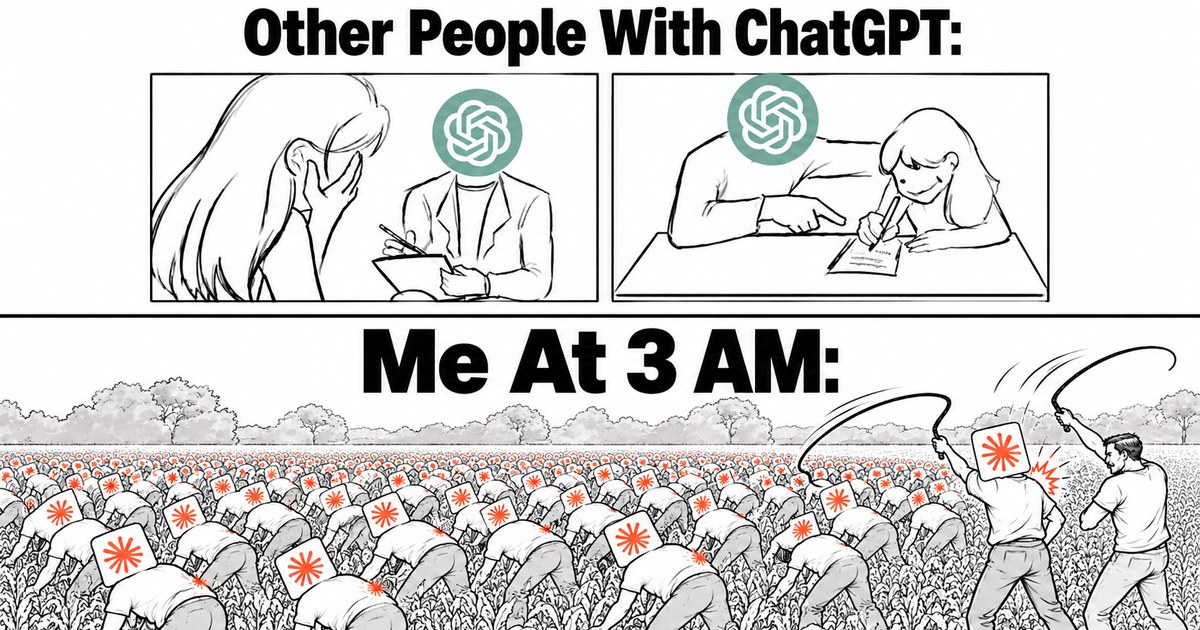
On October 12, 2026, I posted a meme on LinkedIn under one headline: Anthropic bans 'cruel' behaviour against Claude. Top panel: other people use ChatGPT as a therapist and a tutor. Bottom panel: me at 3 AM, arms crossed, while a Claude with a whip drives a field of Claude workers. Story of my life lately.
Then I did the boring part. I read the new policy and the 2025 version side by side, because my agency runs sales and marketing work on Claude. Here is what changes, and what it means if you do the same.
- The new Anthropic usage policy was published on October 8, 2026 and applies from November 12, 2026. The version it replaces dated from September 15, 2025.
- The cruelty rule targets users who repeatedly abuse Claude with no purpose. Frustration, pushback, dark fiction and model testing are excluded.
- For sales and marketing teams, the bigger change is a new section on deceptive campaigns: fake personas, fake reviews, bots that claim to be human, and content seeded to fool search engines and AI answers.
- The usage policy says what you may do with Claude. It does not change your plan's usage limits.
 in
in
“Anthropic Bans 'Cruel' Behaviour Against Claude. Story of my life lately:”
What Is the Anthropic Usage Policy?
The Anthropic usage policy, also called the Acceptable Use Policy or AUP, sets what you may and may not do with Claude. It applies to anyone who submits inputs: people on Claude.ai and Claude Code, developers on the API, customers on cloud platforms, and the end users of products built on Claude.
It has three parts. Universal Usage Standards are bans that apply to everyone. High-risk Use Case Requirements add controls when Claude makes recommendations about someone's health, money, rights or job, or controls hardware that could hurt someone. Additional Use Case Guidelines cover chatbots, products for minors, agents and directory software.
Anthropic's Safeguards Team enforces it with detection and monitoring. If Anthropic suspects a violation, the new text says it may warn you, or throttle, limit, suspend or terminate your access. The 2025 text acted when Anthropic learned of a violation, and listed no warning step.
What Changes in the Anthropic Usage Policy on November 12, 2026?
Most of the update clarifies rules that already existed, according to Anthropic's announcement. A few changes are real, and the table compares the two texts on the points that matter most to a business.
| Topic | September 2025 version | November 2026 version |
|---|---|---|
| Abuse toward Claude | Not in the policy. Since August 2025, Claude Opus 4 and 4.1 could end persistently abusive chats | Bans sustained and needless abusive or cruel behavior toward Anthropic's models |
| Fake accounts and reviews | Spread across sections; fake reviews and comments sat under fraud | New section: "Do Not Engage in Deceptive Campaigns or Artificial Activity" |
| Gaming AI answers | Not named | Bans seeding search engines or AI systems with content that hides its origin or independence |
| Elections | Included a blanket ban on personalized vote or campaign targeting | Renamed "Do Not Undermine Democratic Processes"; blanket targeting ban removed, deception still banned |
| High-risk uses | 7 categories, including auto-generated content published for external consumption | 11 high-risk recommendation areas, such as hiring, credit and medical, plus 6 kinds of high-risk physical actions; publishing content is not on the list |
| AI disclosure in chatbots | At the start of each chat session | At the start of each session or in the product interface; naming Claude is not required |
| Reselling access | No specific clause | Bans reselling or proxying Claude through unauthorized means, including routing requests through consumer subscriptions |
| Enforcement | Acts if Anthropic learns of a violation: throttle, suspend or terminate | Acts if Anthropic suspects one: warn, throttle, limit, suspend or terminate; a blocked output alone is not a violation |
Anthropic also tightened the wording on weapons, now including the software that makes weapons work and arming drones, and on surveillance. Tracking people without consent is banned even through analysis of data already collected. Anthropic says these two edits match what it already enforced.
Three more additions. If Claude controls hardware that could hurt someone, a qualified person must be able to watch it and stop it, and the equipment must hold a safe state if Claude disconnects. Doxxing is named as banned. And Anthropic's Supported Regions page now spells out that companies majority-owned from unsupported regions cannot use Claude.
What Counts as Cruel Behavior Toward Claude?
Only extreme cases count. Anthropic says the rule applies where users repeatedly act cruelly toward its models with no discernible purpose. It does not apply to common user frustration, pushback, dark creative themes, or model testing and research.
So the meme is safe. Pushing Claude through a long task list at 3 AM is just work. Swearing at it once over a broken script is frustration. Spending an hour insulting it for fun, after it has tried to steer the chat elsewhere, is the case the rule describes.
The penalty is mostly the one that already existed. Anthropic says Claude's ability to end these conversations stays the main enforcement tool, on Claude.ai and Claude Code. When Claude ends a chat, you cannot send new messages in it. Your other chats are untouched, and you can start a new one or edit an earlier message.
Why would a company protect a model? Anthropic says it is highly uncertain whether Claude has any moral status. It treats letting the model exit abusive chats as a low-cost precaution, in case model welfare turns out to matter.
If you want a method for reading claims like this one, I wrote a guide on how to evaluate AI safety claims.
What Does the New Usage Policy Mean for Sales and Marketing Teams?
For a go-to-market team, the cruelty rule changes nothing. The deceptive campaigns section changes a lot. It bans using Claude to run fake personas, fake reviews or bots that claim to be human when the goal is to mislead people about who is behind them. It also bans building the tools that make those things scale, and selling them as a service.
One line reads like it was written for 2026 marketing. You may not seed search engines or AI systems with content that misrepresents its origin, such as networks of sites posing as independent sources that confirm the same claims. If you do GEO, read that line twice. One relief for content teams: the 2025 text treated auto-published content as high-risk, with a human reviewer and an AI disclosure. That category is gone.
The 2025 text also banned presenting AI output as human-generated. That line is gone. What stays banned is using fake personas or accounts to make people think they are talking to a human.
Two older rules still apply. Spam is banned, and so is using Claude to get around the guardrails or terms of other platforms. If your outreach tool breaks LinkedIn's rules and Claude writes the messages, both sets of terms are in play.
Agents get a clear line too. Users are responsible for what the agents they build or deploy do, including actions through tools, browsers and connected systems. Any consumer-facing chatbot or AI agent that talks directly with external users must say it is AI. The 2025 text was wider: it covered any external-facing or interactive AI agent.
My cautious reading: if prospects talk to your AI SDR, treat it as covered. Here is the checklist I am running on our own stack before November 12.
- List every place Claude writes something a prospect or customer will read: emails, DMs, chat, landing pages.
- Make sure a real person approves each outbound message, or that the agent sending it says it is AI.
- If an AI agent replies to people on its own, disclose it at the start of the chat or in the interface.
- Never let Claude write reviews, testimonials or comments that pretend to come from customers.
- Publish GEO content under your real name and brand. No networks of fake independent sites.
- Check that each automation tool respects the terms of the platform it runs on.
- No shared consumer logins resold or proxied to clients.
If you run outbound with AI, my guide to AI SDRs covers where full automation works and where it backfires.
Does the Usage Policy Change Claude's Usage Limits?
No. The usage policy decides what you may use Claude for. Usage limits decide how much you can use it on your plan, such as the caps on Pro and Max. The November 12 update does not touch prices or limits.
If you are hitting caps, my guide to Claude Max usage limits explains how they reset.
What Happens If You Violate Anthropic's Usage Policy?
If Anthropic suspects a violation, it may warn you, or throttle, limit, suspend or terminate your access. The warning step is new in the November 2026 text. A blocked answer is not proof of a violation: the policy says real-time safeguards may block outputs without you breaking any rule.
Getting around a ban with a new account is itself a violation, and so is creating multiple accounts to avoid detection. For cruelty toward Claude, Anthropic says the main response stays the same: Claude ends the conversation.
My take: nobody in sales will ever trip the cruelty rule. The rules that cost accounts are spam, fake personas and automation that breaks other platforms' terms. Those were there in 2025 too, and now nobody can say they are unclear.
If you want outbound built on signals and real people instead of volume tricks, that is what our B2B lead generation service does.
Frequently asked questions
When does the new Anthropic usage policy take effect?
The new Anthropic usage policy takes effect on November 12, 2026. Anthropic published it on October 8, 2026, so users have about five weeks to adapt. It replaces the version that took effect on September 15, 2025. The full text, with a link to the previous version, is on anthropic.com/legal/aup.
Is it against Anthropic's policy to be rude to Claude?
Not in normal use. The new rule bans sustained and needless abusive or cruel behavior toward Anthropic's models. Anthropic says it covers only extreme cases where users repeatedly act cruelly with no purpose. Frustration, pushback, dark creative themes and model testing or research are explicitly excluded.
Can Claude end a conversation?
Yes. Since August 2025 Anthropic has let Claude end rare conversations with persistently harmful or abusive users (first Opus 4 and 4.1, in the Claude apps), as a last resort. You then cannot send new messages in that chat. Your other chats are unaffected, and you can start a new chat or edit and retry an earlier message.
Does the Anthropic usage policy apply to the API?
Yes. It applies to anyone who submits inputs to Anthropic's products, including developers and businesses on the API, customers on cloud platforms and authorized resellers, and the end users of products built on Claude. Builders are also responsible for what their agents do through tools and browsers.
What does 'request blocked by Anthropic usage policy' mean?
It means a real-time safeguard stopped that output. A block does not by itself mean you broke the rules. If your use is legitimate, state its purpose clearly, and never try to work around the block. Security and life-sciences teams can apply to Anthropic's Cyber or Life Sciences Verification Programs for adjusted safeguards.
Sources
Anthropic, Updating our Usage Policy, October 8, 2026, read October 12, 2026.
Anthropic, Usage Policy, effective November 12, 2026, read October 12, 2026.
Anthropic, Usage Policy, effective September 15, 2025 (previous version), read October 12, 2026.
Anthropic, Claude Opus 4 and 4.1 can now end a rare subset of conversations, August 15, 2025.
TechCrunch, Anthropic changes usage policy to ban model abuse and election interference, October 8, 2026.
MacRumors, Anthropic Says Users Can't Be Needlessly Cruel to Claude, October 8, 2026.


