
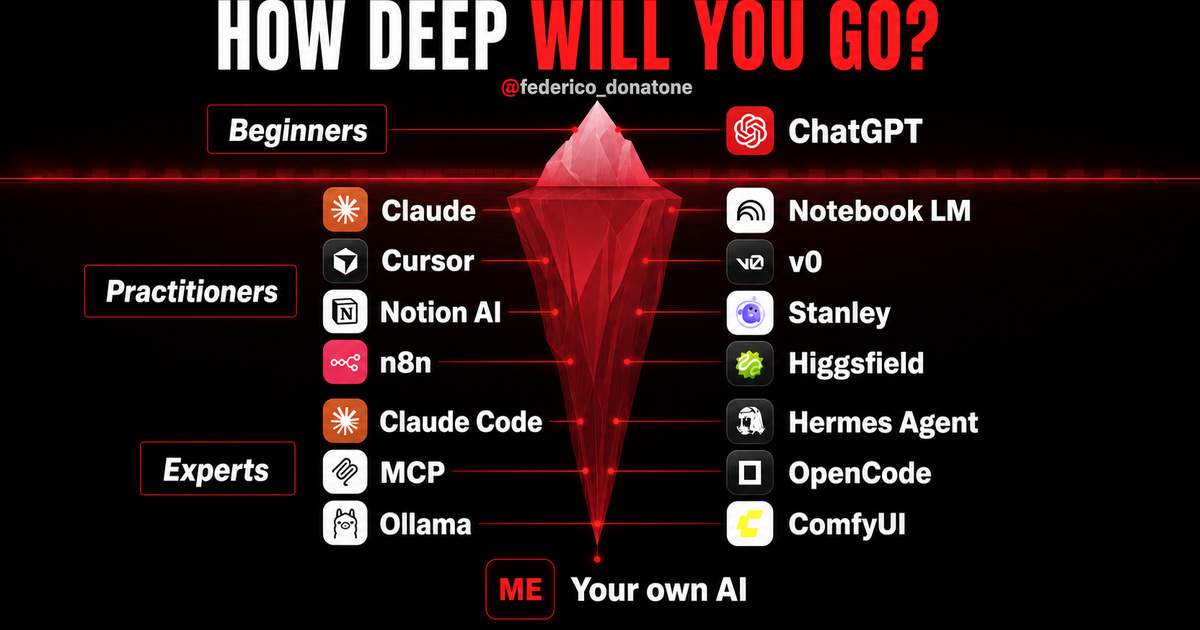
I spent $10,000 testing AI tools for small business, and fifteen of them now give me the output of a ten-person team. My LinkedIn video mapped them as an iceberg. ChatGPT sat above the water. The systems that do the work, from Claude and NotebookLM to Cursor and n8n, sat underneath it. The post took 322 reactions and 69 comments, mostly asking which tools mattered and which were decoration. The better question is how the pieces earn their place together.
I run Growth Cab, a GTM advisory. We use AI for research, operations, coding, content, automation and the work that connects those jobs. That gives me a useful test for every new subscription. A tool belongs in the stack only when it owns a clear job, hands its output to the next job cleanly and saves more review than it creates. The logo matters far less than the handoff.
 in
in
“I spent $10,000 this month testing AI tools. These 15 give me the output of a 10-person team.”
The AI Tools for Small Business in My 15-Tool Stack
The iceberg starts with ChatGPT because that is where most teams start. One interface can draft, summarize, brainstorm and answer questions. It is useful precisely because it is broad. The danger is treating broad access as a complete operating system. A chat can produce a good answer and still leave the work trapped in a conversation, with no trigger, owner, record or next step.
The practitioner layer gives each recurring job a specialist. In my map, Claude handles deep thinking and NotebookLM handles research grounded in a defined source set. Cursor handles coding and v0 accelerates interfaces. Notion AI supports operations, Stanley supports content, n8n connects automations and Higgsfield handles video. The exact vendors can change. The important part is that every tool has a sentence describing the job it owns.
The expert layer moves from using applications to building systems. Claude Code ships working changes. Hermes Agent coordinates longer agent work. MCP connects models to tools and data. OpenCode provides another coding surface. Ollama runs local models, while ComfyUI gives precise control over generation workflows. These tools demand more setup, but they also let a small company control the process instead of renting every step from a separate dashboard.
The bottom of the iceberg says your own AI. That does not require training a frontier model. It means the briefs, rules, data and verification loops belong to your company. A vendor may execute the job today, but the definition of good work stays portable. That is the layer that turns a list of subscriptions into an asset.
The brief is the part to own first. This is how I write a four-part brief before any agent touches the work: done, constraints, one excellent example, self-check.
Start With Jobs and Measurable Outputs
Before testing another tool, write down the jobs your business repeats every week. Research an account. Prepare a call. Turn a transcript into a follow-up. Build a landing page. Clean a list. Produce a video. Reconcile an invoice. Each job needs an input, a finished output, an owner and one measure of quality. If you cannot describe those four things, software will only automate the confusion.
Account research and call prep have their own page: my guide to the best AI sales tools shows the five pre-call workflows I kept.
Then give one tool primary responsibility for each job. Overlap is allowed during a test, because parallel runs expose quality differences. Permanent overlap is expensive. Two research tools, three writing tools and four automation products create more surfaces to monitor while everyone assumes somebody else owns the result. A small business wins by making ownership obvious.
For sales and outbound, our GTM tool stack page applies the same rule: one primary tool per job, with starting prices and a test for each.
My $10,000 month was a test budget, and it would be absurd as a default subscription plan. The point of the test was to buy evidence quickly. I ran tools on live jobs, compared what came back and kept the ones that improved throughput. A founder copying the bill would learn almost nothing. A founder copying the test method can reach the same decision for a fraction of the cost.
The Four-Part Scorecard for Every AI Tool
First, measure output quality on a representative batch. Ten easy examples prove very little. Use the messy inputs your team actually sees, including thin accounts, incomplete notes and edge cases. Score accuracy, completeness and how much editing a person needed. A fluent answer that takes twenty minutes to repair is a weak result, even when the demo looks impressive.
Second, test the handoff. Can the output move into the CRM, document, codebase or next automation without a person copying fields? Most AI stacks lose their savings between tools. One product finishes its part and leaves a human to rename the file, repair the format and paste the result somewhere else. The handoff is often a bigger cost than the generation.
Third, test control. Ask where the data lives, which actions can run automatically and how you stop a bad run. Local tools such as Ollama can improve privacy and resilience, while MCP can make connections easier to replace. Those benefits matter only when somebody maintains permissions, logs and fallbacks. Control is an operating responsibility rather than a checkbox on a pricing page.
Fourth, calculate total cost per accepted output. Include licenses, credits, setup time and review time. A cheap tool that produces twice the volume can still cost more when the team rejects half of it. The winning number is the cost of work you would actually use, measured against the human process it replaces or improves.
My Perplexity and Claude research test applies the same logic to sales research: ten representative accounts, sparse ones included, and cost per accepted result.
Documentation tools follow the same rule. My Guideless review shows a training video tool where the people who only watch the guides never need a seat.
Where a 15-Tool AI Stack Breaks
Fifteen tools do not literally become ten employees. They compress pieces of ten roles when the work is well defined. Strategy, taste, accountability and the final commercial decision still need an owner. If a team hears the ten-person line and removes every human checkpoint, it has created a faster way to multiply one bad instruction.
The second failure is integration debt. APIs change, models drift and permissions expire. A workflow that passed last month can start returning a different format today without raising an error. Every important automation needs a visible postcondition: the record exists, the page rendered, the number reconciled or the draft matches the source. A green process is weak evidence when the customer-facing result is wrong.
The third failure is buying depth before the company needs it. Claude Code, Hermes Agent, MCP, Ollama and ComfyUI can create enormous leverage. They also require someone who understands the system well enough to diagnose it. A five-person company with one weekly research job may get more value from ChatGPT and a disciplined checklist than from a local agent stack nobody can maintain.
A 30-Day Test for Your Own Stack
Choose three recurring jobs with visible costs. Record the current time, quality and failure rate for each. Run one candidate tool in draft mode for two weeks, with a person approving every result. Keep the evidence from rejected outputs, because those failures write the rules the workflow needs. In week three, connect the handoff. In week four, let only the low-risk slice run automatically.
At day thirty, keep a tool only if it improved an accepted business output. Cancel anything that merely produced more material to read. The goal is a stack where every layer has a job, every job has a check and every handoff leaves evidence. That is how fifteen tools can give a small business unusual leverage without turning the founder into a full-time software administrator.
Use the sales stack consolidation test when several tools appear to cover the same job and you need evidence before removing one.
Every Wednesday, AI Frontier gives you one signal, my read on it and one practical play from the systems we run at Growth Cab, all in under five minutes. The original iceberg video is on my LinkedIn. The useful conversation is deeper than which logo sits where. It is which job in your company still lacks a clear owner, measurable output and a verification loop.


