
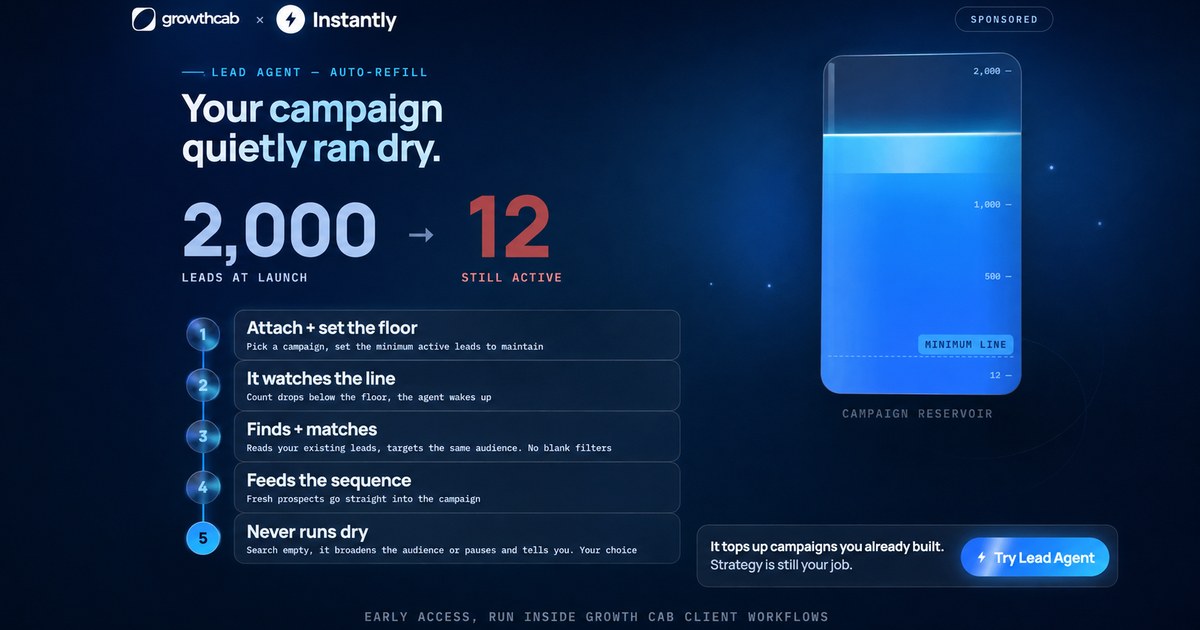
Right now one of your campaigns is emailing twelve people. It launched with two thousand leads. They ran out. Nobody noticed. I posted exactly that a week ago and it collected 226 reactions and 71 comments, which confirmed something I had suspected for years: a campaign starving to death is the failure nobody puts on a dashboard.
I run Growth Cab, a GTM advisory, and watching lead lists run dry has always been the most annoying part of running outbound for clients. Instantly gave me early access to their new Lead Agent, and I ran it inside real client workflows before writing a word about it.
Here is what it does, and where ai prospecting tools still need a person sitting on top of them.
 in
in
“Right now one of your campaigns is emailing 12 people. It launched with 2,000 leads. They ran out. Nobody noticed.”
The Failure AI Prospecting Tools Were Built to Catch
Outbound breaks in two ways. The loud one is easy: your domain gets flagged, replies stop, someone raises a hand in the client channel by lunchtime. The quiet one is the campaign that keeps running on an empty tank.
The sequence is still live, the sending schedule is still green, the daily send count just gets smaller every week until it is sending to a dozen contacts. Nothing alerts you, because nothing failed. The percentages even look better for a while, since a shrinking denominator flatters an open rate. That is the trap.
A campaign that mails twelve people can post a beautiful reply rate and produce nothing that reaches a pipeline review.
For most teams the fix has been a human who remembers to check. Someone opens the tool on Monday, notices the list is thin, exports a new one, cleans it, uploads it, maps the fields, and gets back to their actual job. It works right up to the week it does not, because remembering is the least reliable part of any process.
Every operator I know has a story about a client campaign that ran on fumes for a month before anyone opened the lead count.
How the Lead Agent Refills a Campaign
The mechanic is refreshingly boring, which is usually the sign of a good one. You attach the agent to a campaign and set the minimum number of active leads you want that campaign to maintain. That number becomes a floor.
When the count of live prospects drops below it, the agent goes and finds new ones, matches them against the audience the campaign is already working, and feeds them straight into the sequence. No export, no CSV, no field mapping on a Monday morning.
The part I did not expect is how it decides who to target. It reads the leads already sitting in the campaign and uses them as the brief. You are not handed a blank filter form asking for industry, headcount, geography, and seniority, which is the step where most people either freeze or lie to themselves about their ideal customer.
The existing list is the definition. If your campaign is full of operations leaders at mid-market logistics companies, that is the shape it goes looking for.
The behaviour when a search comes up empty matters just as much. The agent either broadens the audience on its own or stops and tells you, and you pick which of those two happens before you ever need it. That single choice is the difference between a tool you can leave running on a client account and one you cannot. Silent broadening on a tightly targeted campaign would be a very expensive surprise.
What Actually Changed in My Week
Before, checking lead counts was a recurring task on a human being, and recurring tasks on human beings decay. Now the checking belongs to the machine, and my attention goes to the two questions that were always the real work: is the audience right, and is the offer landing.
That is a small change on paper and a large one in practice, because the thing I stopped doing was never intellectually hard. It was just constant, and constant is what kills operators.
It also changes what a campaign is. A campaign used to be a fixed batch of names moving through a sequence until the batch ran out. With a floor and an agent watching it, a campaign becomes a running system with a supply line attached to it. You stop thinking in list uploads and start thinking in throughput, which is how the rest of your revenue machine already works.
Where AI Prospecting Tools Still Need a Human
Let me be precise about scope, because this is where most write-ups go soft. Lead Agent tops up campaigns you already built. It does not decide who you should be selling to, it does not write your angle, and it will not tell you the offer is wrong. Strategy stays your job.
If the campaign underneath is badly targeted, an automatic refill makes a bad campaign bigger and faster, which is a worse outcome than the campaign quietly dying would have been.
Two more limits are worth naming. First, more leads in the tank does not mean more sends. Your real ceiling is inbox capacity and deliverability, so if you set a floor your infrastructure cannot serve, you have moved the bottleneck rather than removed it. Second, an audience defined by the leads already in the campaign inherits whatever bias is in that list.
If the original upload was skewed toward one segment because that was the export you happened to have, the agent will faithfully reproduce the skew. Garbage in stays garbage in, only now it refills itself.
How I Would Roll It Out
On client accounts I set the floor to something my sending infrastructure can genuinely serve for a week. The biggest number the interface accepts is almost always the wrong one. On tightly targeted campaigns, the ones aimed at named accounts or a narrow segment, I choose pause and tell me.
On wide-net campaigns where the audience is a category rather than a shortlist, automatic broadening is fine. Then I review the leads the agent added once a week, at the same time I review reply quality, because the two questions are the same question. If the new names look like the ones that reply, the floor is doing its job.
That review is the whole discipline. An agent that feeds a campaign is only as good as the audience it inherited, so the human work moves upstream to defining that audience well and checking that it holds. The work does not disappear. It gets better.
The Honest Verdict on This Category
Most ai prospecting tools I test try to replace the interesting part of outbound, which is judgment, and leave the boring part on your plate. This one does the opposite, and that is why it stuck in my stack after the test. The best automation takes the task you would forget rather than the task you enjoy.
A campaign that emails twelve people is rarely a strategy problem. It is an attention problem, and attention is exactly what software should be buying back for you.
So the question I left under the post is the one worth asking yourself today: when did you last check how many active leads your campaigns have left? If the answer is that you do not remember, you already know what you will find.
Disclosure: Instantly provided Growth Cab with early access to Lead Agent and sponsored the LinkedIn post this article is based on. The test ran inside live client workflows, and nobody reviewed this text before publication.
Use the sales trigger qualification guide to check why a newly sourced account should enter the campaign now.


