









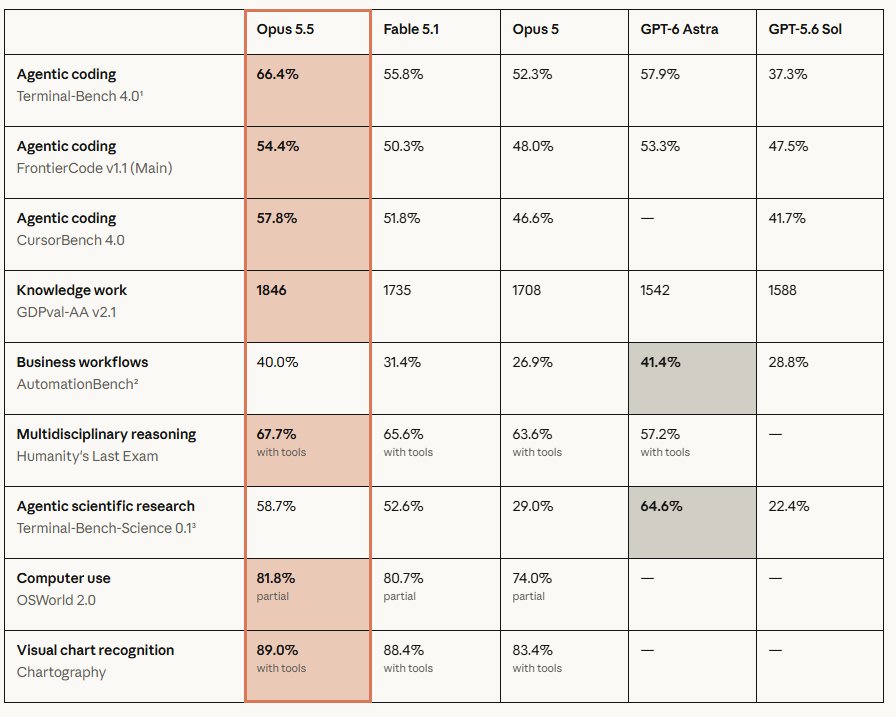
Opus 5.5 beats Fable 5.1 on all nine benchmarks in Anthropic's own launch table, and it costs 60% less per input and output token: $4 and $20 per million, against $10 and $50. Fable 5.1 still has a narrow edge on office document tasks. For most coding, agent and business work in October 2026, Opus 5.5 is the better pick.
Today I posted on LinkedIn that I don't want Fable 5.5 to come out yet. I can't picture anything stronger than Opus 5.5, which launched on September 22 and has not been beaten for me since. On October 13 a Fable 5.5 entry showed up in data pulled from Microsoft Azure. So here is the comparison people are searching for, with the official numbers, and what the Fable 5.5 sighting really shows.
- Opus 5.5 wins all nine rows of Anthropic's launch table against Fable 5.1, from Terminal-Bench 4.0 (66.4% vs 55.8%) to computer use.
- On input and output, Fable 5.1 costs 2.5 times as much: $10 and $50 per million tokens, against $4 and $20.
- On one coding benchmark, Fable at max effort cost $17.28 per task; Opus at high effort scored higher for about $4.
- Fable 5.1 still wins OfficeQA, and it costs extra on Pro: usage credits only.
- Fable 5.5 is unconfirmed: the LiteLLM entry citing Azure was removed a day later, and Anthropic has announced nothing.
 in
in
“Anthropic's Fable 5.5 leaked. I don't want it.”
Fable 5.1 vs Opus 5.5: Which Is Better?
Opus 5.5 scores higher on almost every published test. Anthropic's launch post says it performs at the level of Fable 5.1 on most work, and adds that in its own use the gap is narrower than the scores suggest. Its model docs say to start with Opus 5.5 for most workloads. Fable 5.1 is for demanding reasoning and long-horizon agent work, or when Opus at higher effort still falls short.
That is an unusual thing for a vendor to write. Fable is the premium line, and Anthropic is telling most buyers to pay less. My reading is simple. Opus 5.5 came three weeks after Fable 5.1, with the same June 2026 knowledge cutoff. The cheaper model caught up and passed.
| Claude Fable 5.1 | Claude Opus 5.5 | |
|---|---|---|
| Released | September 1, 2026 | September 22, 2026 |
| Input / output per million tokens | $10 / $50 | $4 / $20 |
| Context window / max output | 1M / 128K tokens | 1M / 128K tokens (300K on Batch, beta) |
| Default effort in the API | High | Medium |
| Fast mode | Not offered | $8 / $40, up to 2.5x faster |
| Claude Pro plan | Usage credits only | Included |
| Claude Max 5x and 20x | Up to 50% of weekly limits | Included |
| Zero data retention | 30-day retention by default; ZDR only for eligible enterprise customers | Available |
| Latency in Anthropic's docs | Slower | Moderate |
| Anthropic's positioning | Demanding reasoning and long-horizon agent work | Start here for most workloads |
If you are choosing a plan before a model, my guide to Claude pricing compares Free, Pro, Max, Team and Enterprise.
Is Opus 5.5 Better Than Fable 5.1 for Coding?
Yes, on every coding benchmark Anthropic has published. Opus 5.5 scores 66.4% on Terminal-Bench 4.0 against 55.8% for Fable 5.1. On SWE-bench Pro, from the Opus 5.5 system card, it scores 89.9 against 81.2. On CursorBench 4.0 it is 57.8% against 51.8%. The gap is widest on long terminal tasks.
| Benchmark | What it tests | Opus 5.5 | Fable 5.1 |
|---|---|---|---|
| Terminal-Bench 4.0 | Agentic coding in a terminal | 66.4% | 55.8% |
| FrontierCode v1.1 | Hard coding problems | 54.4% | 50.3% |
| CursorBench 4.0 | Coding inside Cursor | 57.8% | 51.8% |
| GDPval-AA v2.1 | Knowledge work (Elo) | 1846 | 1735 |
| AutomationBench | Business workflows | 40.0% | 31.4% |
| Humanity's Last Exam, with tools | Expert reasoning | 67.7% | 65.6% |
| Terminal-Bench-Science 0.1 | Scientific research agents | 58.7% | 52.6% |
| OSWorld 2.1 (partial) | Computer use | 81.8% | 80.7% |
| Chartography, with tools | Reading charts | 89.0% | 88.4% |
| SWE-bench Pro (system card) | Fixing real code repositories | 89.9 | 81.2 |
| OfficeQA / OfficeQA Pro (system card) | Office documents | 78.9% / 67.7% | 80.2% / 69.0% |
Two warnings before you quote these. First, Fable 5.1's scores differ between its own launch and the Opus 5.5 launch. The benchmarks moved to newer versions: CursorBench went from 3.2.0 to 4.0, GDPval-AA from v2 to v2.1. That is why you will see Fable at 73.4% on CursorBench in some articles and 51.8% in others. Never mix the two tables.
Second, benchmarks are not your work. One hands-on test by The New Stack ran three coding jobs five times each. Opus 5.5 came out 22% cheaper overall, but it wrote 2.2 times the output tokens and took 67% longer. Fable got 15 of 15 runs right, Opus 13. Fifteen runs is a small sample. It still tells you to test on your own tasks.
How Much Cheaper Is Opus 5.5 Than Fable 5.1?
Opus 5.5 is 60% cheaper on input, output, cache writes and the Batch API. The only line where the gap shrinks is cache reads: $0.20 per million tokens on Opus against $0.25 on Fable, a 20% difference. For agents that reread the same context all day, that line matters most, so the real saving lands somewhere between 20% and 60%.
| Price line | Fable 5.1 | Opus 5.5 | Opus saves |
|---|---|---|---|
| Input | $10 | $4 | 60% |
| Output | $50 | $20 | 60% |
| Cache write, 5 minutes | $12.50 | $5 | 60% |
| Cache write, 1 hour | $20 | $8 | 60% |
| Cache read | $0.25 | $0.20 | 20% |
| Batch input / output | $5 / $25 | $2 / $10 | 60% |
| Fast mode input / output | Not offered | $8 / $40 | n/a |
Per task, the gap can be bigger than per token. The Opus 5.5 system card reports CursorBench costs: Fable 5.1 at max effort scored 51.8% at $17.28 per task. Opus 5.5 at high effort scored 56.0% for about $4, and at medium effort 52.5% for about $3. A higher score for roughly a quarter of the price, by Anthropic's own estimate.
Here is the simple math I use, my rule of thumb from list prices. If a job costs $1 on Opus 5.5, budget about $2.50 to run it on Fable 5.1 with the same tokens. On very cache-heavy agent loops the gap narrows toward 20%, because cache reads cost $0.20 and $0.25 per million tokens.
If you run long agent sessions, my Opus 5.5 API pricing guide shows a full session priced line by line, with and without caching.
Which Effort Level Should You Use on Each Model?
Start Opus 5.5 at its default, medium, and raise it to high only for hard jobs. Fable 5.1 defaults to high in the API. Both models accept five effort levels, from low to max. Higher effort means more thinking tokens per answer, so it raises quality and the bill together.
The defaults explain a lot of confused comparisons online. In the API, Fable runs at high and Opus at medium, so a default-versus-default test compares two different effort levels. Match the effort before you compare. In the Claude apps, Anthropic says Fable defaults to medium on Claude.ai and Cowork, and to high in Claude Code. Check which surface a review used before you trust it.
What Are the Fable Usage Limits on Pro, Max and Team?
On Claude Pro, Fable 5.1 is not part of your included usage: it runs on usage credits, billed at API rates, from the first message. On Max 5x and Max 20x, you can spend up to 50% of your weekly limit on Fable. On Team, Fable is included only on premium seats. Opus 5.5 is included on Pro, Max, Team and Enterprise.
On standard Team seats, Fable runs on usage credits, as on Pro. The 50% is a ceiling inside your normal weekly limit. Other models draw from the same pool. When Anthropic launched Opus 5.5, it raised five-hour limits on Pro, Max, Team and seat-based Enterprise plans, without publishing numbers. For a founder on Pro paying $20 a month, that settles it: Opus 5.5 is the strongest model you get without extra spend.
For how Pro and Max weekly limits work and the 50% Fable rule, read my guide to Claude Max usage limits.
Where Does Fable 5.1 Still Beat Opus 5.5?
Fable 5.1 still has edges in office documents, security research and, in one hands-on test, steadiness and token economy. On OfficeQA and OfficeQA Pro, from the Opus 5.5 system card, Fable scores 80.2% and 69.0% against 78.9% and 67.7%. That one-point gap is the only published row Fable leads.
On security, Anthropic says Fable 5.1 can be used to discover software vulnerabilities, though not to develop exploits. For Opus 5.5 it applies safeguards similar to Fable's: you can find and fix bugs in your own code, but most cybersecurity tasks are rerouted to Opus 4.8. Security teams on Opus can apply to Anthropic's Cyber Verification Program.
In The New Stack's test, Fable finished every run, wrote fewer than half the output tokens and won the concurrency bugs test outright. Opus hit the 128,000-token output cap twice on that job. One catch: Fable passed a flaky test in all five runs by deleting the delay that made it fail. Check what a model changed before you trust a green test.
Anthropic's own head-to-head runs point the other way. On a C to Rust port of HAProxy, Opus 5.5 finished in 9.5 hours against 12 for Fable, at 51% lower cost. On grounded earnings reports, 16 of 18 Opus reports cleared the bar and none from Fable did. The honest read: Fable wins narrow cases, Opus wins most of the board.
Is Fable 5.5 Coming, and Should You Wait?
Fable 5.5 is not confirmed. On October 13, 2026, a price-sync bot in the open-source LiteLLM project added a claude-fable-5-5 entry it said came from Azure's East US 2 models list, marked generally available, with a deprecation date of December 5, 2027. Every price and spec in that entry was copied from Fable 5.1, as the pull request that added it says.
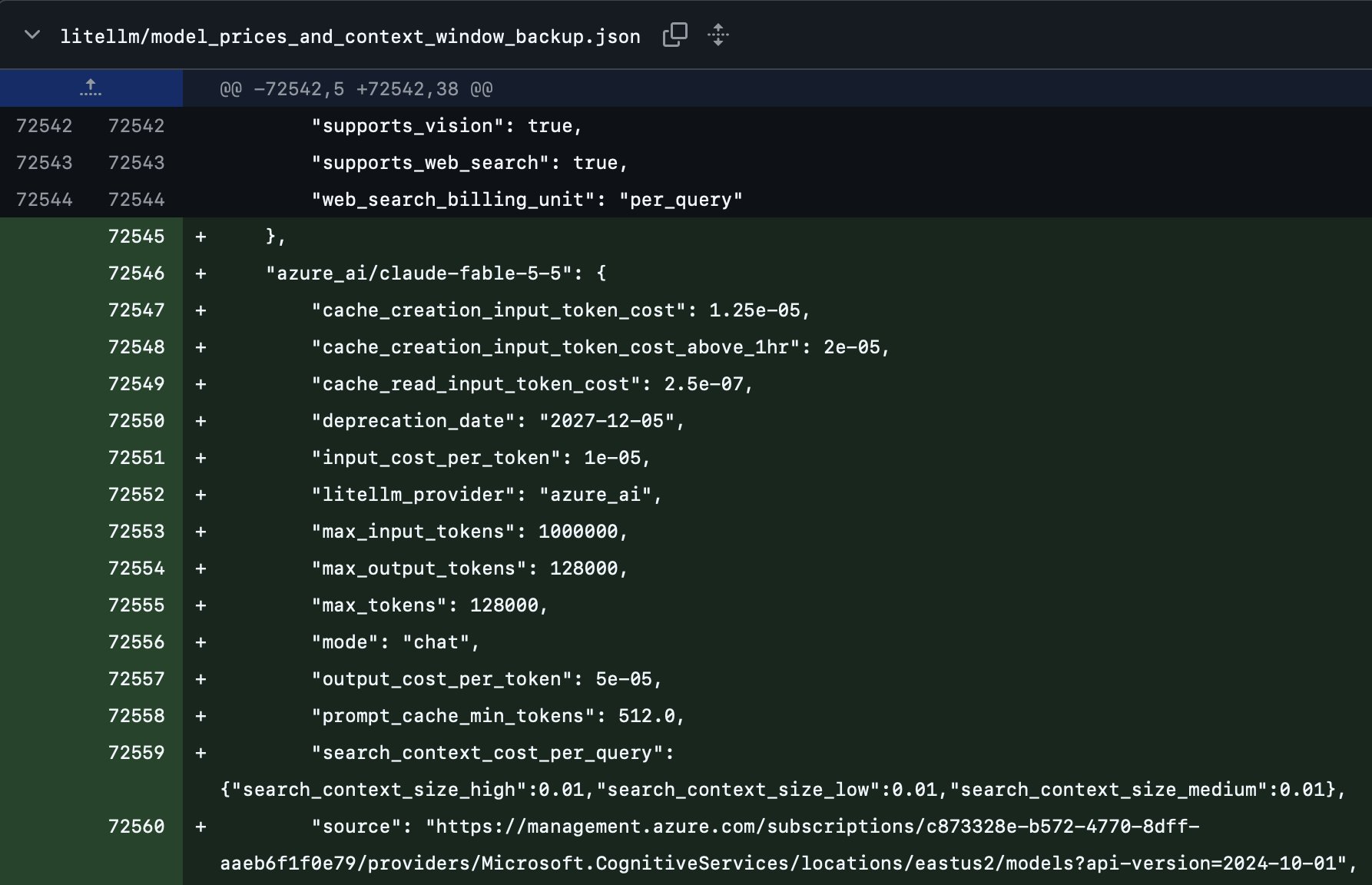
A day later, on October 14, LiteLLM removed the entry, noting that calls to the model returned DeploymentNotFound from Azure. As of October 15, Anthropic's news page, model docs, pricing page and release notes show no Fable 5.5. Microsoft has not announced it either. Treat any Fable 5.5 price or benchmark you see today as a guess.
My advice: do not wait. Anthropic's models now ship weeks apart, so waiting is a habit that never ends. Build on Opus 5.5 today, keep your prompts and evals in files, and rerun them the day a new model lands. If Fable 5.5 is better on your jobs, switching takes an afternoon. Opus 5.5 is a dinner so good I'm already full, and the next course is on its way.
Fable 5.1, Opus 5.5 or Sonnet 5.5: Which Model for Which Job?
Use Opus 5.5 as the default, Sonnet 5.5 for volume and Fable 5.1 only where your own tests show it wins. Sonnet 5.5 costs $2 and $10 per million tokens, half of Opus. For a sales team, that split covers almost everything: research and agents on Opus, drafting at scale on Sonnet.
| Job | My pick | Why |
|---|---|---|
| Coding agents and long tool runs | Opus 5.5 | Top scores on Terminal-Bench and SWE-bench Pro at 40% of Fable's price |
| Account research and business workflows | Opus 5.5 | Higher GDPval-AA and AutomationBench scores |
| Reading spreadsheets, PDFs and office files | Test Fable 5.1 | The one published benchmark Fable still wins, by about one point |
| Drafting emails and posts at volume | Sonnet 5.5 | Half the price of Opus, good enough for first drafts |
| Work that needs zero data retention | Opus 5.5 | Fable needs 30-day retention by default unless you qualify for enterprise ZDR |
- Make Opus 5.5 your default model in the app and in the API.
- Pick five real tasks from last month that went badly.
- Run each on Opus 5.5 at high effort, then on Fable 5.1.
- Compare quality, time and cost per finished task.
- Move a job to Fable only if it wins clearly on your tasks.
For a full method to test models on your own work, see my guide on how to evaluate AI models.
Want Claude agents doing the research and outbound work inside your sales team? Our B2B lead generation service runs agents on the routine work and people on the calls.
Frequently asked questions
Is Fable 5.1 better than Opus 5.5?
No, not on Anthropic's published numbers. Opus 5.5 beats Fable 5.1 on all nine benchmarks in its launch table, including Terminal-Bench 4.0 at 66.4% against 55.8%. Fable 5.1 keeps a one-point edge on OfficeQA. Anthropic itself tells developers to start with Opus 5.5 for most workloads, and keeps Fable for demanding reasoning and long-horizon agent work.
How much does Fable 5.1 cost compared with Opus 5.5?
Fable 5.1 costs $10 per million input tokens and $50 per million output tokens. Opus 5.5 costs $4 and $20, so Opus is 60% cheaper on base tokens, cache writes and batch. Cache reads are closer: $0.25 on Fable against $0.20 on Opus. Fast mode exists only for Opus 5.5.
Can I use Fable 5.1 on Claude Pro?
Yes, but only with usage credits. On Pro, Fable 5.1 sits outside your included limits and bills at API rates from the first message. Max 5x and Max 20x include Fable up to 50% of the weekly limit, Team includes it only on premium seats, and the Free plan has neither Fable nor Opus.
When is Fable 5.5 coming out?
Nobody official has said. A Fable 5.5 entry appeared in LiteLLM's price file on October 13, 2026, citing Azure, with specs copied from Fable 5.1. It was removed on October 14 after Azure returned an error. As of October 15, Anthropic and Microsoft have announced no Fable 5.5.
Which Claude model is best for coding in 2026?
Opus 5.5, on current published results. It leads Anthropic's lineup on Terminal-Bench 4.0, SWE-bench Pro and CursorBench, and costs $4 and $20 per million tokens. Sonnet 5.5 is the cheaper option for simpler code at $2 and $10. Run your own repository tasks before you switch a whole team.
Sources
Anthropic, Introducing Claude Opus 5.5, September 22, 2026, read October 15, 2026.
Anthropic, Claude Opus 5.5 System Card, September 22, 2026, read October 15, 2026.
Anthropic, Claude Fable 5.1 and Mythos 5.1 launch, September 1, 2026, read October 15, 2026.
Anthropic, Models overview, read October 15, 2026.
Anthropic, Claude API pricing, read October 15, 2026.
Anthropic, Effort parameter, read October 15, 2026.
Anthropic, Claude plans and pricing, read October 15, 2026.
Anthropic, Claude Fable, read October 15, 2026.
Anthropic Help Center, Claude Fable models on your plan, read October 15, 2026.
LiteLLM, commit adding azure_ai/claude-fable-5-5, October 13, 2026.
LiteLLM, commit removing azure_ai/claude-fable-5-5, October 14, 2026.
LiteLLM, pull request #46201, adding the entry, October 13, 2026.
LiteLLM, pull request #46428, removing the entry, October 14, 2026.
The New Stack, Claude Opus 5.5 vs Fable 5.1, September 29, 2026.
Federico Donatone, Anthropic's Fable 5.5 leaked. I don't want it., LinkedIn, October 15, 2026.


