









Claude has five effort levels: low, medium, high, xhigh (shown as Extra high in the apps) and max. Opus 5.5 defaults to medium, one step below Opus 5. Use medium for clear, scoped work, high or xhigh for hard coding and agent runs, and max only for problems you leave Claude to grind alone.
On October 19 I posted on LinkedIn that Opus 5.5 started the SaaS apocalypse. Last Saturday we rebuilt three tools: a booking page, a screen for running dozens of Claude chats at once, and a dictation app. The only setting we still argue about is how hard to let it think. We use max for code and extra high for everyday work. Half the internet swears by medium.
Here is what each Claude effort level does, what it costs per task on Anthropic's numbers, and where to set it.
- Five levels: low, medium, high, xhigh and max. Opus 4.6 and Sonnet 4.6 have no xhigh.
- Opus 5.5 and Haiku 5.5 default to medium in the API. Most other models default to high.
- On Anthropic's SWE-bench Pro subset, Opus 5.5 at medium cost $0.21 per task and xhigh $0.74, for 92.8% vs 96.7% solved.
- Higher effort uses more tokens, so you hit your plan's usage limits sooner.
- In Claude Code, /effort changes it. Max lasts one session unless you set an environment variable.
 in
“Opus 5.5 started the SaaS apocalypse. Here are 3 tools we rebuilt last Saturday.”
What Is the Claude Effort Level?
The effort level tells Claude how much work to put into each answer. It covers thinking, but also how many tool calls it makes, how many files it reads and how much it checks before replying. Anthropic describes it as a behavioral signal that Claude adapts to each problem. At low effort Claude still thinks on hard problems, just less.
Effort and thinking are two separate settings in the app. Effort sets how thorough Claude is. The thinking toggle sets whether it reasons in a visible section first. On Opus 5.5, Sonnet 5.5, Haiku 5.5, Fable 5.1 and Opus 5 the toggle is gone: thinking cannot be turned off.
On Opus 5.5 this matters more than before. With thinking locked on, effort is the only dial you have for depth, speed and cost. Anthropic's own Claude Code guide puts it simply: if Claude skipped a file, did not run the tests or quit a refactor halfway, raise the effort. If it had everything and still got it wrong, pick a stronger model.
One more signal from the same guide. If you keep raising effort on a task that should not need it, the fix is often upstream: your context, your CLAUDE.md or how the task is scoped.
Claude Effort Levels Explained: Low, Medium, High, Xhigh and Max
Each level trades tokens for capability. The names are the same across models, but Anthropic calibrates the scale per model, so high on Opus 5.5 is not the same amount of work as high on Opus 5. This table combines Anthropic's API docs and its Claude Code guidance.
| Level | What Anthropic says it is for | Default on |
|---|---|---|
| low | Quick exchanges you review step by step, simple high-volume tasks, subagents | None |
| medium | Day-to-day work with a clear scope, like building a defined feature | Opus 5.5, Haiku 5.5 (API); also Sonnet 5.5 in Claude Code |
| high | Work where verification matters, like fixing a bug in an existing codebase | Most other models, including Fable 5.1, Opus 5 and Sonnet 5.5 in the API |
| xhigh | Long agentic and coding runs, over 30 minutes, with token budgets in the millions | Opus 4.7 (Claude Code only) |
| max | Hard problems Claude works through without you, like hunting security bugs | None |
Two warnings from the docs. Not every model that supports max supports xhigh: Opus 4.6 and Sonnet 4.6 stop at four levels. And Claude Code says plainly that max may show diminishing returns and is prone to overthinking, so test it before you make it a habit.
If you are still choosing between the big models, my comparison of Fable 5.1 vs Opus 5.5 covers which model to pick before you pick the effort.
What Does Each Effort Level Cost on Opus 5.5?
On Anthropic's own coding test, each step up buys a few points and costs a lot more. On a subset of SWE-bench Pro, Opus 5.5 solved 87.4% of tasks at low for $0.11 each, 92.8% at medium for $0.21, 95.3% at high for $0.29 and 96.7% at xhigh for $0.74. Xhigh costs 3.5 times medium for 3.9 more points.
| Effort | Tasks solved | Cost per task | Cost vs medium |
|---|---|---|---|
| low | 87.4% | $0.11 | 0.5x |
| medium (default) | 92.8% | $0.21 | 1x |
| high | 95.3% | $0.29 | 1.4x |
| xhigh | 96.7% | $0.74 | 3.5x |
| low, failures re-run at high | About 97% | About $0.17 | 0.8x |
Look at the last row. When you can check the output, for example with tests, Anthropic found that running everything at low and re-running only the failures at high solved about 97% of tasks for about $0.17. That matches the best fixed level in the table, xhigh at 96.7%, for less than high costs. The catch is time: every failure runs twice.
Cursor's benchmark tells the same story. In the Opus 5.5 system card, Opus scored 57.8% on CursorBench 4.0 at max, 56.0% at xhigh and high, and 52.5% at medium. Anthropic estimates high at about $4 per task and medium at about $3, from Cursor's token counts at list prices. Even medium beat Fable 5.1 at max, which scored 51.8% for $17.28.
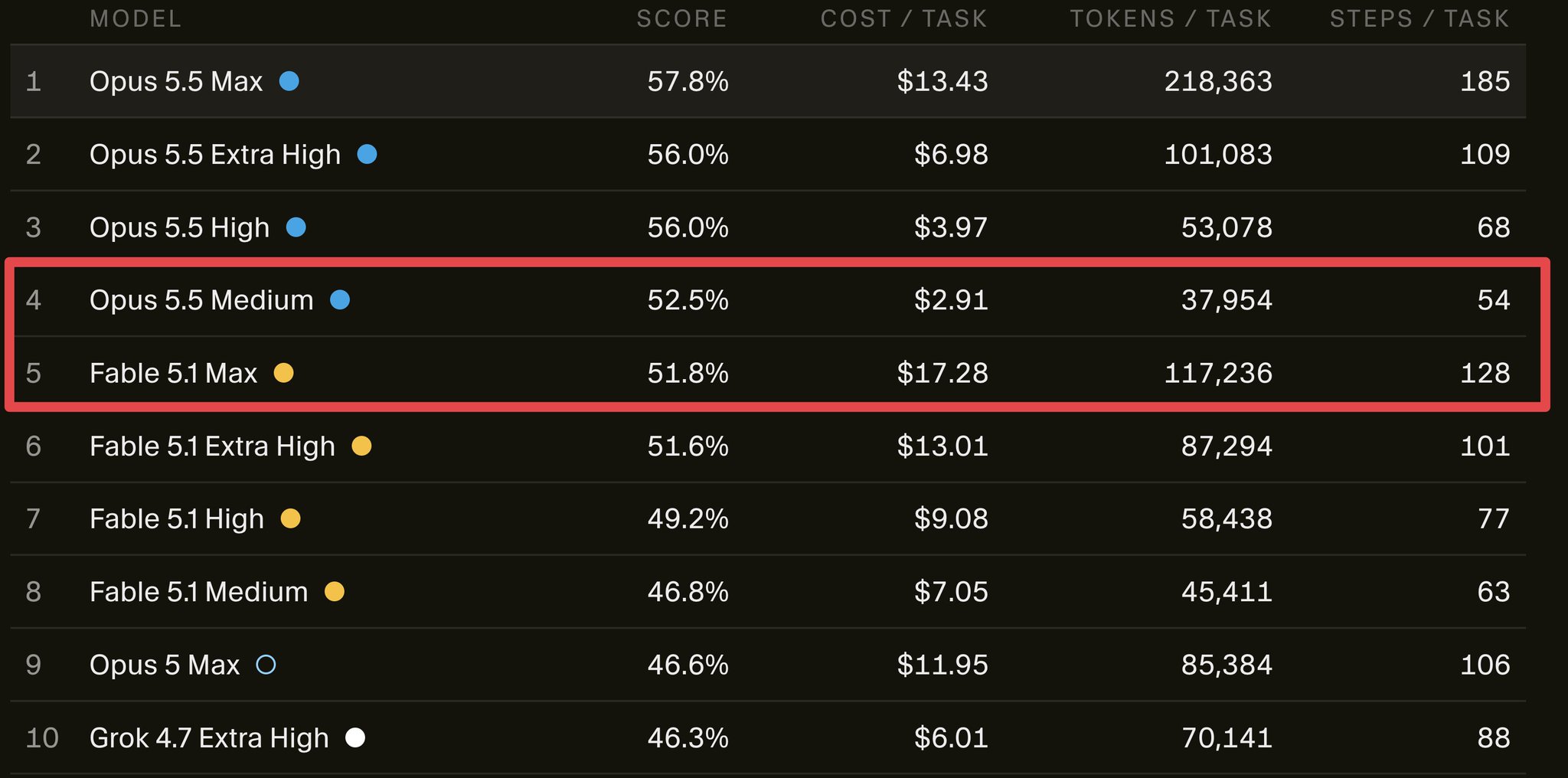
On Cursor's leaderboard, as shared by @matthewmillerai, max cost $13.43 per task and xhigh $6.98, against $3.97 for high. Same score at xhigh and high, about 1.8 times the price. Research work is less predictable. On the DRACO research benchmark, a typical Opus 5.5 task at low took 84% less time than at medium but scored 13.3 points lower.
For list prices, caching and a full agent session priced line by line, see my Claude Opus 5.5 API pricing guide.
Does Higher Effort Use Up Your Claude Usage Limits Faster?
Yes. Anthropic's help center says higher effort gives more thorough answers, but they take longer and use more tokens, so you reach your usage limits faster. On Pro or Max you never see a bill per task. You see the five-hour window close earlier.
On the API, the table above is money. On a subscription, the same multiplier is time you lose waiting for a reset. On Cursor's leaderboard, Opus 5.5 used 37,954 tokens per task at medium, 53,078 at high, 101,083 at xhigh and 218,363 at max. Max uses almost six times the tokens of medium. Expect your session limit to drain at roughly that rate on heavy work. That is my estimate. Anthropic does not publish one.
How the five-hour and weekly windows work is in my guide to Claude Max usage limits.
How to Change the Claude Effort Level in the App, Claude Code and the API
In the Claude apps, click the model name next to the send button, click Effort and pick a level. Each model's recommended level is marked Default. On Enterprise plans, an admin can hide levels for your role. The effort menu covers Opus 5.5, Sonnet 5.5, Haiku 5.5, Fable 5.1, Opus 5, Sonnet 5, Fable 5, Opus 4.7, Opus 4.6 and Sonnet 4.6.
Anthropic's own guidance in that menu: low and medium for routine tasks that should stretch your usage, high as the best overall balance of quality and speed, Extra high for long coding and agent runs, and Max for the deepest possible reasoning.
In Claude Code you have more controls. These are the controls that matter, all from Anthropic's model configuration docs.
- Type /effort to open the slider, or /effort high to set a level directly. /effort auto clears your saved choice.
- Launch with claude --effort xhigh to set one session.
- Set CLAUDE_CODE_EFFORT_LEVEL=max in your shell. It is the only way to keep max beyond one session.
- Add effort to a skill or subagent's frontmatter to run that job at its own level.
- Write ultrathink in a prompt for deeper reasoning on one turn, without changing the session level.
- Check the session header: it shows the level, for example with low effort.
In the API, set output_config.effort to low, medium, high, xhigh or max. At the higher levels, set a large max_tokens: it is a hard limit on thinking plus the answer combined. Changing it between requests restarts the prompt cache. On Opus 5.5 and the other newest models, a per-message effort change keeps the cache, using the beta header mid-conversation-output-config-2026-07-01.
What Is Ultracode in Claude Code?
Ultracode is a separate Claude Code setting that sits next to the effort levels. With it on, Claude orchestrates a dynamic workflow for each substantial task, at whatever effort the session runs (Claude Code v2.1.284 or later). You switch it with /effort ultracode or the Tab key in the slider. Launching with claude --effort ultracode also sets the session to xhigh.
Which Claude Effort Level Should You Use?
Start at the default and move one step at a time. Anthropic's docs say Opus 5.5 at medium matches or beats Opus 5 at high on coding and knowledge work, and Opus 5 was the top Opus until September. If you came from Opus 5 and kept high everywhere, you are probably paying for a step you do not need.
| Job | Level | Why |
|---|---|---|
| Brainstorming, renames, quick edits you review | low | Fast, cheap, you check every answer anyway |
| Emails, research summaries, a feature with a clear spec | medium | The default, and the cheapest level that clears 90% on Anthropic's test |
| Bug fixes in a codebase you did not write | high | Needs reading and checking before acting |
| Agent runs over 30 minutes, everyday work in Claude Code | xhigh | Fewer stops to ask you, more verification |
| A build you leave running while you sleep | max | Top score on CursorBench, when nobody is there to steer |
So why do we run max for code and extra high for everything else? Because our bottleneck is attention. Tokens are cheap next to an interrupted afternoon. When Claude rebuilds a tool on a Saturday, every question it asks me is a stop. Higher effort makes more choices on its own and tests more edge cases, which Anthropic's Claude Code docs confirm. That autonomy is what we pay for.
Medium is right for a different job. If you sit with Claude and review each step, medium returns a starting point sooner and leaves the steering to you. Half the internet is not wrong. They work closer to the code than we do. The mistake is picking a level once and never checking what it costs you.
Want agents like these doing the research and outbound work in your sales team? Our B2B lead generation service runs Claude agents on the routine work and people on the calls.
Frequently asked questions
What is the default effort level for Claude Opus 5.5?
Medium. Anthropic's API docs say Opus 5.5 and Haiku 5.5 default to medium, one step below Opus 5, which defaulted to high. Claude Code also starts Opus 5.5 at medium unless you set a level. Anthropic says Opus 5.5 at medium matches or exceeds Opus 5 at high on coding and knowledge-work evaluations.
Is max effort better than xhigh in Claude?
Slightly, at a much higher cost. In the Opus 5.5 system card, Opus scored 57.8% on CursorBench at max and 56.0% at xhigh. Claude Code's docs warn that max may show diminishing returns and is prone to overthinking. Use max for hard problems Claude works on alone, and test it on your own tasks first.
What does Extra high mean in Claude?
Extra high is the app name for the xhigh effort level. It sits between high and max and is meant for long agentic and coding tasks. Anthropic's help center suggests trying Extra high first for complex coding and agent work on Opus 4.7 or newer, and Max only for the hardest, correctness-critical jobs.
How do I change the effort level in Claude Code?
Type /effort to open a slider, or /effort followed by a level name, such as /effort high. You can also launch with claude --effort xhigh or set the CLAUDE_CODE_EFFORT_LEVEL environment variable. Max applies to the current session only unless you set it through that environment variable.
Does effort level affect cost on the Claude API?
Yes, because effort changes how many output tokens Claude writes, including thinking and tool calls. On Anthropic's SWE-bench Pro test, Opus 5.5 cost $0.11 per task at low, $0.21 at medium, $0.29 at high and $0.74 at xhigh. Output tokens on Opus 5.5 cost $20 per million.
Why don't I see xhigh or max in Claude?
Your model may not support it. Opus 4.6 and Sonnet 4.6 have no xhigh, and in Claude Code xhigh runs as high on Opus 4.6. On Enterprise plans an admin can cap effort per role, and the maxEffortLevel setting caps it on any plan. Switch model or ask your admin.
Sources
Anthropic, Effort, Claude Platform docs, read October 19, 2026.
Anthropic, Optimizing for cost and intelligence, Claude Platform docs, read October 19, 2026.
Anthropic, What's new in Claude Opus 5.5, Claude Platform docs, read October 19, 2026.
Anthropic, Claude Code model configuration, read October 19, 2026.
Anthropic Help Center, Change the model, effort, and thinking settings, read October 19, 2026.
Anthropic, Claude Opus 5.5 System Card, section 8.8 CursorBench 4.0, September 22, 2026, read October 19, 2026.
Lydia Hallie, Anthropic, Choosing a Claude model and effort level in Claude Code, July 7, 2026.


