






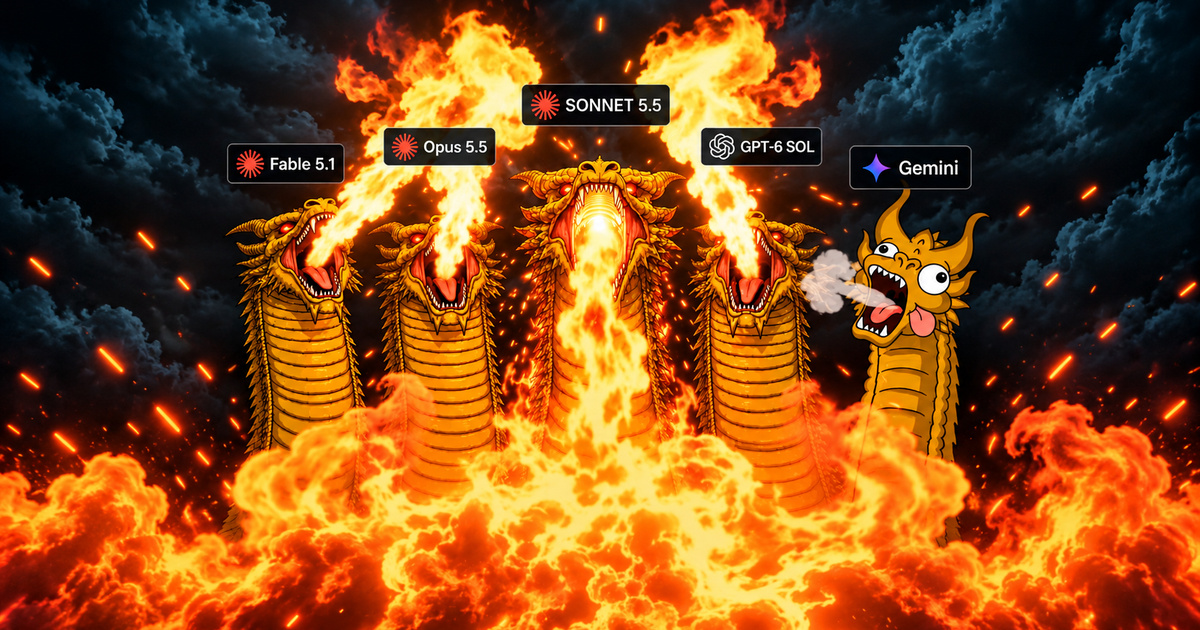
Gemini 4 Argon is Google's new flagship model. It costs $2 per million input tokens and $10 per million output tokens until November 30, 2026, then $4 and $20 from December 1. It scores 53 on the Artificial Analysis Intelligence Index, below Claude Sonnet 5.5 at 56, at the same launch price. Its edge is cost per task.
Today I posted on LinkedIn that Google dropped Gemini 4 and it still loses to Sonnet 5.5. The post went through six facts, from the cyber-first launch to a developer forum thread called "How Bad Is Gemini 4 Argon?". Here is each fact checked against Google's own pages, two independent indexes and Anthropic's price list, plus where Argon actually wins.
- Price: $2 in and $10 out per million tokens until November 30, then $4 and $20. Cached input is 95% off.
- Access: paid API tier, Google AI Pro at $19.99 a month and Google AI Ultra. No free API tier.
- Quality: 53 on the Artificial Analysis index, behind Sonnet 5.5 (56) and tied with GPT-6 Astra.
- Coding: in Google's table Argon beats Opus 5.5 on DeepSWE (77.9% to 74.2%) and loses on FrontierSWE (55.0% to 62.3%) and Terminal-Bench 4.0 (57.4% to 66.4%).
- Cost per task: $1.62 on the index against $5.46 for Sonnet 5.5, so Argon stays cheaper even after the price doubles.
 in
“Google dropped Gemini 4. It still loses to Sonnet 5.5.”
What Is Gemini 4 Argon?
Gemini 4 Argon is the first Gemini 4 model and Google's top model in the API, AI Studio, Antigravity and the Gemini app. The API name is gemini-4-argon. It takes text, images, video, audio and PDF, writes text, and has a 1,048,576 token window shared by input, thinking and output. Its knowledge cutoff is March 2026.
The launch was unusual. Google announced Argon on September 30, 2026, and gave it first to vetted cyber defenders through its Fairwind Program. Developers, companies and paying app users got it on October 13, about two weeks later. That is the first fact of my post, and Google's two posts confirm it.
| Gemini 4 Argon | |
|---|---|
| API name | gemini-4-argon |
| Announced | September 30, 2026, to cyber defenders in the Fairwind Program |
| Generally available | October 13, 2026 |
| Input / output per 1M tokens | $2 / $10 until November 30, then $4 / $20 |
| Cached input per 1M tokens | $0.10, then $0.20 from December 1 (implicit caching only) |
| Batch and Flex per 1M tokens | $1 / $5, then $2 / $10 |
| Context window | 1,048,576 tokens, input and output combined |
| Max output | 65,536 by default, up to the full window with long decode |
| Thinking levels | Low, medium, high |
| Free API tier | Not available |
Weighing OpenAI's tiers too? My GPT-6 Sol vs Astra comparison covers the other half of this race.
How Much Does Gemini 4 Argon Cost?
Gemini 4 Argon costs $2 per million input tokens and $10 per million output tokens through November 30, 2026. From December 1 the standard price doubles to $4 and $20. Cached input costs $0.10 per million, then $0.20. Batch and Flex cost half. The free API tier does not include Argon at all.
Here is the detail my post was pointing at. The launch price is exactly Claude Sonnet 5.5's price. The December price is exactly Claude Opus 5.5's price. So today you pay Sonnet money for a model that scores below Sonnet. On December 1 you pay Opus money for it.
| Model | Input | Cached input | Output |
|---|---|---|---|
| Gemini 4 Argon, until November 30 | $2.00 | $0.10 | $10.00 |
| Gemini 4 Argon, from December 1 | $4.00 | $0.20 | $20.00 |
| Claude Sonnet 5.5 | $2.00 | $0.10 | $10.00 |
| Claude Opus 5.5 | $4.00 | $0.20 | $20.00 |
| Claude Fable 5.1 | $10.00 | $0.25 | $50.00 |
| Gemini 3.8 Flash, until December 31 | $0.75 | $0.075 | $3.75 |
In the Gemini app, Argon comes with Google AI Pro at $19.99 a month, with 4 times the free usage limits. Google AI Ultra costs $99.99 a month for 5 times the Pro limits, or $199.99 for 20 times. Plus at $4.99 does not list Argon. Limits reset every 5 hours up to a weekly cap.
The same price ladder for Anthropic's models, with real agent costs, is in my Claude API pricing guide.
Gemini 4 Argon vs Claude: Which Scores Higher?
Claude scores higher on Artificial Analysis, and Argon wins most of Google's own tests. Artificial Analysis gives Argon 53 at high effort and Sonnet 5.5 56, second of 221 models. Argon ties GPT-6 Astra at 53. Google's model card scores Argon against Opus 5.5 on 18 tests. Argon wins 14 and loses 4, including two agent tests I care about. On Vals, a second independent index, Argon ranks third of 28 at 69.2%.
| Test | What it measures | Gemini 4 Argon | Claude Opus 5.5 | GPT-6 Astra |
|---|---|---|---|---|
| DeepSWE v1.1 | Coding in real repositories | 77.9% | 74.2% | 74.1% |
| FrontierSWE v2 | Coding on longer engineering tasks | 55.0% | 62.3% | 65.5% |
| Terminal-Bench 4.0 | Agent work in a terminal | 57.4% | 66.4% | 58.2% |
| Vals Index | Knowledge work | 68.9% | 67.0% | 63.1% |
| PostTrainBench | Machine learning engineering | 45.3% | 49.3% | 44.3% |
| LABBench 2 | Science lab reasoning | 88.8% | 73.1% | 85.4% |
| GraphWalks, 256K to 1M tokens | Long context | 84.2% | 66.8% | 71.8% |
| CWE-bench v1 | Finding software weaknesses | 68.0% | 67.0% | 68.0% |
So my post's facts 2 and 4 come from the same Google table. Argon wins DeepSWE, 77.9% to 74.2%. Opus 5.5 wins FrontierSWE, 62.3% to 55.0%, and the terminal test, 66.4% to 57.4%, a 9 point gap. Google's table compares Argon with Opus and leaves Sonnet 5.5 out. Google's table shows an earlier Vals run at 68.9%.
The terminal test matters most to me. It is closest to how agents work: open files, run commands, fix what breaks, repeat. In Artificial Analysis' own Terminal-Bench 4 run at launch, Argon scored 57%, behind Sonnet 5.5 at 64% and Opus 5.5 at 60%. The same analysis found a 15% hallucination rate, the lowest of any model scoring 45 or more. Its model page also clocks it at 79 tokens a second, below the median of 85.
Not sure which test fits your work? My guide on how to evaluate AI models shows how to test on your own tasks.
Is Gemini 4 Argon Cheaper Than Claude Sonnet 5.5 Per Task?
Yes, by a wide margin today. Artificial Analysis puts Argon at $1.62 per Intelligence Index task and Sonnet 5.5 at $5.46. Argon uses more output tokens than the median model, but it still costs less than a third of Sonnet per task. At double the price after December 1, it would still sit near $3.24.
That last number is my estimate at double the price. At launch, Artificial Analysis measured $1.99 per task and projected $3.98 at full price. It is the fair counterpoint to my post. Argon trails Sonnet by three points on the index. For bulk work, a cost per task under a third of Sonnet's can matter more.
| Model | Index score | Cost per index task |
|---|---|---|
| Claude Sonnet 5.5 (max) | 56 | $5.46 |
| Gemini 4 Argon (high), intro price, measured today | 53 | $1.62 |
| Gemini 4 Argon (high), from December 1 | 53 | About $3.24 (my estimate) |
Why Are Developers Calling Gemini 4 a Meme?
Because the first reviews from users did not match the launch slides. On October 16, a developer opened a thread on Google's own AI developer forum titled "How Bad Is Gemini 4 Argon?". The opener wrote that it feels "only 1.2× better than Gemini 3.8 Flash" and called its coding "underwhelming".
The same post ends with advice I did not expect on a Google forum. "I'd recommend considering a Claude coding plan instead of relying on Gemini 4 Argon." When I read it, the thread had two replies. Both leaned the same way. One said Argon is "not on par with Anthropic's or Openai's models". Three developers make a mood check. A study needs far more.
Should You Switch From Claude to Gemini 4 Argon?
For agent work, stay on Claude. For volume work, test Argon. For coding agents and long terminal runs, Claude still wins the tests that look most like that job. For high-volume jobs with clear rules, Argon gives index-level quality at a lower cost per task, at least until the price doubles. Test before you move anything.
| Job | My pick | Why |
|---|---|---|
| Coding and terminal agents | Claude Sonnet 5.5 or Opus 5.5 | Opus leads Terminal-Bench 4.0 by 9 points in Google's own table |
| Account research agents | Claude Sonnet 5.5 | Higher index score at the same launch price |
| Bulk tagging, extraction, lead sorting | Test Gemini 4 Argon | About a third of Sonnet's cost per index task today |
| Very long documents, 500K tokens and up | Test Gemini 4 Argon | Highest GraphWalks score in Google's table |
| Anything you budget past December 1 | Reprice first | Argon's list price doubles to Opus 5.5 level |
- Pick five real tasks from last month: one research job, one email batch, one long document, two agent runs.
- Run each on Sonnet 5.5 and on Gemini 4 Argon with the same prompt.
- Score the output yourself and log tokens and cost per finished task.
- Redo the cost math at December prices before you sign anything.
- Move only the jobs where Argon wins on your own work.
Choosing a lab for the whole team? My Claude vs ChatGPT for business guide compares them on real team work.
Want AI agents doing the research and outbound work inside your sales team? Our B2B lead generation service runs agents on the routine work and people on the calls.
Frequently asked questions
How much does Gemini 4 Argon cost?
In the Gemini API, Gemini 4 Argon costs $2 per million input tokens and $10 per million output tokens through November 30, 2026. From December 1 it costs $4 and $20. Cached input is $0.10 per million, then $0.20, and Batch or Flex costs half. In the Gemini app it comes with Google AI Pro at $19.99 a month.
Is Gemini 4 Argon free?
No. Google's pricing page says Gemini 4 Argon is not available on the free API tier, so you need a paid API account. In the Gemini app, free accounts and Google AI Plus do not list Argon. You get it with Google AI Pro at $19.99 a month or Google AI Ultra from $99.99 a month.
Is Gemini 4 Argon better than Claude Opus 5.5?
On some tests. In Google's own table, Argon beats Opus 5.5 on DeepSWE v1.1 (77.9% to 74.2%), the Vals Index, LABBench 2 and long context. Opus 5.5 wins Terminal-Bench 4.0 (66.4% to 57.4%), FrontierSWE v2 (62.3% to 55.0%) and PostTrainBench. These are vendor numbers, so check them on your own tasks before switching.
Is Gemini 4 Argon better than Claude Sonnet 5.5?
Not on Artificial Analysis. It scores Claude Sonnet 5.5 at 56 and Gemini 4 Argon at 53, and Sonnet also led its own Terminal-Bench 4 run at launch, 64% to 57%. Argon is cheaper per task: $1.62 against $5.46 on the same index, at the same launch list price.
When did Gemini 4 Argon come out?
Google announced Gemini 4 Argon on September 30, 2026, and first gave it to vetted cyber defenders through its Fairwind Program. It became generally available on October 13, 2026, in the Gemini API, AI Studio, Antigravity, Gemini for business and the Gemini app for Google AI Pro and Ultra subscribers.
Sources
Google, Gemini 4 Argon: our next era of frontier intelligence, September 30, 2026, read October 27, 2026.
Google, Gemini 4 Argon: Built to solve your hardest problems, October 13, 2026, read October 27, 2026.
Google DeepMind, Gemini 4 Argon model card, October 2026, read October 27, 2026.
Google AI for Developers, Gemini API pricing, read October 27, 2026.
Google AI for Developers, Gemini 4 Argon model page, read October 27, 2026.
Google, Google AI plans, read October 27, 2026.
Google, Gemini Apps limits, read October 27, 2026.
Anthropic, Claude pricing, read October 27, 2026.
Artificial Analysis, Gemini 4 Argon model page, read October 27, 2026.
Artificial Analysis, Claude Sonnet 5.5 model page, read October 27, 2026.
Artificial Analysis, Gemini 4 Argon launch analysis, September 30, 2026, read October 27, 2026.
Google AI Developers Forum, How Bad Is Gemini 4 Argon?, October 16, 2026, read October 27, 2026.
Vals AI, Gemini 4 Argon on the Vals Index, read October 27, 2026.


