






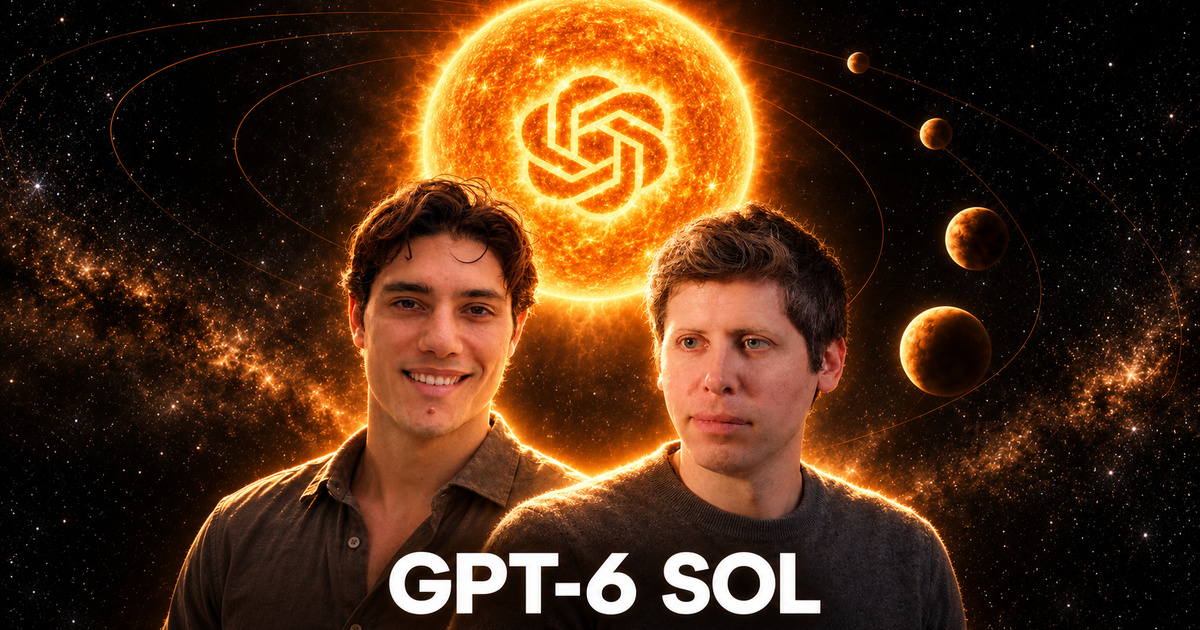
GPT-6 Astra is OpenAI's strongest model, and GPT-6 Sol is the cheaper one under it. Sol costs $2 per million input tokens and $10 per million output tokens. Astra costs $10 and $50, five times more. Since GPT-6.1 Sol shipped on September 29, the gap in quality is small. Start on Sol and move a job to Astra only when Sol fails it.
On September 16 I posted on LinkedIn that GPT-6 Sol was coming. My post said it would sit under Astra, almost as good for much less money, like Opus under Fable. I said Thursday. It shipped on Tuesday, September 22, with Luna next to it. Here is what OpenAI actually published, what one independent test found, and which model I would pay for.
- Price: Sol is one fifth of Astra on input and output, and one tenth on cached input with GPT-6.1 Sol.
- Quality: GPT-6.1 Sol matched Astra on all 15 runs of a public three-test comparison, at 18% of the cost.
- Astra still leads on the hardest science work and stays OpenAI's best model for computer use.
- In ChatGPT, Sol powers GPT-6 for paid plans, and Astra sits behind the Pro thinking option on Pro, Business and Enterprise plans.
- My default for sales and GTM work: GPT-6.1 Sol, with Astra kept for the few jobs where your own tests show it wins.
 in
“OpenAI just teased GPT-6 SOL. Someone already has it.”
GPT-6 Sol vs Astra: Which Is Better?
Astra is better on paper, and Sol is the better buy for most work. OpenAI calls Astra its best model across the board and tells you to pick it when you want an uncompromising result. It also says GPT-6.1 Sol nearly matches Astra on agentic coding, computer use and professional work, at one fifth of the token price.
Anthropic goes further: its docs tell developers to start with Opus 5.5, which already beats Fable 5.1 on all nine launch benchmarks. My reading is simple. The flagship sets the ceiling, and a few weeks later the cheaper model inherits most of it at a fraction of the price.
| GPT-6.1 Sol | GPT-6 Astra | |
|---|---|---|
| API name | gpt-6.1-sol | gpt-6-astra |
| Released | September 29, 2026 (GPT-6 Sol: September 22) | September 3, 2026 |
| Input / output per 1M tokens | $2 / $10 | $10 / $50 |
| Cached input per 1M tokens | $0.10 | $1.00 |
| Context window | 1,050,000 tokens | 1,050,000 tokens |
| Max output | 128,000 tokens | 128,000 tokens |
| Knowledge cutoff | April 30, 2026 | April 30, 2026 |
| Effort levels | low to max, medium by default | low to max |
| Where OpenAI points it | Complex coding and agent workflows at scale | The hardest end-to-end work |
Choosing between labs? My Claude vs ChatGPT for business guide compares the two on real team work.
How Much Cheaper Is GPT-6 Sol Than Astra?
Sol is 80% cheaper than Astra on input and output tokens. With GPT-6.1 Sol, cached input costs $0.10 per million against $1.00 on Astra, so the cache line is 90% cheaper. For agents that reread the same instructions and files all day, that cache price matters more than the headline number.
| Model | Input | Cached input | Output |
|---|---|---|---|
| GPT-6 Astra | $10.00 | $1.00 | $50.00 |
| GPT-6.1 Sol | $2.00 | $0.10 | $10.00 |
| GPT-6 Sol | $2.00 | $0.20 | $10.00 |
| GPT-6 Luna | $0.10 | $0.01 | $0.50 |
| GPT-5.6 Sol (promotional price before the cut) | $4.00 | n/a | $20.00 |
Three rules change the bill. Prompts above 272,000 input tokens cost 2 times on input and cache, and 1.5 times on output, for the whole request. Cache writes cost 1.25 times the normal input rate. Batch and Flex cost half. Fast mode costs double on Astra and on both Sol models.
Speed has its own price. Ultrafast runs GPT-6.1 Sol up to 8 times faster at 6 times the standard API rate. In Codex it is open only to Pro $500 and eligible Enterprise and Edu workspaces.
Here is the math I use, my illustration from list prices. Say a research agent reads 50,000 tokens about one account and writes 5,000. On GPT-6.1 Sol that run costs about 15 cents. On Astra it costs about 75 cents. The table scales it up, before any caching.
| Runs per month | GPT-6.1 Sol | GPT-6 Astra | GPT-6 Luna |
|---|---|---|---|
| 100 | $15 | $75 | $0.75 |
| 1,000 | $150 | $750 | $7.50 |
| 10,000 | $1,500 | $7,500 | $75 |
The same per-run math for Anthropic's models is in my Claude Opus API pricing guide.
GPT-6.1 Sol vs Astra Benchmarks: Where Does Astra Still Lead?
Astra keeps a clear lead on the hardest science tasks and a 2.1 point lead on computer use. On coding, computer use and factuality, OpenAI puts GPT-6.1 Sol at most 2.1 points behind Astra, at one fifth to one seventh of the cost per task. These are OpenAI's own numbers.
| Test | What it measures | What OpenAI reports |
|---|---|---|
| DeepSWE v1.1 | Software engineering in real codebases | GPT-6.1 Sol matches Astra at about one fifth of the cost. GPT-6 Sol scored 68.8% at max effort. |
| OSWorld 2.0 offline | Long computer-use workflows | GPT-6.1 Sol within 2.1 points of Astra at max effort, about one seventh of the cost per task. |
| AutomationBench | Business workflows using 47 tools | GPT-6 Sol at xhigh scored 33.2% at $0.27 per task, above Astra at low effort (30.3%, 3.9 times the cost). GPT-6.1 Sol adds 4.8 points over GPT-6 Sol at the same setting. |
| GDP.pdf | Answers from complex PDF documents | GPT-6.1 Sol approaches Astra at roughly one fifth of the cost per task, and beats Opus 5.5 with fallbacks at under half the cost. |
| Terminal-Bench Science 0.1 | Data analysis, simulation, proofs | Astra scores highest at 68.1%. GPT-6.1 Sol costs $5.47 per task against $23.80 for Astra. |
| Factuality on hard prompts | Share of answers with a factual error | GPT-6.1 Sol stays within 1.9 points of Astra at under one fifth of the cost. |
One independent test backs this up. On October 7, The New Stack ran GPT-6.1 Sol and Astra through three jobs, five times each: CI triage, incident log analysis and writing a dependency resolver. Both models were right on all 15 runs. Sol cost $2.66 in total against $14.77 for Astra, or 18%, and it was faster on the two longer jobs.
Per finished job, Sol cost 2 cents against 11 on CI triage, 31 cents against $1.57 on the log analysis, and 20 cents against $1.28 on the resolver.
That is one test with three tasks, so it cannot prove the models are equal on everything. The author notes that the Artificial Analysis index still puts Astra slightly ahead at max effort. The site's owner, Insight Partners, invests in OpenAI. Still, the price gap held on real token use: Astra wrote 28% more output on the hardest task.
For a method to run this kind of test on your own work, see my guide on how to evaluate AI models.
Is GPT-6.1 Sol Better Than GPT-6 Sol?
Yes, at the same $2 and $10 price, with half the cached input price. OpenAI says GPT-6.1 Sol beats GPT-6 Sol's best DeepSWE score by 6.4 points at lower effort. It gains 7 points on OSWorld 2.0 at max effort and more than doubles its Terminal-Bench Science score. At low effort it cuts answers with a factual error from 11.4% to 7.7%.
OpenAI's pricing page now lists GPT-6.1 Sol and no longer shows GPT-6 Sol, which keeps its own model page. If you call gpt-6-sol in the API, test gpt-6.1-sol on the same prompts and switch. One catch: GPT-6.1 Sol does not support the none and minimal effort settings, while GPT-6 Sol accepts none. In ChatGPT Work and Codex, GPT-6.1 Sol has a default context window of 500,000 tokens.
Which GPT-6 Model Do You Get in ChatGPT?
On paid plans, GPT-6 in Chat runs on Sol, and Astra appears only under the Pro thinking option. Free and Go users get Luna. In Work and Codex, the agent side of ChatGPT, you choose the model yourself: GPT-6.1 Sol on paid plans, plus Astra with limits that depend on the plan.
| Plan | Chat | Work and Codex |
|---|---|---|
| Free and Go | GPT-6 Luna, rolling out since October 8 | GPT-6 Luna in the desktop app |
| Plus | GPT-6 Sol up to High thinking. No Extra High, no Pro option | GPT-6.1 Sol, plus limited Astra usage, then optional credits |
| Pro $100 and Pro $200 | GPT-6 Sol up to Extra High, plus GPT-6 Pro powered by Astra | Astra can use the full plan allowance |
| Pro $500 | Not listed separately in OpenAI's GPT-6 Pro article | Highest Pro allowance plus Astra Ultrafast, which draws it at 8 times the standard rate |
| Business and Enterprise | GPT-6 Sol, plus GPT-6 Pro powered by Astra | Business: limited Astra on Standard seats, full on Premium seats. Enterprise: admins control access |
OpenAI warns that Astra may use your allowance faster than GPT-5.6 Sol did, depending on task size, effort and speed. So on Plus, the practical rule is the same as in the API. Run your daily work on Sol and save the limited Astra usage for the jobs that need it.
Pro 200 had a strange autumn. My piece on the ChatGPT Pro subscription pause covers what happened to it.
Where Does GPT-6 Luna Fit Next to Sol and Astra?
Luna is the bulk tier: $0.10 per million input tokens and $0.50 output, one twentieth of Sol. Use it for jobs with clear instructions and many repeats, such as tagging replies, extracting fields or sorting leads. OpenAI says GPT-6 Luna at higher effort matches GPT-5.6 Sol on its factuality test at about a hundredth of the cost.
For a sales team the three tiers map neatly onto the work. Luna sorts, Sol thinks and writes, Astra handles the rare job where a mistake costs more than the model.
GPT-6 Sol or Astra: Which Model for Which Sales Job?
Use GPT-6.1 Sol as the default, Luna for volume and Astra only where your own tests show it wins. That is my judgment for B2B sales and GTM work, where most tasks are research, writing and data handling at scale. The table below is how I would split it.
| Job | My pick | Why |
|---|---|---|
| Account and contact research agents | GPT-6.1 Sol | Near-Astra quality on long tool runs at one fifth of the price |
| Cold email first drafts and follow-ups | GPT-6.1 Sol | You run it thousands of times, so price per draft matters most |
| Reply tagging, CRM field extraction, lead sorting | GPT-6 Luna | Clear rules, huge volume, one twentieth of Sol |
| Long contract or RFP analysis | GPT-6.1 Sol, Astra if it misses | Sol nears Astra on documents. Escalate only the misses |
| Hardest multi-step agent builds | GPT-6 Astra | Top scores where the gap is real, and errors cost more than tokens |
- Set GPT-6.1 Sol as the default model in your API code or in Work.
- Pick five real tasks from last month that went badly.
- Run each on Sol at high effort, then on Astra.
- Compare quality, time and cost per finished task.
- Move a job to Astra only if it wins on your work, and recheck every new release.
One practical note. OpenAI rolls models out gradually, and Codex desktop keeps the model you picked by hand. So after every launch, check the model picker and confirm which model your team is running.
Comparing with Anthropic? My Fable 5.1 vs Opus 5.5 guide runs the same flagship-against-middle-model test on Claude.
Want AI agents doing the research and outbound work inside your sales team? Our B2B lead generation service runs agents on the routine work and people on the calls.
Frequently asked questions
Is GPT-6 Sol as good as Astra?
Close, on most work. OpenAI says GPT-6.1 Sol nearly matches GPT-6 Astra on agentic coding, computer use and professional work at one fifth of the token price. In an independent test by The New Stack, both models were right on all 15 runs, and Sol cost 18% of Astra. Astra still leads on the hardest science tasks.
How much does GPT-6 Sol cost?
GPT-6 Sol and GPT-6.1 Sol both cost $2 per million input tokens and $10 per million output tokens in the OpenAI API. Cached input costs $0.10 per million on GPT-6.1 Sol and $0.20 on GPT-6 Sol. Prompts above 272,000 tokens cost 2 times on input and 1.5 times on output for the whole request.
How much does GPT-6 Astra cost?
GPT-6 Astra costs $10 per million input tokens, $1 per million cached input tokens and $50 per million output tokens. Cache writes cost $12.50 per million. Batch and Flex cost half the standard rate, and Fast mode costs double for up to twice the speed. In ChatGPT, Astra powers GPT-6 Pro on Pro, Business and Enterprise plans.
Can I use GPT-6 Astra on ChatGPT Plus?
Yes, in Work and Codex, with limited usage and optional credits after that. In regular Chat, Plus gets GPT-6 Sol up to High thinking, and the Pro option powered by Astra is not included. Pro $100, Pro $200, Business and Enterprise plans get GPT-6 Pro, powered by Astra, in Chat.
What is the difference between GPT-6 Sol, Luna and Astra?
They are three price tiers of the same GPT-6 family. Astra is the most capable at $10 and $50 per million tokens. Sol is the middle tier at $2 and $10, close to Astra on most tests. Luna is the bulk tier at $0.10 and $0.50, for simple tasks with clear instructions and very high volume.
Sources
OpenAI, Introducing GPT-6 Sol and Luna, September 22, 2026, read October 26, 2026.
OpenAI, Introducing GPT-6.1 Sol, September 29, 2026, read October 26, 2026.
OpenAI, GPT-6 Astra: A new generation of intelligence, September 3, 2026, read October 26, 2026.
OpenAI, API pricing, read October 26, 2026.
OpenAI, GPT-6.1 Sol model page and
OpenAI, ChatGPT release notes, entries of September 3 to October 16, 2026, read October 26, 2026.
OpenAI Help Center, GPT-5.6 and GPT-6 Pro in ChatGPT and
Anthropic, Models overview, read October 26, 2026.
The New Stack, GPT-6.1 Sol vs. GPT-6 Astra: Same accuracy at 18% of the cost, October 7, 2026.
Federico Donatone, OpenAI just teased GPT-6 SOL. Someone already has it., LinkedIn, September 16, 2026.


