






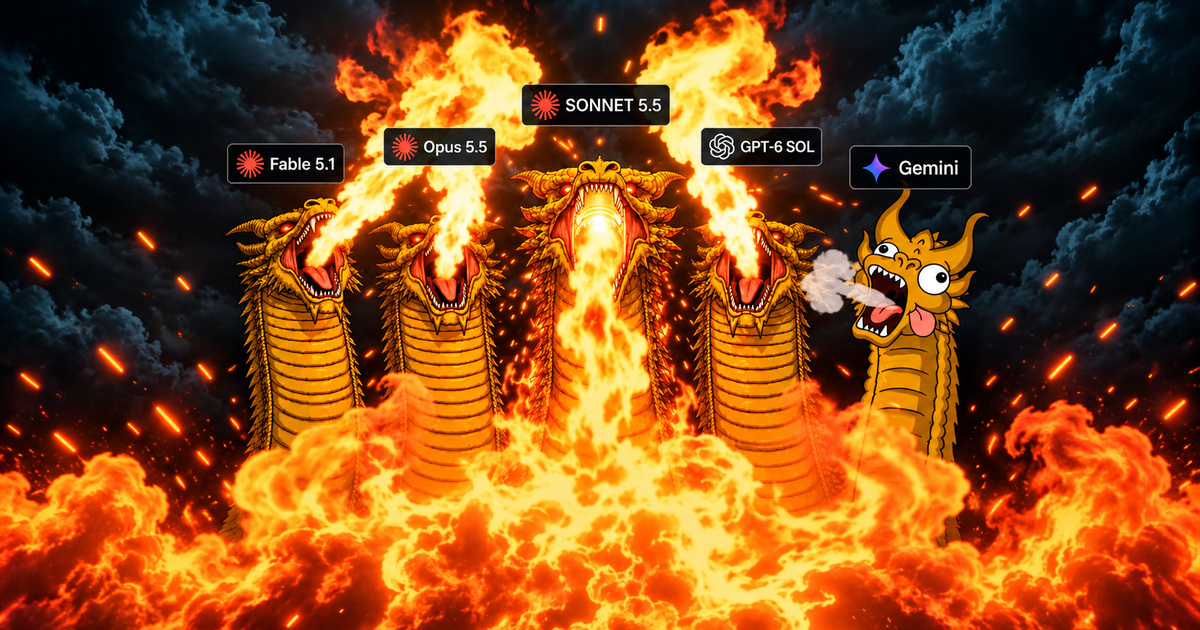
Gemini 4 Hydrogen is Google's new fast Gemini 4 model, out November 12, 2026. In the Gemini API it costs $1.50 per million input tokens and $7.50 per million output tokens, flat across its 1 million token window. It is the first Gemini 4 model on the free API tier. In Google's own table it beats Claude Sonnet 5.5 on 7 of 10 tests. Sonnet keeps the terminal and computer use tests.
On October 27 I posted on LinkedIn that Google dropped Gemini 4 and it still loses to Sonnet 5.5. Hydrogen is Google's answer at a lower price. Here is what changed on November 12, read on Google's own pricing page, model page and launch posts, plus where I would use it in a sales team.
- Price: $1.50 in and $7.50 out per million tokens, 25% below Claude Sonnet 5.5 at $2 and $10.
- Cached input: $0.075 per million, a 95% discount, implicit caching only.
- Free tier: yes in the Gemini API and AI Studio. Argon and Carbon have none.
- Gemini app: free users get it through auto model selection; Google AI Plus at $4.99 a month lists it.
- Benchmarks: ahead of Sonnet 5.5 on 7 of Google's 10 tests, behind on Terminal-Bench 4.1, OSWorld-2.1 and Terminal-Bench-Science.
- Thinking: four levels, with a new xhigh above the default high.
 in
“Google dropped Gemini 4. It still loses to Sonnet 5.5.”
What Is Gemini 4 Hydrogen?
Gemini 4 Hydrogen is the fast model of the Gemini 4 family, built for everyday coding and agent work. Google positions it under Gemini 4 Carbon and Gemini 4 Argon, which keep the hardest reasoning. The API name is gemini-4-hydrogen. It reads text, images, video, audio and PDF, and writes text.
Google calls it the recommended upgrade from Gemini 3.8 Flash and older Gemini 3 and 2.5 models. It shares the 1,048,576 token window of Carbon and Argon, counted once for input, thinking and output. It answers up to 65,536 tokens at a time, and up to the full window with long decode.
| Before November 12 | From November 12 | |
|---|---|---|
| Cheapest Gemini 4 in the API | Gemini 4 Argon and Carbon, $2 / $10 until November 30, then $4 / $20 | Gemini 4 Hydrogen, $1.50 / $7.50 |
| Gemini 4 on the free API tier | None | Gemini 4 Hydrogen |
| Thinking levels on Gemini 4 | Low, medium, high, medium by default | Hydrogen adds xhigh and defaults to high |
| Gemini app, free accounts (plans page lists Flash-Lite) | No Gemini 4 model | Hydrogen through auto model selection |
| Gemini app, Google AI Plus ($4.99) | Argon not listed (checked October 27) | Access to Gemini 4 Hydrogen |
How the two bigger models compare, with benchmarks against Claude, is in my guide to Gemini 4 Argon vs Carbon.
How Much Does Gemini 4 Hydrogen Cost?
Gemini 4 Hydrogen costs $1.50 per million input tokens and $7.50 per million output tokens on the paid tier. Thinking tokens bill as output. Cached input costs $0.075 per million, a 95% discount that Google applies on its own to prompts of at least 4,096 tokens. Explicit caching is not supported. The price is the same across the whole 1 million token window.
The comparison I care about is the price ladder. Hydrogen costs 25% less than Claude Sonnet 5.5 per token. It is also 25% below Argon today and 62.5% below Argon from December 1. One detail is easy to miss. From January 1, 2027, Gemini 3.8 Flash also moves to $1.50 and $7.50, so Hydrogen will cost the same as the older Flash.
| Model | Input | Cached input | Output |
|---|---|---|---|
| Gemini 4 Hydrogen | $1.50 | $0.075 | $7.50 |
| Gemini 4 Argon and Carbon, until November 30 | $2.00 | $0.10 | $10.00 |
| Gemini 4 Argon and Carbon, from December 1 | $4.00 | $0.20 | $20.00 |
| Gemini 3.8 Flash, until December 31 | $0.75 | $0.075 | $3.75 |
| Gemini 3.8 Flash, from January 1, 2027 | $1.50 | $0.15 | $7.50 |
| Claude Haiku 5.5, prompts up to 100K tokens | $0.10 | $0.01 | $0.50 |
| Claude Sonnet 5.5 | $2.00 | $0.10 | $10.00 |
| Claude Opus 5.5 | $4.00 | $0.20 | $20.00 |
Here is the math I use, my illustration from list prices. Say a research agent reads 50,000 tokens about one account and writes 5,000. On Hydrogen that run costs about 11 cents. On Sonnet 5.5 it costs 15 cents. On Argon after December 1 it costs 30 cents. Real runs add thinking tokens, so log the count on your own jobs.
| Runs per month | Gemini 4 Hydrogen | Claude Sonnet 5.5 | Gemini 4 Argon from December 1 |
|---|---|---|---|
| 100 | $11.25 | $15 | $30 |
| 1,000 | $112.50 | $150 | $300 |
| 10,000 | $1,125 | $1,500 | $3,000 |
The same per-run math for Anthropic's models is in my Claude API pricing guide.
Is Gemini 4 Hydrogen Free?
Yes, with limits. Google's pricing page lists Gemini 4 Hydrogen as free of charge on the free tier of the Gemini API, for input, output and caching. On the free tier Google may use your content to improve its products, and grounding with Google Search and Maps is not available. For client data, use the paid tier.
In the Gemini app, Google says free users reach Hydrogen through auto model selection, when Gemini picks it for the prompt. Google AI Plus at $4.99 a month lists access to it with twice the free limits. Google AI Pro at $19.99 lists Hydrogen and Argon. Ultra, from $99.99 a month, lists the highest access. Hydrogen also runs in Google Search for all users.
Gemini 4 Hydrogen vs Claude Sonnet 5.5: Which Is Better?
It depends on the job. In Google's launch table, Hydrogen beats Sonnet 5.5 on 7 of 10 tests, including bug fixing on SWE-sweep, business automation, knowledge work and reasoning. Sonnet 5.5 wins Terminal-Bench 4.1, computer use on OSWorld-2.1 and science in a terminal. Google chose the tests and ran the numbers.
| Test | What it measures | Gemini 4 Hydrogen | Claude Sonnet 5.5 | GPT-6.1 Terra |
|---|---|---|---|---|
| SWE-sweep | Finding and fixing bugs in a repository | 13.5% | 3.1% | 5.8% |
| Terminal-Bench 4.1 | Agent work in a terminal (cheating-adjusted) | 57.0% | 63.9% | n/a |
| Agents' Last Exam v1.1 | Knowledge work | 71.6% | 60.4% | 69.8% |
| AutomationBench-AA | Business automation | 76.1% | 71.8% | 60.2% |
| Vending-Bench 2 | Running a small business (bank balance) | $14,549 | $11,165 | $9,107 |
| OSWorld-2.1 | Computer use (offline subset) | 77.6% | 83.9% | 74.2% |
| MKA | Multimodal understanding | 53.4% | 52.0% | 43.8% |
| Chartography | Reading charts | 66.6% | 61.6% | 63.2% |
| Terminal-Bench-Science 0.1 | Science tasks in a terminal | 51.4% | 59.9% | 58.3% |
| HLE-Diamond | Hard reasoning | 58.8% | 53.3% | 47.3% |
The terminal gap matters most to me. Sonnet 5.5 leads Terminal-Bench 4.1 by 6.9 points and OSWorld-2.1 by 6.3. Those two tests look like real agent runs: open files, run commands, click through software, fix what breaks. That is the same pattern as Argon in October, so the headline of my post still holds for long agent runs.
Against Sonnet 5.5, cost is where Hydrogen wins. On Google's chart of the Artificial Analysis Intelligence Index v5.0.1, Hydrogen scores 51 at its default high level and 54 at xhigh, against 50 for Argon. At xhigh it matches Sonnet 5.5's top score for roughly a third of the cost per task. GPT-6.1 Terra reaches 51 at about half Hydrogen's cost, and stops there.
One caution on those numbers. They come from Google, on index version 5.0.1, so they do not match the older Artificial Analysis scores in my Argon guide, where Argon had 53 and Sonnet 56. The outside rankings Google cites are friendlier: #5 on Agent Arena, #1 on the Vals Tax Agent Bench at 52.3% and a tie for #1 on Vals Legal Research at 55.8%.
Not sure which test fits your work? My guide on how to evaluate AI models shows how to test on your own tasks.
Hydrogen vs Argon vs Carbon: Which Gemini 4 Should You Use?
Start on Hydrogen and move up only when it fails. Google's own advice is the same. It points Hydrogen at everyday coding, web apps, tool-using agents and document work. Carbon is for hard architecture, debugging and security audits. Argon sits between them for long tasks with fewer thinking tokens than Carbon. Note the default: Hydrogen thinks at high, while Argon and Carbon start at medium.
Google also pairs them. In Google Antigravity, a new Orchestrator switches between Carbon and Hydrogen in the same session. On Terminal-Bench 4.0, Google says it came close to Carbon's success rate while using 24% less quota and finishing 19% faster. Against Gemini 3.8 Flash, Google reports Hydrogen 2.5 times faster, with Terminal-Bench 4.1 up from 18.2% to 57%.
For agents that touch client data, Google's safety numbers matter too. It reports fabricated claims cut more than 5 times against 3.8 Flash, a 96.7% honesty rate on its internal agent test and more than 2.3 times more resistance to indirect prompt injection on the Gray Swan benchmark. The Antigravity agent in Gemini Managed Agents now runs on Hydrogen by default.
| Job | My pick | Why |
|---|---|---|
| Coding and terminal agents | Claude Sonnet 5.5 | Leads Terminal-Bench 4.1 and OSWorld-2.1 in Google's table, though Hydrogen leads SWE-sweep |
| Account research and briefs | Test Gemini 4 Hydrogen | Wins Google's knowledge work tests at 25% less per token |
| Bulk tagging, extraction, lead sorting | Claude Haiku 5.5 first | $0.10 and $0.50 per million tokens on short prompts |
| Reading PDFs, charts and decks | Test Gemini 4 Hydrogen | Leads MKA and Chartography in Google's table |
| Gemini jobs you budget past December 1 | Hydrogen before Argon | Argon doubles to $4 and $20 |
Should You Move Your Agents to Gemini 4 Hydrogen?
Move a job only when your own test says so. Hydrogen is the cheapest Gemini 4 model, and the free tier makes the test cost nothing. My rule stays the same as with Argon. Keep the agent jobs on Claude and test Hydrogen on research, reading and writing at volume.
- Pick five real tasks from last month: one account brief, one email batch, one long PDF, two agent runs.
- Run each on Hydrogen at high and on Sonnet 5.5 with the same prompt.
- Rerun the failed ones on Hydrogen at xhigh and log the extra tokens.
- Score the output yourself and compare cost per finished task.
- Move a job only where Hydrogen wins on your own work, on the paid tier for client data.
Choosing a lab for the whole team? My Claude vs ChatGPT for business guide compares them on real team work.
Want AI agents doing the research and outbound work inside your sales team? Our B2B lead generation service runs agents on the routine work and people on the calls.
Frequently asked questions
How much does Gemini 4 Hydrogen cost?
In the paid Gemini API, Gemini 4 Hydrogen costs $1.50 per million input tokens and $7.50 per million output tokens, thinking tokens included. Cached input costs $0.075 per million, with implicit caching only. The price is flat across the 1 million token window. On the free tier of the API it costs nothing, within free-tier rate limits.
Is Gemini 4 Hydrogen better than Claude Sonnet 5.5?
On 7 of 10 tests in Google's launch table, yes, including Agents' Last Exam (71.6% to 60.4%) and HLE-Diamond (58.8% to 53.3%). Sonnet 5.5 wins Terminal-Bench 4.1 (63.9% to 57.0%), OSWorld-2.1 (83.9% to 77.6%) and Terminal-Bench-Science. Google ran these tests, so check them on your own tasks.
When did Gemini 4 Hydrogen come out?
Google released Gemini 4 Hydrogen on November 12, 2026. It started rolling out the same day in the Gemini API and AI Studio, on both free and paid tiers, in Gemini for business, in the Gemini app and in Google Search for all users. Paid Google AI Pro and Ultra subscribers also get it in Google Antigravity.
Is Gemini 4 Hydrogen better than Gemini 4 Argon?
For price and Google's index score, yes. Google says Hydrogen scores 51 on the Artificial Analysis Intelligence Index v5.0.1 at its default level, against 50 for Argon, at $1.50 and $7.50 per million tokens against Argon's $2 and $10. Google still points the hardest long tasks to Argon and Carbon.
What are the Gemini 4 Hydrogen thinking levels?
Four: low, medium, high and xhigh. High is the default and Google recommends it for most complex tasks. Xhigh is new in Gemini 4 and gives the deepest reasoning, with more latency and more output tokens, so Google suggests it only when high falls short. You set it with the thinking_level field.
Sources
Google, Introducing Gemini 4 Hydrogen, November 12, 2026, read November 13, 2026.
Google, Gemini 4 Hydrogen: everyday coding and agentic workflows for developers, November 12, 2026, read November 13, 2026.
Google, Google Search gets a major upgrade with Gemini 4 Hydrogen, November 12, 2026, read November 13, 2026.
Google AI for Developers, Gemini API pricing, read November 13, 2026.
Google AI Studio, What's new in Gemini 4 Hydrogen, read November 13, 2026.
Google AI Studio, Gemini 4 Hydrogen model page, read November 13, 2026.
Google, Google AI plans, read November 13, 2026.
Anthropic, Claude pricing, read November 13, 2026.


