








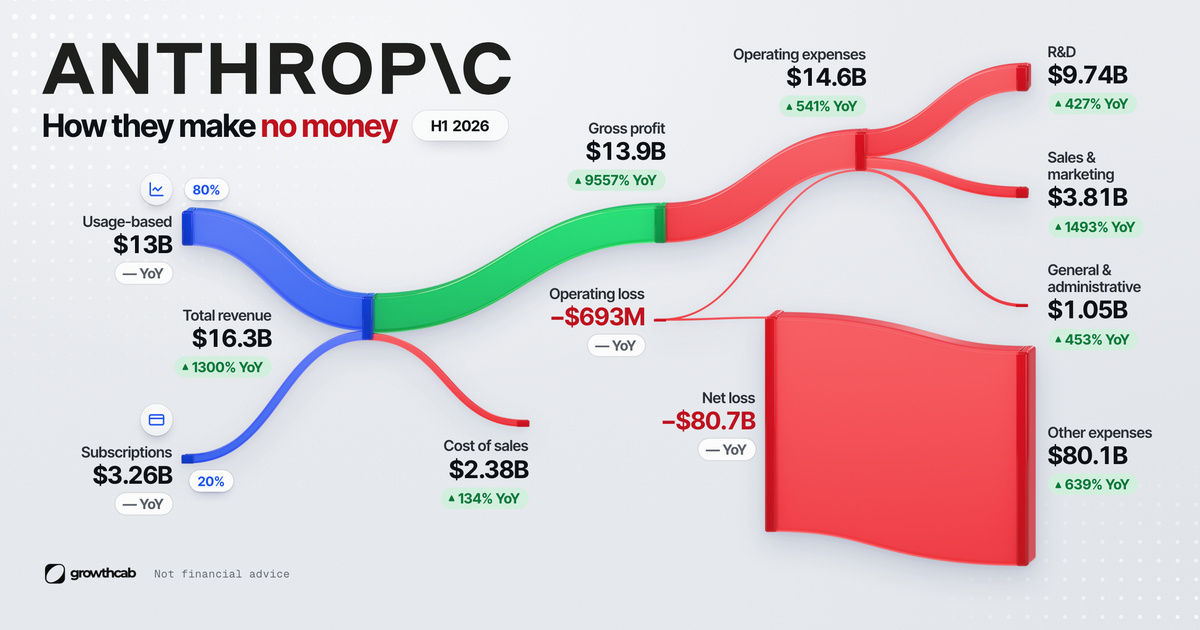
No. Anthropic is not profitable under standard accounting. Its amended IPO filing of November 2, 2026 shows a $104.0 billion net loss on $33.2 billion of revenue in the first nine months of 2026. The business underneath is close to breakeven: a $974 million operating profit in the second quarter, then a $567 million operating loss in the third.
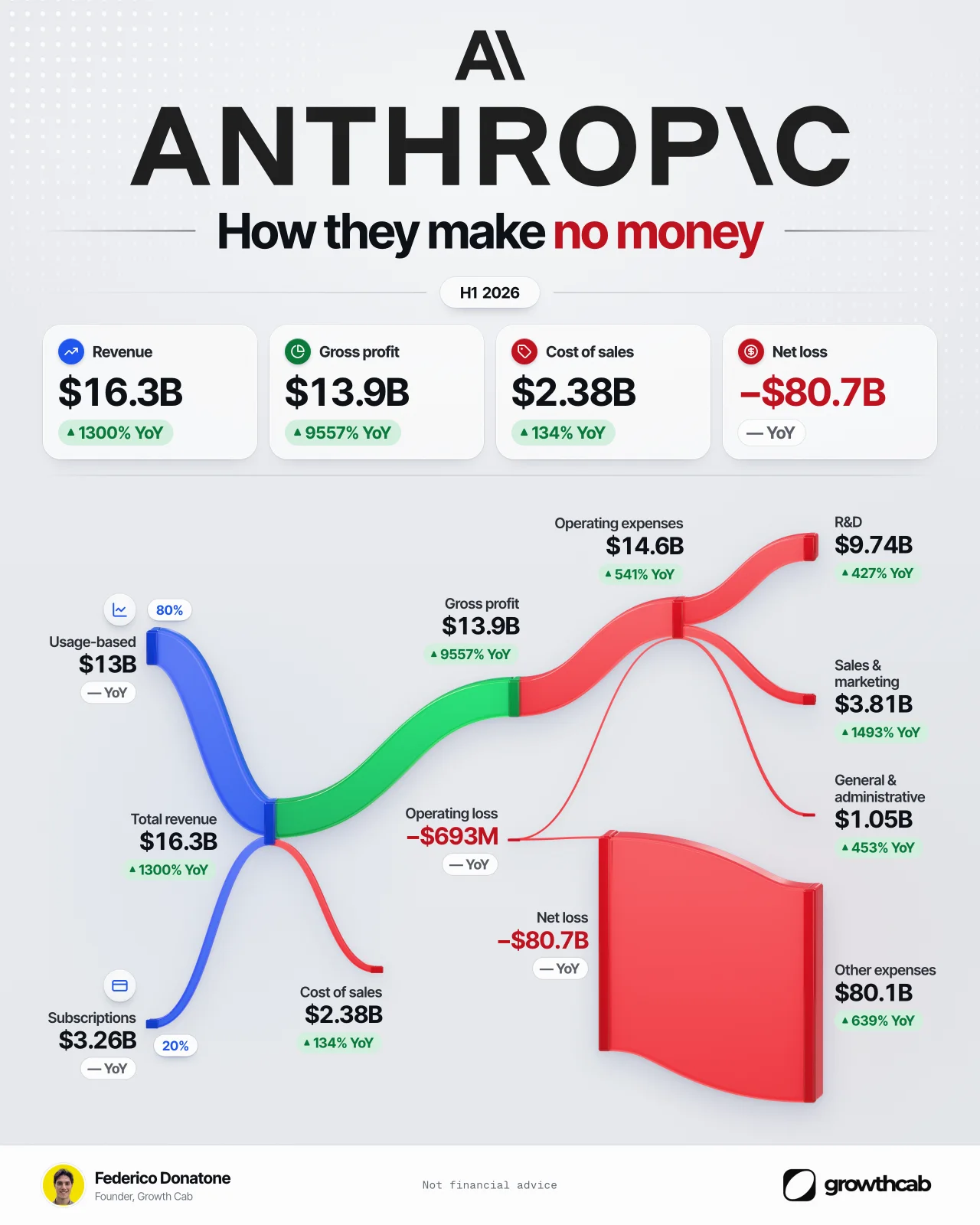
On November 4, 2026 I posted on LinkedIn the seven numbers from Anthropic's first IPO filing, the one covering the first half of 2026. Since then Anthropic has filed an update with nine months of data. Here is the newer picture, read line by line from the S-1/A on SEC EDGAR, and the four ways to answer the question.
- Net loss: $104.0 billion in nine months. $94.3 billion of it is a paper charge on convertible notes and SAFEs.
- Operating result: a $1.26 billion loss in nine months on $33.2 billion of revenue, under 4% of sales.
- Gross margin: about 86%. Serving Claude to customers cost $4.8 billion.
- Adjusted operating income: $2.5 billion in Q3, a 15% margin, on Anthropic's own measure.
- Cash: operations brought in $6.6 billion. Compute commitments total $895.4 billion.
 in
“Anthropic lost $80 billion. It almost made a profit.”
Is Anthropic Profitable in 2026?
Anthropic is not profitable in 2026 on a net basis, and it is slightly unprofitable on an operating basis. The answer depends on which line of the income statement you read. Here are the four lines people mean when they ask, with the nine-month and third-quarter figures from the filing.
| Measure | 9 months to Sep 30, 2026 | Q3 2026 | Profitable? |
|---|---|---|---|
| Net income (GAAP) | -$104.0 billion | -$23.3 billion | No |
| Operating income (GAAP) | -$1.26 billion | -$567 million | No, close to breakeven |
| Adjusted operating income (company measure) | +$4.1 billion (12% margin) | +$2.5 billion (15% margin) | Yes, on its own definition |
| Operating cash flow | +$6.6 billion | about +$2.6 billion (derived: nine months minus first half) | Yes, cash came in |
So the honest one-line answer: Anthropic loses money on paper, almost breaks even running the business, and brings in cash. All three are true. Pick the one that matches your question.
Is Anthropic Profitable on Inference?
Yes. Selling Claude makes money. In the first nine months of 2026 Anthropic booked $33.2 billion of revenue, and the cost of revenue was $4.8 billion. That leaves $28.4 billion of gross profit, a margin of about 86%. The filing says cost of revenue is substantially all compute for customer-serving workloads. Two costs sit outside that margin: fees paid to channel partners and the compute for free users, both booked in sales and marketing.
Most of that revenue is metered. Consumption, the pay-per-token side, brought $26.3 billion, or 79%. Subscriptions like Claude Pro, Max and Ultra brought $6.9 billion, or 21%. In my post I had the first-half split: $13.1 billion usage and $3.2 billion subscriptions, per the original S-1.
Why Is Anthropic Not Profitable?
Anthropic is not profitable because of a $94.3 billion non-cash charge and $19.2 billion of R&D in nine months. The charge is accounting: $94.3 billion of the nine-month loss is the change in fair value of convertible notes, derivatives and SAFEs. The filing says it was driven by the rise in Anthropic's own valuation. No cash left the company for it.
Another $10.4 billion of net other expense, driven by an $11.0 billion fair-value charge on partner financing arrangements, also sits below the operating line. Interest income of $2.4 billion on its cash softens the hit.
R&D is the cost of building the next model, and it ate more than half of revenue. Sales and marketing took $6.6 billion and general and administrative $3.8 billion. Add R&D, those two and the $4.8 billion cost of revenue and you get $34.5 billion of operating expenses against $33.2 billion of revenue.
Anthropic says it plainly. It writes that it has "incurred net losses in each year since our founding" and that it "may not achieve or sustain profitability in the future."
Was Anthropic Profitable Last Quarter?
No. In Q3 2026 Anthropic made $17.0 billion of revenue and posted a $567 million operating loss, after a $974 million operating profit in Q2. Q2 was its first operating profit in the seven quarters the filing shows. The swing has one clear cause, visible in the quarterly table. Growth is slowing too: revenue rose 144% from Q1 to Q2 and 47% from Q2 to Q3.
| Quarter | Revenue | Operating income | Adjusted operating income | Net loss |
|---|---|---|---|---|
| Q1 2025 | 376 | -935 | -830 | -6,592 |
| Q2 2025 | 787 | -1,200 | -1,019 | -6,377 |
| Q3 2025 | 1,382 | -3,089 | -1,284 | -12,138 |
| Q4 2025 | 2,040 | -2,836 | -1,721 | -16,858 |
| Q1 2026 | 4,731 | -1,667 | -617 | -14,439 |
| Q2 2026 | 11,555 | +974 | +2,235 | -66,309 |
| Q3 2026 | 16,956 | -567 | +2,463 | -23,291 |
The cause is a $1.96 billion non-cash charge in Q3 for Anthropic's donation matching program, whose value is tied to employee equity. Take it out and Q3 operating income would be about $1.4 billion. Anthropic also says price cuts on new models and contract discounts took about $600 million off Q3 revenue growth versus Q2.
Is Anthropic Profitable If You Take Out Expenses?
Yes, Anthropic is profitable on its adjusted numbers: adjusted operating income was $4.1 billion in the first nine months of 2026. Adjusted operating income was $2.2 billion in Q2 and $2.5 billion in Q3, margins of 19% and 15%. Adjusted net income was $2.7 billion and $3.2 billion. These are company measures, outside standard accounting, and they remove real costs.
The adjustment removes stock-based compensation ($1.1 billion in Q3), the non-cash charitable contributions and the 2025 Bartz settlement. For net income it also removes the fair-value charges on notes, SAFEs and partner financing. Stock compensation is still a cost, because it dilutes shareholders. Training costs stay in. Read the adjusted line as a view of the core business, and keep the GAAP line next to it.
Does Anthropic Burn Cash?
No, Anthropic's operations do not burn cash: they brought in $6.6 billion in the first nine months of 2026, up from $3.9 billion in the first half. A year earlier, the same nine months used $2.0 billion. Anthropic held $131.8 billion of cash and short-term investments on September 30, 2026.
Most new cash still came from investors: financing brought in $110.7 billion in nine months. The real weight sits in the future. Anthropic reports about $895.4 billion of committed spend, substantially all compute and infrastructure. About $69.8 billion falls due in the 12 months after September 30, 2026, and $447.5 billion before the end of 2030. Revenue has to keep growing to carry that.
For the valuation side of the IPO, I broke down Anthropic's market cap against 35 SaaS companies.
OpenAI is the obvious comparison, and I put the two side by side in Anthropic vs OpenAI revenue.
When Will Anthropic Be Profitable?
Anthropic gives no date for profitability in its IPO filing. Anthropic writes only that it "may not achieve or sustain profitability in the future." The numbers show an operating line within $1.7 billion of zero in each of the last three quarters, with revenue up 47% in the latest one. My read: a quarter without big non-cash charges could print a GAAP operating profit.
A GAAP net profit is harder. It needs the fair-value charges on notes and SAFEs to fade. The filing says the Amazon notes convert into shares with the IPO. The part above Amazon's ownership cap converts in quarterly steps, or is repaid in cash at maturity. While those notes are outstanding, a higher Anthropic valuation keeps showing up as a loss.
What Does Anthropic's Profitability Mean If You Pay for Claude?
For Claude buyers, the 86% gross margin is good news: Anthropic earns far more on the tokens it serves than they cost. So I don't see pressure to raise prices to fix the books. The $600 million of Q3 price cuts points the other way: new models arrive cheaper, and contract discounts exist.
My read for B2B teams: Anthropic got so valuable that its own convertible notes and SAFEs cost it $94 billion on paper, while the business underneath almost broke even. That's a vendor with pricing power and room to cut prices. Negotiate volume. Budget for tokens, since usage is where 79% of its money comes from.
If you are sizing a Claude budget, start from Claude's plans and prices.
For the per-token rates, see Claude Opus API pricing.
And if you want Claude working inside your sales team, here is how we run go-to-market consulting at Growth Cab.
Frequently asked questions
Is Anthropic profitable yet?
No. Anthropic's amended S-1 shows a $104.0 billion net loss in the first nine months of 2026 and a $1.26 billion operating loss. It made its first operating profit in Q2 2026, $974 million, then went back to a $567 million operating loss in Q3 because of a $1.96 billion non-cash charge.
Why is Anthropic's net loss so large?
Because of an accounting charge. $94.3 billion of the $104.0 billion nine-month loss is the change in fair value of convertible notes, derivatives and SAFEs, driven by Anthropic's rising valuation. It is a paper loss: no cash left the company. The remaining $9.7 billion is $10.4 billion of other expense, mostly partner financing, plus the $1.26 billion operating loss and $0.4 billion of tax, minus $2.4 billion of interest income.
Is Anthropic profitable on inference?
Yes. In the first nine months of 2026 Anthropic's cost of revenue was $4.8 billion against $33.2 billion of revenue, a gross margin of about 86%. Cost of revenue is mostly compute for serving customers. The losses come from research, sales, administration and accounting charges. Serving Claude itself makes money.
Will Anthropic be profitable after the IPO?
Nobody can promise that, and Anthropic itself writes that it may not achieve or sustain profitability. The operating line is near breakeven and adjusted operating income was $2.5 billion in Q3. Against that sit about $895.4 billion of compute commitments, $69.8 billion due within a year.
How much does Anthropic spend on research?
Anthropic spent $19.2 billion on research and development in the first nine months of 2026, against $33.2 billion of revenue. R&D is mostly compute for model development, research and internal usage, plus researcher pay. It is the largest operating cost, four times the $4.8 billion it cost to serve customers.
Sources
Anthropic, PBC, Form S-1/A, Amendment No. 1, SEC EDGAR, filed November 2, 2026 (nine months to September 30, 2026; quarterly tables; cash flows; commitments).
Anthropic, PBC, Form S-1, SEC EDGAR, filed October 26, 2026 (six months to June 30, 2026).
SEC EDGAR, Anthropic, PBC filing index, CIK 0002130357, read November 4, 2026.
Fortune, Anthropic's IPO prospectus shows $16.3 billion in revenue, an $80.7 billion net loss, October 26, 2026.
Understanding AI, Anthropic's financials are surprisingly strong, October 29, 2026.
Federico Donatone, Anthropic lost $80 billion. It almost made a profit., LinkedIn, November 4, 2026.


