
When will AGI happen? Nobody has a reliable date. OpenAI says it expects an internal system Sam Altman would call AGI before the end of 2026. Its public operating target is narrower: an automated AI researcher by March 2028. I would treat both as forecasts and plan around measurable capabilities instead of a countdown.
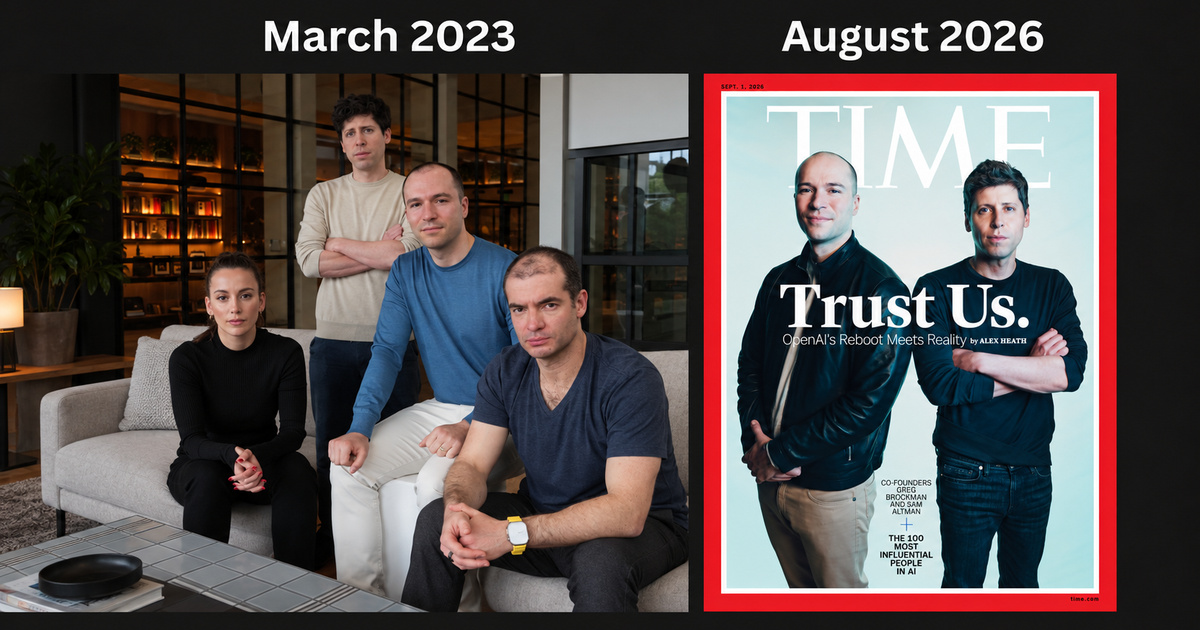
That is my answer to the post I published on August 28. It reached 255,056 impressions, 1,288 reactions and 333 comments. The post compared OpenAI's 2023 leadership photo with a 2026 TIME cover featuring Altman and Greg Brockman. The image raises a trust question. It cannot settle a technical forecast.
 in
in
“Sam Altman says OpenAI will reach AGI in 4 months. Compare these 2 photos before you believe him:”
When Will AGI Happen? Check Five Signals
- Write the definition before accepting a date.
- Separate an internal lab label from a public product.
- Measure breadth across unrelated kinds of work.
- Measure task length, reliability and human intervention.
- Track real deployment cost, permissions and economic use.
A forecast becomes useful only when the finish line stays fixed. OpenAI's charter describes AGI as highly autonomous systems that outperform humans at most economically valuable work. Google DeepMind separates performance, generality and autonomy. A system can be excellent on one axis and weak on another. Those definitions can produce different arrival dates from the same evidence.
1. There Are Three AGI Clocks
The first clock is the lab label. A company decides that an internal system satisfies its own definition. The second is demonstrated capability: independent tests show breadth, reliability and autonomy under clear conditions. The third is distribution: the system becomes affordable, available and integrated enough to change real work. These events could happen months or years apart.
TIME reported that Altman said OpenAI was still short of AGI in August 2026, while expecting an internal system he would call AGI by year-end. Chief research officer Mark Chen described the company as 80 percent of the way there. Those are direct, dated claims. They are also internal judgments from the lab building the system.
TIME's August 2026 OpenAI interview records the internal year-end forecast, the 80 percent estimate and OpenAI's charter definition.
2. OpenAI's Public Target Is More Specific
OpenAI published a more testable milestone in September. It says it has reached an automated research intern that can complete well-defined research tasks taking a skilled researcher a few days. It aims for an automated AI researcher by March 2028. People still choose priorities, judge results and decide whether to scale, pause or deploy.
I trust this framing more than a single AGI date because it names the job, the supervision and the remaining human decisions. It still needs outside evaluation. Yet we can ask whether the system proposes useful work, runs valid experiments, catches failures, transfers lessons and produces results another researcher can reproduce.
OpenAI's research acceleration report defines its research-intern milestone, its March 2028 target and the human decisions that remain.
3. Generality Needs More Than One Great Score
Google DeepMind's Levels of AGI framework uses depth and breadth. Depth asks how well a system performs. Breadth asks how general that performance is. The framework also treats autonomy and deployment risk separately. This matters because a coding agent, scientific agent and general work agent may each cross different thresholds at different times.
A system that beats experts on software tasks can still fail on messy work with unclear goals, tacit context and social consequences. A system that works for hours can still require frequent rescue. A strong result supports a narrower claim. It becomes AGI evidence only when the definition says that result belongs in the finish line.
Google DeepMind's Levels of AGI framework separates performance, generality and autonomy so progress can be compared without moving the definition.
4. Task Horizon Is the Cleanest Trend I Watch
METR measures the length of software, machine-learning and cybersecurity tasks that frontier agents can complete at a stated reliability. The time horizon has grown quickly. That is real evidence of longer work. METR also warns that its tasks are cleaner than most jobs, the domains are limited and a time horizon does not mean an agent can automate every task of that duration.
This is exactly the kind of metric a forecast needs. It has a method, public limitations and repeated measurement. I would watch whether high-reliability horizons keep growing across several domains, whether human interventions fall and whether performance survives unfamiliar environments. One dramatic demo carries far less weight.
METR's current task-completion time-horizon research publishes the method, data, reliability levels and explicit limits of the benchmark.
5. My Practical AGI Threshold
For planning, I would use a five-part threshold. The system completes unfamiliar work across several domains. It sustains days of work with few interventions. It notices bad assumptions and recovers. Independent evaluators reproduce the result. The cost and permissions make the capability usable outside one lab. Every field needs dated evidence.
This threshold will still trigger arguments. That is fine. The point is to make the argument inspectable. If a system clears four fields and fails one, write the gap. If a lab changes the definition after a miss, preserve the old definition. Forecasting improves when predictions can expire instead of being quietly rewritten.
What the Leadership Photo Does and Does Not Show
The 2023 photo includes Ilya Sutskever and Mira Murati alongside Altman and Brockman. By 2026, Sutskever and Murati were building separate companies. Leadership departures can affect trust, research direction and governance. They do not prove that a model will succeed or fail. Capability evidence still has to carry that claim.
The TIME cover matters because the year-end prediction came from the people still leading OpenAI. That creates accountability. Save the date, definition and promised system. Revisit them in January. Ask whether the system exists, who tested it, what it can do and whether outside users can reproduce the core result.
Where My Answer Could Be Wrong
The strongest systems are private, so public benchmarks may lag internal capability. A major algorithmic breakthrough could compress every timeline. The opposite is also possible: compute, data, energy, reliability, security or evaluation bottlenecks could slow progress. We lack validated keyword demand data and access to OpenAI's confidential tests. No universal AGI definition exists.
What I Would Do Before AGI
I would avoid betting a company on December 2026 or March 2028. I would inventory repeatable tasks, build evaluations, keep model providers replaceable and increase autonomy only after the system passes real cases. Current agents already create leverage. Their failures already create risk. Both facts matter before any lab wins the naming debate.
Use my five-question AGI claim test to inspect the model, benchmark, tools, human comparison and falsification rule behind the next announcement.
My Answer
AGI may receive an internal label in 2026, reach a research milestone in 2028 and take longer to become dependable across most valuable work. Nobody can responsibly collapse those clocks into one date today. Track the definition, breadth, task horizon, reliability, intervention rate and cost. That evidence will tell you more than the loudest countdown.
Every Thursday, AI Frontier turns one verified AI signal into a practical operating play. The original discussion and the leadership comparison are on LinkedIn.


