

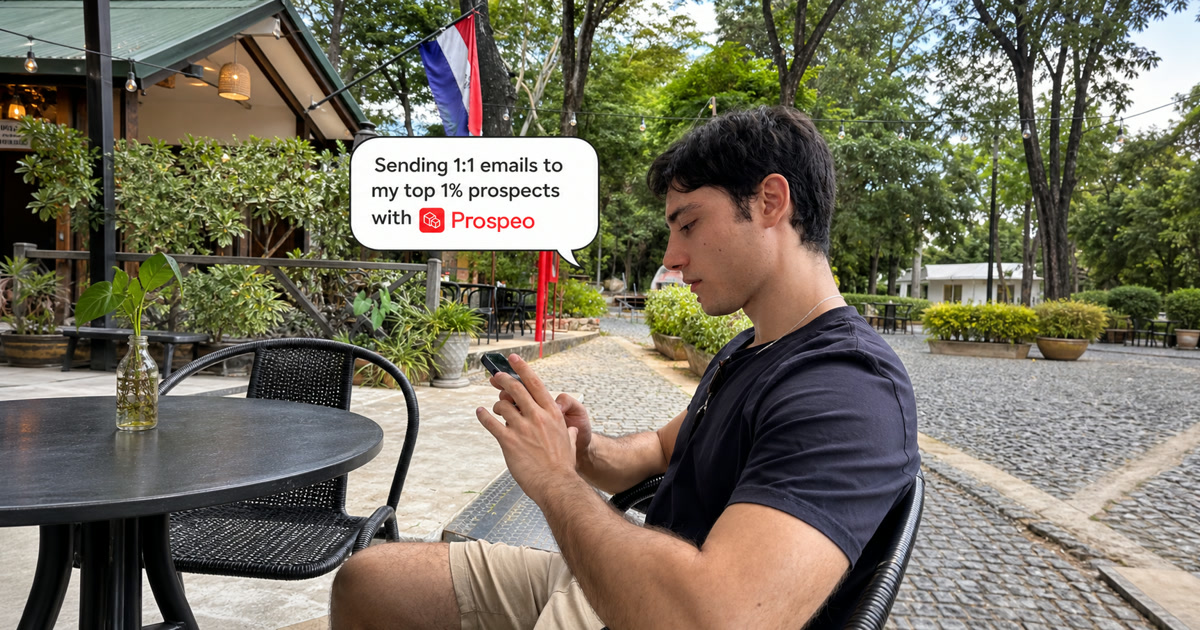
AI made it trivial to send more email. That is the problem, not the win. Every founder now has the same tools, the same enrichment data, and the same clever templates, so every C-level inbox looks like a landfill of near-identical automation. When the cost of sending drops to zero, the value of a message that clearly took effort goes up.
For high-ACV deals sold to founders and operators, the meeting still goes to the person who did the work by hand. Across 400+ B2B engagements, that pattern has only gotten stronger, not weaker.
What AI Is Actually Good For
Use AI for everything that happens before the writing. It is very good at research: pulling a prospect's recent podcast appearance, reading their last four LinkedIn posts, summarizing a funding round, mapping the org chart. It is good at list-building and enrichment, at finding the right person and a verified address. It is good at a rough first draft that gets a blank page off your screen.
So let the model do the heavy lifting on inputs. Give it a company and let it hand you back ten specific, verifiable facts about the buyer. That is real leverage, and it saves you the boring hour. Where founders go wrong is letting the same model also decide what to say and hitting send on all of it. The research scales beautifully. The judgment does not.
Where Manual Judgment Wins
The first twenty words decide whether you get read. A model will give you a competent opener that sounds like every other competent opener, and a busy founder recognizes that texture in half a second.
What lands is the one specific observation only a human would bother to make: a line from their earnings call, a broken flow in their own signup, a comment they left on someone else's post. AI can surface the raw material. Choosing which detail earns the reply is your job.
Timing is the other place humans win. Knowing that a new VP of Sales just started, or that a competitor raised yesterday, and writing at that exact moment beats any cadence a tool runs on a fixed schedule. The best outbound reads like a peer noticed something and reached out, because that is what happened.
A Simple Rule For Manual Versus Automated
Size the effort to the size of the deal. If closing this account would move your quarter, write to that person by hand, every word. If you are testing a message across a wide, low-conviction list to learn what resonates, automate it and read the reply rates. The mistake is treating a $100K logo like a line item in a sequence.
Here is how a founder should spend the outreach hour. Give the first fifteen minutes to AI research on five accounts you genuinely want. Spend the next forty writing five emails by hand, each built on one real observation. Leave five minutes to send. Five researched, manual emails to the right buyers beat five hundred automated ones, and it takes less of your day than you think.
Build A Manual Lane Inside The System
Manual does not mean improvised. Keep a small priority queue of the accounts that deserve founder attention, with a reason each one is there. The reason might be a new executive, an expansion into your market, a hiring pattern, or a public complaint your offer can solve. Research can refresh automatically, but a human should choose the angle, confirm the evidence, and decide whether the timing is real.
Separate that lane from scaled experiments. A broad campaign can test a pain point across hundreds of lower-priority accounts, while the top one percent receives a message written from scratch. Do not let automated volume hide weak results in the high-value lane. Track positive replies, qualified conversations, and pipeline created separately, because five strategic accounts should never be judged by the same denominator as a five-thousand-contact test.
Turn Every Reply Into Better Judgment
Save the sentences buyers use when they answer. Their language becomes the evidence base for the next message: the way they describe urgency, the objection they raise, and the outcome they value. Over time, the manual lane teaches the automated lane what deserves to scale. That is the correct order. Human judgment discovers the signal first, then automation carries a proven signal farther. Keep the failed angles too, so the system remembers what buyers already rejected.
The Takeaway
Let AI do the research, the lists, and the rough draft, then write the first twenty words yourself and send at the moment that matters. The tools that flooded every inbox are exactly why a handful of hand-written emails still stand out. For founder-led, high-ACV deals, the manual hour is the highest-return hour you will spend all week. Protect it every week.
Use it on accounts where one careful observation can open a quarter-changing conversation, and make the automated lane earn the right to inherit anything you discover. Five extra minutes of judgment can protect months of potential revenue.
Our cold email personalization workflow shows how to preserve account relevance when research and drafting become automated.


