






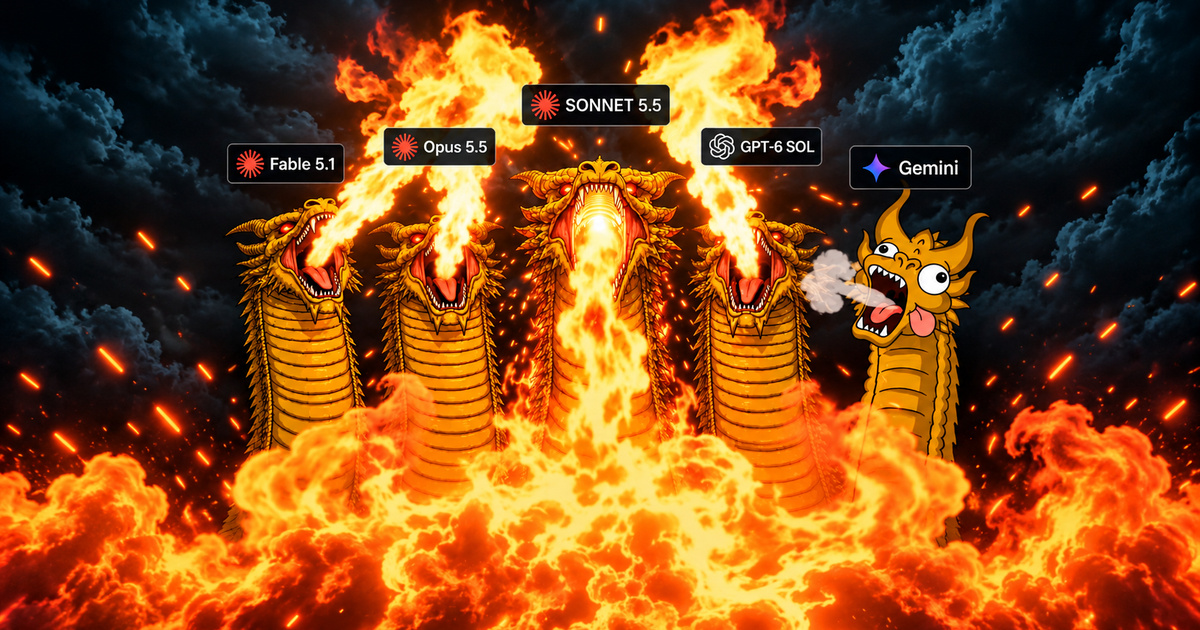
Gemini 4 Neon is Google's new middle Gemini 4 model, out November 18, 2026. In the Gemini API it costs $3 per million input tokens and $15 per million output tokens, 25% below Claude Opus 5.5. There is no free tier. In Google's own table it has the top score on 16 of 19 rows against Opus 5.5 and GPT-6.2 Sol. Opus 5.5 keeps Terminal-Bench 4.1 and FrontierCode 2.0.
On October 27 I posted on LinkedIn that Google dropped Gemini 4 and it still loses to Sonnet 5.5. On November 12 Google answered with Hydrogen, the cheap one. Now it aims higher, at Opus. Here is what changed on November 18, from Google's own pages. Then where I would use it in a sales team.
- Price: $3 in and $15 out per million tokens, flat across the 1 million token window, with no launch discount.
- Cached input: $0.15 per million, 95% off, implicit caching only.
- Free tier: none. Paid API tier, and Google AI Studio for Google AI Pro and Ultra plans.
- Benchmarks: top score on 16 of 19 rows in Google's model card. Opus 5.5 wins Terminal-Bench 4.1 and FrontierCode 2.0.
- Where it sits: between Hydrogen and Carbon. From December 1 it costs less than Carbon and Argon.
 in
“Google dropped Gemini 4. It still loses to Sonnet 5.5.”
What Is Gemini 4 Neon?
Gemini 4 Neon is the middle model of the Gemini 4 family. Google says it sits between Gemini 4 Hydrogen, the fast and cheap one, and Gemini 4 Carbon, the strongest. The model card says Neon is adapted from Carbon. The API name is gemini-4-neon. It reads text, images, video, audio and PDF, and writes text.
Google built it for complex coding, knowledge work and science jobs that run often. Its knowledge cutoff is March 2026. Google names it the upgrade for Gemini 3.1 Pro Preview users. It shares the 1,048,576 token window of the other Gemini 4 models, counted once for input, thinking and output. It answers up to 65,536 tokens at a time, and up to the full window with long decode. It supports computer use, function calling, Google Search grounding, Batch and Flex.
The same day Google added a change that matters for account research. The Gemini API now takes Word, PowerPoint and Excel files directly, and you can send only the pages, tabs, cell ranges or time intervals you need. You pay for that slice only.
| Before November 18 | From November 18 | |
|---|---|---|
| Gemini 4 models in the API | Carbon, Argon and Hydrogen | Carbon, Argon, Hydrogen and Neon |
| Gemini 4 price points | $1.50 / $7.50 (Hydrogen), $2 / $10 until November 30 then $4 / $20 (Argon, Carbon) | Adds $3 / $15, with no introductory price |
| Gemini 4 with the xhigh thinking level | Hydrogen only | Hydrogen and Neon |
| Claude model in Google's launch table | Sonnet 5.5 (Hydrogen, November 12) | Opus 5.5 (Neon) |
The cheaper model from last week is in my notes on Gemini 4 Hydrogen.
How Much Does Gemini 4 Neon Cost?
Gemini 4 Neon costs $3 per million input tokens and $15 per million output tokens on the paid tier. Thinking tokens bill as output. Cached input costs $0.15 per million, a 95% discount on cache hits that Google applies on its own to prompts of at least 4,096 tokens. Explicit caching is not supported. The price is the same across the whole 1 million token window, and Batch or Flex cut it by 50%.
The price ladder tells the story. Neon costs 25% less than Claude Opus 5.5 and 50% more than Claude Sonnet 5.5 and GPT-6.2 Sol. Inside Google's own lineup, Neon costs twice Hydrogen. It is 50% above Carbon and Argon today. From December 1, when those two move to $4 and $20, Neon becomes 25% cheaper than both.
| Model | Input | Output |
|---|---|---|
| Gemini 4 Hydrogen | $1.50 | $7.50 |
| Claude Sonnet 5.5 | $2.00 | $10.00 |
| GPT-6.2 Sol | $2.00 | $10.00 |
| Gemini 4 Argon and Carbon, until November 30 | $2.00 | $10.00 |
| Gemini 4 Neon | $3.00 | $15.00 |
| Claude Opus 5.5 | $4.00 | $20.00 |
| Gemini 4 Argon and Carbon, from December 1 | $4.00 | $20.00 |
| GPT-6.2 Astra | $8.00 | $40.00 |
Here is the math I use, my illustration from list prices. Say a research agent reads 50,000 tokens about one account and writes 5,000. On Neon that run costs 22.5 cents. On Opus 5.5 it costs 30 cents. On Sonnet 5.5 or GPT-6.2 Sol it costs 15 cents. Real runs add thinking tokens, and Neon thinks at high by default, so log the count on your own jobs.
| Runs per month | Gemini 4 Neon | Claude Opus 5.5 | Sonnet 5.5 or GPT-6.2 Sol | Gemini 4 Hydrogen |
|---|---|---|---|---|
| 100 | $22.50 | $30 | $15 | $11.25 |
| 1,000 | $225 | $300 | $150 | $112.50 |
| 10,000 | $2,250 | $3,000 | $1,500 | $1,125 |
The same per-run math for Anthropic's models is in my Claude API pricing guide.
Is Gemini 4 Neon Free?
No. Google's pricing page lists Gemini 4 Neon as not available on the free tier of the Gemini API. You need a paid tier project. On the paid tier Google says it does not use your content to improve its products. Grounding with Google Search gives 5,000 free requests a month, shared across Gemini 3 and newer models, then $14 per 1,000, with a cap of 1,500 requests a day.
Outside the API, Google says Neon is available in Google AI Studio with the Google AI Pro and Ultra plans. Today's Gemini app release notes do not mention it. If you want to try a Gemini 4 model for free, Hydrogen is still the only one on the free API tier.
Gemini 4 Neon vs Claude Opus 5.5: Which Is Better?
On Google's numbers, Neon wins most tests and the coding results are split. Neon has the top score on 16 of 19 rows in Google's model card. Against Opus 5.5 it leads 16 of the 18 rows where both are scored. Opus 5.5 leads Terminal-Bench 4.1 by 0.6 points and FrontierCode 2.0 by 1.1 points. GPT-6.2 Sol leads Chartography. Google chose the tests and ran the numbers.
| Test | Google's category | Gemini 4 Neon | Claude Opus 5.5 | GPT-6.2 Sol |
|---|---|---|---|---|
| AA Index v5.0.1 | Capability index | 61 | 59 | 57 |
| Terminal-Bench 4.1 | Agentic coding (cheating-adjusted) | 65.2% | 65.8% | 61.5% |
| FrontierCode 2.0 | Agentic coding (main score) | 46.2% | 47.3% | 43.8% |
| CursorBench 4.1 | Agentic coding | 65.4% | 58.1% | n/a |
| SWE-sweep | Agentic coding (provider harness) | 39.0% | 10.1% | 8.3% |
| AutomationBench | Knowledge work | 56.3% | 42.5% | 41.3% |
| Agents' Last Exam v1.1 | Knowledge work | 75.8% | 71.6% | 73.0% |
| HLE-Diamond | Reasoning | 71.3% | 67.9% | 64.0% |
| Chartography | Multimodal understanding | 73.5% | 66.3% | 75.1% |
| GraphWalks, 256K to 1M | Long context | 95.2% | 66.8% | 80.1% |
The terminal result is the one I watch, because Terminal-Bench is the test closest to how our agents run. There Opus 5.5 still leads, by a hair. Neon pulls far ahead on AutomationBench, on long context with GraphWalks and on SWE-sweep. Those are Google's runs, so treat them as a reason to test.
One more caution. Google's safety report for Neon is listed as coming soon, and the model card carries forward the risk results of Gemini 4 Argon. For agents that touch client data, I would wait for that report or run your own prompt injection tests first.
Not sure which test fits your work? My guide on how to evaluate AI models shows how to test on your own tasks.
Neon vs Hydrogen vs Carbon: Which Gemini 4 Should You Use?
Start on Hydrogen and move a job to Neon only when Hydrogen fails it. That is Google's own advice. It keeps Hydrogen as the default for everyday coding and agents. It points Neon at multi-file coding, dense knowledge work and science, where Hydrogen is not enough. Carbon stays for the hardest architecture, debugging and security work.
Neon uses the same request format as the other Gemini 4 models, so moving from one of them means changing the model ID. Like Hydrogen, it thinks at high by default and adds xhigh. Carbon and Argon start at medium. Google's Antigravity agent still runs on Hydrogen by default and lets you pick Neon for harder steps.
| Job | My pick | Why |
|---|---|---|
| Terminal agents | Claude Opus 5.5 | Still leads Terminal-Bench 4.1 in Google's own table |
| Bug fixing in a repository | Test Gemini 4 Neon | 39.0% on SWE-sweep against 10.1% for Opus 5.5 in Google's table |
| Account research and long briefs | Test Gemini 4 Neon | Leads Google's knowledge work and long-context rows at 25% less than Opus |
| Automation runs | Test Gemini 4 Neon | 56.3% on AutomationBench against 42.5% for Opus 5.5 in Google's table |
| Drafting at volume | Sonnet 5.5, GPT-6.2 Sol or Hydrogen | Half of Neon's price or less |
| Gemini jobs you budget past December 1 | Neon before Carbon | Carbon and Argon double to $4 and $20 |
Should You Move Your Agents to Gemini 4 Neon?
Move a job only when your own test says so. On paper Neon wins most of Google's table at 25% less than Opus. My rule stays the same. Keep the terminal agents on Claude and test Neon where the gap in Google's table is widest: long documents, automation and bug fixing.
- Pick five real tasks from last month: one account brief, one long PDF, one automation, two agent runs.
- Run each on Neon at high and on Opus 5.5 with the same prompt.
- Rerun the failed ones on Neon at xhigh and log the extra tokens.
- Score the output yourself and compare cost per finished task.
- Move a job only where Neon wins on your own work.
Choosing a lab for the whole team? My Claude vs ChatGPT for business guide compares them on real team work.
Want AI agents doing the research and outbound work inside your sales team? Our B2B lead generation service runs agents on the routine work and people on the calls.
Frequently asked questions
How much does Gemini 4 Neon cost?
In the paid Gemini API, Gemini 4 Neon costs $3 per million input tokens and $15 per million output tokens, thinking tokens included. Cached input costs $0.15 per million, with implicit caching only. The price is flat across the 1 million token window, and Google says Neon has no introductory price.
Is Gemini 4 Neon free?
No. Gemini 4 Neon is not on the free tier of the Gemini API, so you need a paid tier project. Google also lists it in Google AI Studio for Google AI Pro and Ultra plans. Gemini 4 Hydrogen remains the only Gemini 4 model on the free API tier.
Is Gemini 4 Neon better than Claude Opus 5.5?
On most of Google's tests, yes. Against Opus 5.5, Neon leads 16 of the 18 rows where both are scored in Google's model card, including AutomationBench (56.3% to 42.5%). Opus 5.5 wins Terminal-Bench 4.1 (65.8% to 65.2%) and FrontierCode 2.0 (47.3% to 46.2%). Google ran these tests, so check them on your own tasks.
When did Gemini 4 Neon come out?
Google released Gemini 4 Neon on November 18, 2026, as generally available in the Gemini API under the model ID gemini-4-neon. It runs on the paid tier and in Google AI Studio with Google AI Pro and Ultra plans. The DeepMind model card was published the same day.
What is the difference between Gemini 4 Neon and Hydrogen?
Neon is the stronger and pricier one. It costs $3 and $15 per million tokens against $1.50 and $7.50 for Hydrogen, and it has no free tier. Google keeps Hydrogen as the default for everyday coding and agents, and points Neon at complex coding, knowledge work and science.
Sources
Google AI for Developers, Gemini API changelog, November 18, 2026, read November 19, 2026.
Google AI for Developers, Gemini API pricing, read November 19, 2026.
Google AI Studio, What's new in Gemini 4 Neon, read November 19, 2026.
Google AI Studio, Gemini 4 Neon model page and
Google DeepMind, Gemini 4 Neon model card, published November 18, 2026, read November 19, 2026.
Anthropic, Claude API pricing, read November 19, 2026.
OpenAI, API pricing, read November 19, 2026.


