








Supabase costs $0 on Free, $25 a month on Pro and $599 a month on Team. Enterprise is custom. The plan fee is only part of the bill. Every project also pays for compute, from about $10 a month for a Micro to $3,730 for a 16XL. Paid plans include $10 of compute credits a month, enough for one Micro.
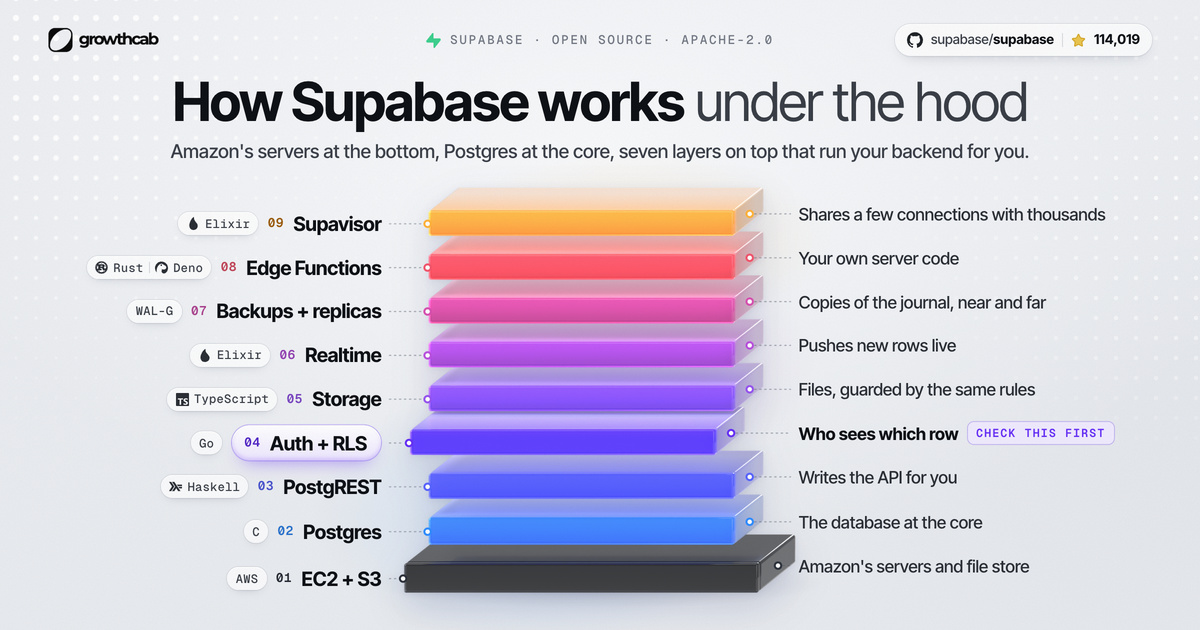
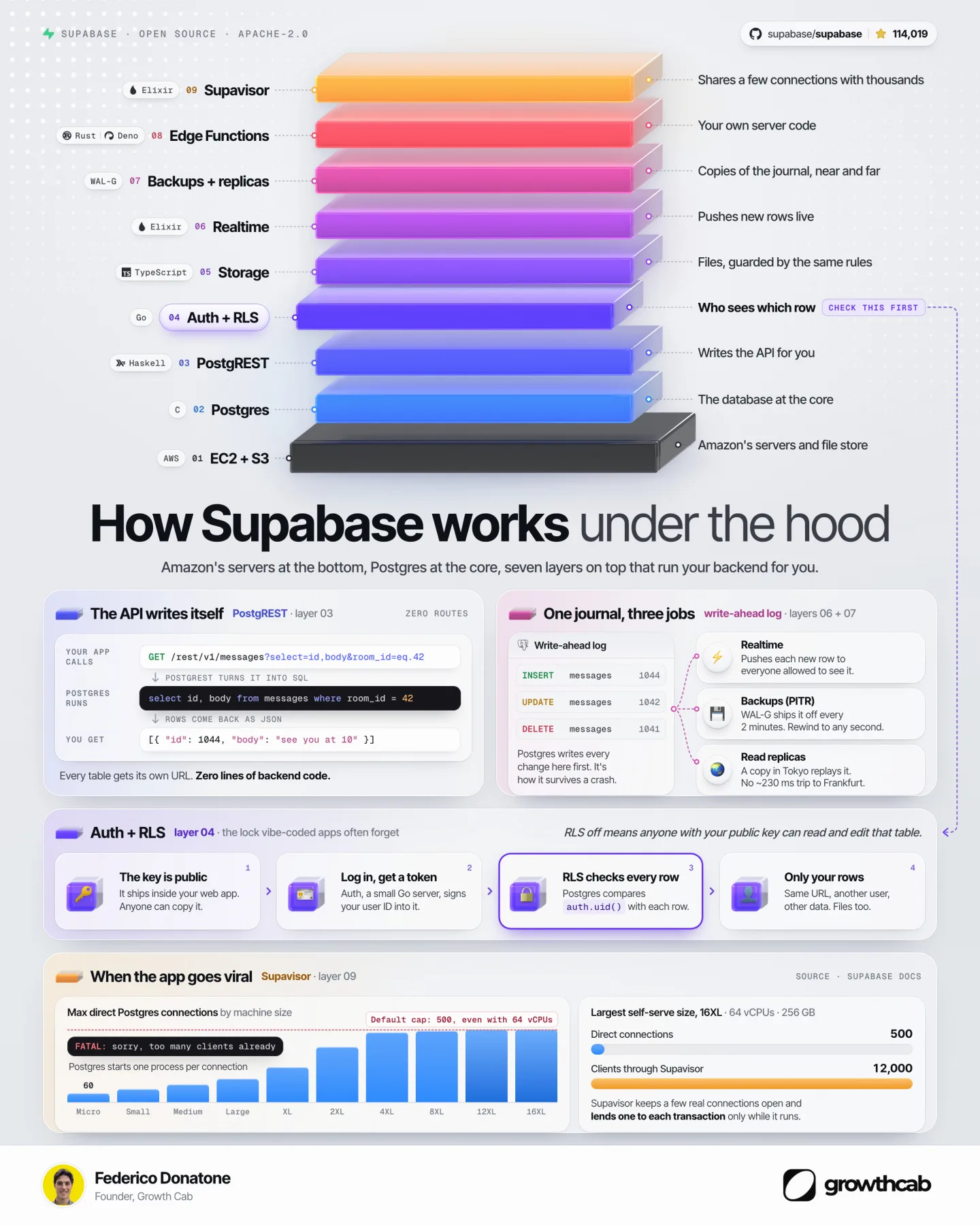
On October 29, 2026 I posted on LinkedIn the 9 layers inside Supabase, from a breakdown by @speedy_devv: Amazon's servers at the bottom, Supavisor at the top. Two of them decide your bill and your risk: compute, which caps your connections, and Auth with row level security, which decides who reads your rows. Every price below comes from Supabase's pricing page, read on October 29, 2026.
- Free, $0: 500 MB database, 50,000 monthly active users, 5 GB egress, 1 GB file storage. It pauses after a week without activity.
- Pro, from $25 a month: 8 GB disk, 100,000 monthly active users, 250 GB egress, 100 GB storage, then pay per use.
- Team, from $599 a month: everything in Pro plus SOC 2, ISO 27001, SSO for the dashboard and 14-day backups. HIPAA is a paid add-on on top.
- Compute is billed by the hour on top of the plan. A Micro is set to 60 direct Postgres connections. The biggest listed size is set to 500.
- The spend cap blocks overage on egress, storage and users. It does not cover compute or paid add-ons.
 in
“Supabase has 114,000 stars. Few know what's inside.”
Supabase Pricing in 2026: What Does Each Plan Cost?
Supabase has four plans. Free, Pro and Team have public prices, and sales quotes Enterprise. Pro and Team say "from" because each project adds compute on top. The table shows what each plan includes before usage charges, taken from Supabase's pricing page on October 29, 2026.
| Item | Free | Pro | Team | Enterprise |
|---|---|---|---|---|
| Price per month | $0 | From $25 | From $599 | Custom |
| Monthly active users | 50,000 | 100,000, then $0.00325 each | 100,000, then $0.00325 each | Custom |
| Database size | 500 MB | 8 GB disk per project, then $0.125 per GB | 8 GB disk per project, then $0.125 per GB | Custom |
| Egress | 5 GB | 250 GB, then $0.09 per GB | 250 GB, then $0.09 per GB | Custom |
| File storage | 1 GB | 100 GB, then $0.0213 per GB | 100 GB, then $0.0213 per GB | Custom |
| Realtime peak connections | 200 | 500, then $10 per 1,000 | 500, then $10 per 1,000 | Custom |
| Edge Function invocations | 500,000 | 2 million, then $2 per million | 2 million, then $2 per million | Custom |
| Automatic backups | None | Daily, kept 7 days | Daily, kept 14 days | Custom |
| Log retention | 1 day | 7 days | 28 days | 90 days |
| Pausing | After 1 week idle | Never | Never | Never |
| SOC 2 and ISO 27001 | No | No | Yes, HIPAA as paid add-on | Yes |
API requests are unlimited on every plan, Free included, and so are team members. What you pay for is data: rows on disk, bytes leaving your project, files in storage and the people who sign in each month. Quotas count per organization, summed across all your projects. Supabase counts a monthly active user once per billing cycle, the first time they sign in or refresh their token.
What Is Included in the Supabase Free Tier?
The Supabase free tier gives you two active projects. Each gets a 500 MB database. The two share 50,000 monthly active users, 5 GB of egress and 1 GB of file storage, because quotas count per organization. Each runs on a shared Nano instance with up to 0.5 GB of RAM, 60 direct database connections and 200 pooled clients. File uploads stop at 50 MB.
Two limits catch people. A free project pauses after one week without activity, so a demo you open once a month will be asleep when the client clicks. And Free has no automatic backups. If anyone depends on that database, the $25 Pro plan is the cheapest insurance in the stack.
How Does Supabase Compute Pricing Work?
Supabase compute costs $10 to $3,730 a month per project, because every project runs its own Postgres instance and you pick its size. Compute is billed by the hour, so you can scale up for a launch and back down after it. Paid plans include $10 of compute credits a month per organization, enough for one Micro. A second project pays its full compute. The credits reset every month and do not carry over.
| Compute size | Price a month | CPU | Memory | Direct connections | Pooler clients |
|---|---|---|---|---|---|
| Nano (Free) | $0 | Shared | Up to 0.5 GB | 60 | 200 |
| Micro | $10 | Shared | 1 GB | 60 | 200 |
| Small | $15 | Shared | 2 GB | 90 | 400 |
| Medium | $60 | Shared | 4 GB | 120 | 600 |
| Large | $110 | 2 dedicated vCPUs | 8 GB | 160 | 800 |
| XL | $210 | 4 dedicated vCPUs | 16 GB | 240 | 1,000 |
| 2XL | $410 | 8 dedicated vCPUs | 32 GB | 380 | 1,500 |
| 4XL | $960 | 16 dedicated vCPUs | 64 GB | 480 | 3,000 |
| 8XL | $1,870 | 32 dedicated vCPUs | 128 GB | 490 | 6,000 |
| 12XL | $2,800 | 48 dedicated vCPUs | 192 GB | 500 | 9,000 |
| 16XL | $3,730 | 64 dedicated vCPUs | 256 GB | 500 | 12,000 |
Read the last two columns before the price. Direct connections grow from 60 to 500 and then stop: 12XL and 16XL are both set to 500. Pooler clients keep growing, from 200 on a Micro to 12,000 on a 16XL. The 12,000 is the number I quoted on LinkedIn. It is why Supavisor, the pooler, exists.
Why Do Connection Limits Decide Your Supabase Bill?
Connection limits decide your Supabase bill because each compute size comes with a set number of direct connections, and running out of them pushes you to a bigger size. Often you can skip that upgrade.
Postgres starts one backend process for every connection. That is how the database is built. It is why Supabase recommends at most 500 direct connections, even on 64 vCPUs. You can raise max_connections, but every extra connection costs memory. When an app hits the limit, new requests fail with the error "sorry, too many clients already", and the usual reflex is to buy a bigger instance.
Supavisor, Supabase's shared pooler, is the cheaper fix. It keeps a few real connections open and lends one to each transaction while it runs. Supabase tells you to use it in transaction mode for serverless and edge functions, which open many short connections. A Micro behind the pooler serves 200 clients for $10. A Large gives you 160 direct connections for $110.
Pro and higher plans also get a dedicated pooler, PgBouncer, running next to your database. So the order is always the same: move your app to a pooler connection string, measure, and only then pay for the next compute size.
What Does a Real Supabase Bill Look Like?
A real Supabase bill runs from $0 to over $1,500 a month, and once an app grows, the $25 plan fee stops being the biggest line. Here are five monthly bills built from list prices. They are my calculations, with the spend cap off and the $10 compute credit applied. Monthly compute prices are rounded as on the pricing page. Hourly billing can add a few dollars, about $1 on a Large and $4 on a 4XL.
| Setup | Calculation | Total a month |
|---|---|---|
| Side project inside free limits | Free plan | $0 |
| One production app on Micro, inside Pro quotas | $25 plan + $10 Micro minus $10 credit | $25 |
| Two production apps, each on Micro | $25 + $10 + $10 minus $10 credit | $35 |
| One app on Large with 150,000 users and 400 GB egress | $25 + $110 minus $10, plus 50,000 extra users x $0.00325, plus 150 GB x $0.09 | $301 |
| Team plan, one app on 4XL | $599 + $960 minus $10 | $1,549 |
The fourth row is the lesson. On that app the users cost more than the server: 50,000 users above the quota add $162.50, while the jump to Large adds $100. Go viral in March and you pay for it in April. Every person who signs in counts once.
Which Supabase Add-Ons Cost Extra?
Supabase add-ons cost extra on top of a paid plan, and most of them are not stopped by the spend cap. They are the lines that surprise people on the second invoice. These are the list prices on October 29, 2026.
| Add-on | Price | Spend cap stops it? |
|---|---|---|
| Point-in-time recovery | $100 a month per 7 days of retention | No |
| Custom domain | $10 a month | No |
| IPv4 address | $0.0055 an hour, about $4 a month | No |
| Branching | $0.01344 per branch, per hour | No |
| Log drain | $60 a month per drain, plus $0.20 per million events and $0.09 per GB | No |
| Phone multi-factor auth | $75 a month for the first project, then $10 per project | No |
| Image transformations | 100 origin images included, then $5 per 1,000 | Yes |
| Realtime messages | 5 million included, then $2.50 per million | Yes |
IPv4 is the one developers miss. Without it, direct connections to the database work over IPv6 only, so an IPv4-only network cannot reach them. The shared pooler works over IPv4 on every plan at no extra cost, which is one more reason to use it.
Does the Supabase Spend Cap Protect You?
The Supabase spend cap protects you only partly. It is on by default on Pro. Once you hit a quota, it blocks extra disk, egress, monthly active users, storage, Edge Function calls, Realtime and logs, and you pay no overage. Compute, read replicas, branching, IPv4, custom domains, log drains, phone MFA and point-in-time recovery are excluded. Supabase treats them as choices you opted into, so they always bill.
So the cap protects your invoice from a bot hammering your API. The price is that egress, storage or sign-ins stop working until the next billing cycle, and on a live product that is an outage. It also does not protect you from a 4XL you forgot after a load test. That one costs $1.32 an hour, about $960 a month. Every time someone on the team upgrades compute, put a date in the calendar to scale it back down.
Does Row Level Security Change Supabase Pricing?
Row level security costs nothing on Supabase, but without it your public anon key can read and edit your tables. The anon key ships inside your web app, so anyone can copy it. RLS makes Postgres check every row against the user who is logged in. With RLS off and the default grants, anyone holding that key can read and edit the table. That is layer 4 in my post.
Supabase's own docs say a new table in the public schema starts with every privilege granted to the anon role on existing projects. Adding policies does not take those grants back.
We moved our internal team hub to Supabase on October 22, 2026. The first migration we wrote there revoked every grant from anon, authenticated and service_role, and turned RLS on for every table. Our hub talks to the database only from its server, so it needed none of them. The hub runs on the Free plan through Vercel, so the whole setup costs us $0 a month.
If you build these apps with an AI coding agent, ask it to write that migration first. My setup is in build an AI agent with Claude. What the agent itself costs is in
Which Supabase Plan Should You Choose?
Pick the plan by what happens if the database breaks. If losing a day of data would cost you a customer, you are on Pro. Then pick compute by how many connections your app opens.
| Your situation | Plan and compute | Why |
|---|---|---|
| Prototype or hackathon | Free | $0, but it pauses after a week idle and has no backups. |
| First paying users | Pro on Micro | $25 a month, daily backups, no pausing, 200 pooled clients. |
| Several apps or client projects | Pro, one Micro each | Each extra project adds about $10 a month in compute. |
| Serverless app with traffic spikes | Pro, pooler first, then Small or Medium | Pooled clients go to 400 or 600 before you pay for dedicated CPU. |
| Company selling to enterprises | Team | SOC 2, ISO 27001 and 14-day backups are what security reviews ask for. Confirm dashboard SSO terms with sales. |
My rule: move to Pro the day a real customer depends on the app. Free is for learning. And buy a bigger instance only after the pooler is in place, because the pooler comes with your plan and the next size up does not.
Supabase is one line in a longer list of tools a small team pays for. The rest of mine, with what each one costs, is in the AI tool stack I actually use.
Shipping the app is the easy part. If filling the calendar with buyers is the hard one, our B2B lead generation service books the meetings while you build.
Frequently asked questions
How much does Supabase cost per month?
Supabase costs $0 on Free, from $25 a month on Pro and from $599 a month on Team, with Enterprise quoted by sales. On top of the plan, each project pays for compute by the hour, from about $10 a month for a Micro to $3,730 for a 16XL. Paid plans include $10 of compute credits a month.
Is Supabase free?
Yes. The Free plan costs $0 and includes two active projects with a 500 MB database each. The two share 50,000 monthly active users, 5 GB of egress and 1 GB of storage, and API requests are unlimited. Free projects pause after one week without activity and have no automatic backups, so they suit prototypes.
How many connections does Supabase allow?
It depends on the compute size. A Micro is set to 60 direct Postgres connections and 200 pooled clients. A 16XL is set to 500 direct connections and 12,000 pooled clients. Supabase recommends at most 500 direct connections from 12XL up, so apps with many short connections should use the pooler in transaction mode.
Does the Supabase spend cap cover compute?
No. The spend cap blocks overage on disk, egress, monthly active users, storage, Edge Function invocations, Realtime and logs. Compute, branching and paid add-ons such as IPv4 and point-in-time recovery are excluded, because Supabase treats them as usage you opted into. A compute upgrade keeps billing by the hour until you scale it back down.
Can you self-host Supabase for free?
Supabase is open source under the Apache 2.0 license, so self-hosting has no license fee. You still pay for your own servers, and you take over backups, upgrades and security that the hosted plans include. A small server can cost less than $25 a month, but the hours spent on backups and upgrades usually cost more.
Sources
Supabase, Pricing, plans, quotas, overage rates and compute sizes with connections, read October 29, 2026.
Supabase Docs, Compute and Disk, Nano instance, max connections and pooler clients per size, read October 29, 2026.
Supabase Docs, Manage Compute usage, hourly prices and compute credits, read October 29, 2026.
Supabase Docs, Cost control, what the spend cap covers and excludes, read October 29, 2026.
Supabase Docs, Connect to your database, pooler modes for serverless functions, read October 29, 2026.
Supabase Docs, Row Level Security, default grants to anon on new tables, read October 29, 2026.
PostgreSQL Documentation, How Connections Are Established, the process per user model, read October 29, 2026.
GitHub, supabase/supabase, Apache 2.0 license and 114,286 stars, read October 29, 2026.
Federico Donatone, Supabase has 114,000 stars. Few know what's inside., LinkedIn, October 29, 2026.


