






Inverse Cramer means doing the opposite of what CNBC host Jim Cramer recommends: sell what he says to buy. It works as a meme. With real money it lost. The only ETF built to short his picks, SJIM, fell about 15% in 11 months while the S&P 500 gained about 25%. It closed in February 2024.
On November 25, 2026 I posted on LinkedIn the 7 facts behind Cramer's latest Nvidia call. Here I check each one, put every serious test of the Inverse Cramer idea in one place, and explain why it keeps failing once money is on the line.
- Inverse Cramer: betting against Jim Cramer's stock picks. The first known use of the phrase, in 2017, was a call to short Nvidia.
- The real ETF that did it, SJIM, lost about 15% and was liquidated. Its twin that copied Cramer, LJIM, was up about 2.2% when its closure was announced.
- The longest study finds Cramer's portfolio trailed the S&P 500 from 2001 to 2016, mostly because it held cash. Adjusted for risk his picks look average, so there is little to bet against.
- November 2026: a day after Cramer set a $199 target on Nvidia, the stock hit an intraday low 8.8% below its previous close.
- The best Inverse Cramer track record online (+158%) is self-reported by the app that sells it.
 in
“Nvidia lost $340 billion after a TV host said "buy".”
What Does Inverse Cramer Mean?
Inverse Cramer is the idea that you make money by doing the opposite of Jim Cramer, the host of CNBC's Mad Money. If he says buy, you sell. If he says sell, you buy. It started as a joke among traders and became one of the most repeated memes on the r/wallstreetbets forum.
The roots go back to 2008, when Cramer was positive on Bear Stearns, Merrill Lynch and Lehman Brothers shortly before they collapsed, per Know Your Meme. The first known use of the phrase came from the account @WSBConsensus on October 10, 2017, and it was about Nvidia: short NVDA, long AMD.
A December 16, 2021 Reddit post titled "Always inverse Jim Cramer" has since passed 8,000 upvotes. About 15 months later, a real fund turned the joke into a product.
What Did Cramer Say About Nvidia and Anthropic in November 2026?
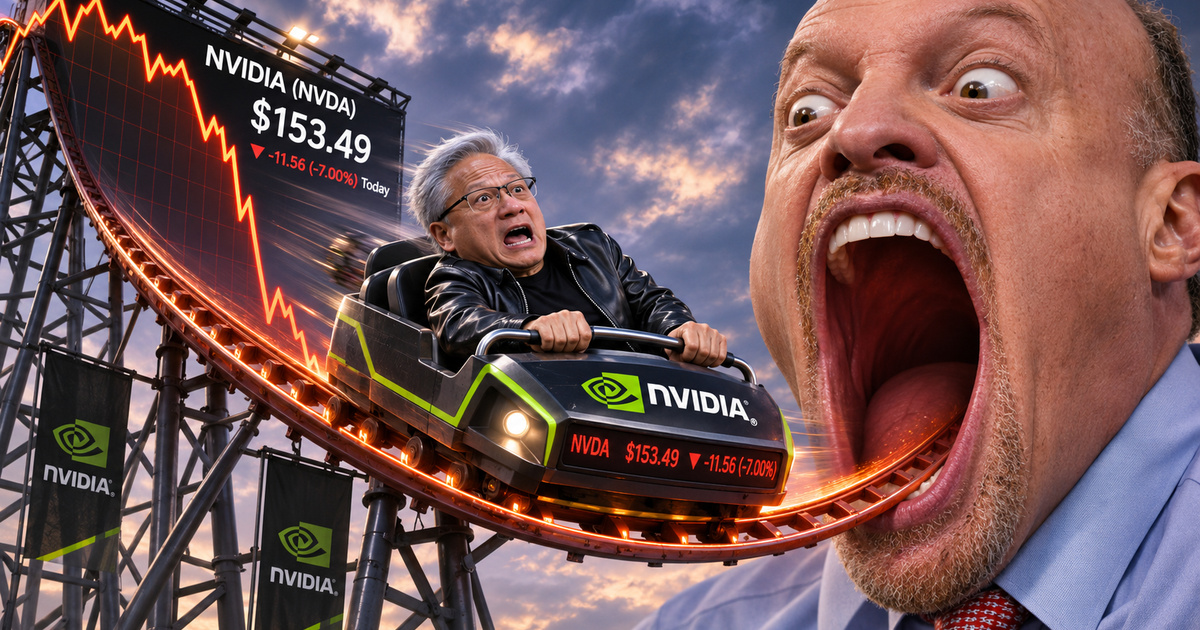
Cramer said $199. The next day Nvidia traded at $150.50. In one week he said investors would rather own Anthropic than wait on Nvidia, set the $199 target, then called Anthropic "the silent killer of this market". Anthropic closed below its $83 IPO price the same day. Nine years after that first tweet, the meme came back to the same stock.
| Date | What Cramer said | What happened next | Source |
|---|---|---|---|
| Nov 18 | On Mad Money: the market "has voted Nvidia off the portfolio island" and investors "would rather just get some Anthropic" | Anthropic priced its IPO at $83 the same day and started trading on Nasdaq (ANT) on Nov 19 | CNBC |
| Nov 23 | "This is a $199 stock... That's my target", after Nvidia closed at $165.05, up 31% on Jensen Huang's return as CEO | Nov 24: Nvidia low $150.50 (-8.8%), close $155.38 (-5.86%). Micron -11.0%, AMD -8.9% | CNBC, Gotrade |
| Nov 24 | At the CNBC Investing Club meeting: "the time is now" to put his trust's sidelined cash to work | The same session the chip stocks above sold off | CNBC Investing Club |
| Nov 24 | On X: "Anthropic is the silent killer of this market" | Anthropic closed at $81.91, down 6.5%, its first close below the $83 IPO price, 5 days after its debut | Benzinga, CNBC |
One fact needs more precision than my post gave it. Nvidia's 8% drop was intraday on November 24, and the stock closed down 5.86%. At the intraday low Nvidia was down $14.55 a share. Using the share count implied by Benzinga's midday figure, that is about $330 billion. So my $340 billion was a little high.
Another fact checks out to the dollar. Dario Amodei sold 3,378,378 shares at $83 to the IPO underwriters on November 20, about $280.4 million, per a Form 4 reported by Benzinga. Daniela Amodei sold the same amount. He kept a stake Benzinga values at $20.9 billion. For the full IPO numbers, see our page on Anthropic's market cap.
Did the Inverse Cramer ETF Work?
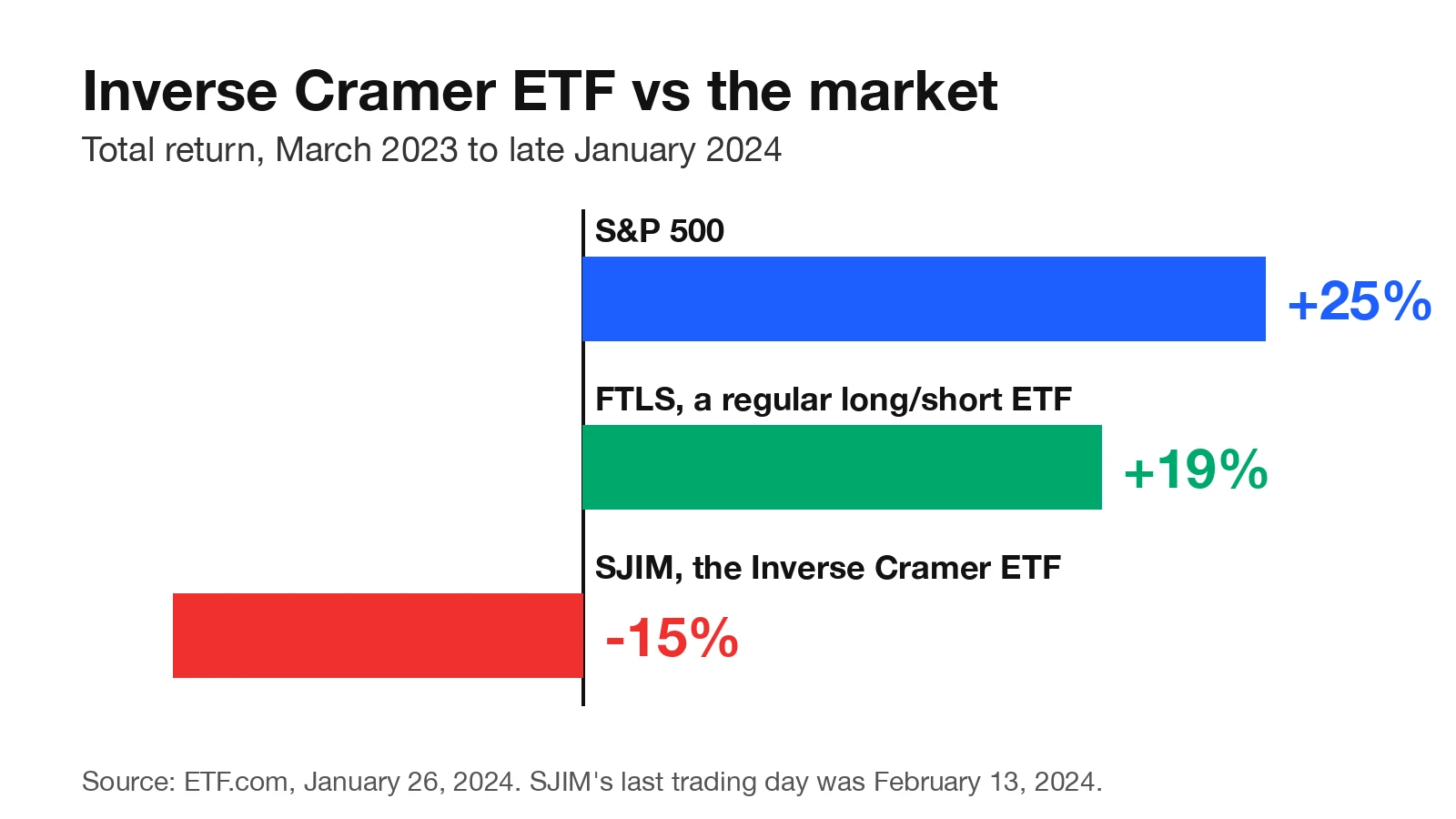
No. The Inverse Cramer Tracker ETF, ticker SJIM, launched on March 2, 2023. It shorted the stocks Cramer recommended on TV and on Twitter, usually for up to five trading days. By late January 2024 it was down about 15% on a total return basis, per Bloomberg. Over the same months the S&P 500 gained about 25%, per ETF.com. Even a regular long/short fund, First Trust's FTLS, gained 19%.
It also never found buyers: $2.4 million came in from launch to closure. The board voted to liquidate SJIM on January 25, 2024. The last trading day was February 13, 2024, and shareholders got their cash on February 23, per the fund's SEC filing. Old quote pages still show a price for a fund that no longer exists.
| Inverse Cramer (SJIM) | Long Cramer (LJIM) | |
|---|---|---|
| Strategy | Short the stocks Cramer recommends | Buy the stocks Cramer recommends |
| Launch | March 2, 2023 | March 2, 2023 |
| Closure decided | January 25, 2024 | August 17, 2023 |
| Last trading day | February 13, 2024 | September 11, 2023 |
| Total return when closure was announced | About -15% | About +2.2% |
| S&P 500 over the same period | About +25% (ETF.com) | Not reported in the same source |
| Long/short fund over the same period | FTLS about +19% (ETF.com) | Not reported |
| Money attracted | $2.4 million since launch | $1.3 million in assets |
| Net expense ratio | 1.20% after fee waiver | 1.20% (secondary sources) |
Both funds came from Tuttle Capital Management, and the prospectus says neither had any link to Cramer. Matt Tuttle gave the reason for the closure in January 2024: "the interest in a long/short portfolio never fully materialized." So the bet failed twice. It lost money, and almost nobody wanted to own it.
Does Inverse Cramer Actually Work According to the Studies?
Not reliably. The longest study finds Cramer's portfolio trailed the S&P 500 from 2001 to 2016, which sounds like good news for inverters. Most of that gap came from holding cash. His buy calls move prices for a short time, then the move fades. No peer-reviewed study finds his picks bad enough to beat the market by betting against them after costs.
| Study | Period | Finding |
|---|---|---|
| Hartley and Olson, Wharton working paper, 2016 | Aug 2001 to Mar 2016, Action Alerts PLUS portfolio | 64.45% cumulative vs 126.06% for the S&P 500 with dividends. Most of the gap comes from low market exposure (cash) |
| Engelberg, Sasseville and Williams, Management Science, 2012 | Mad Money buy calls | Large overnight price jumps after a buy call, reversed over the next months. Strongest in small, illiquid stocks |
| Bolster and Trahan, 2009 (via NPR) | Mid-2005 to 2007 | Just over 12% a year vs 7.4% for the S&P 500, in line with the market after risk adjustment |
| Quiver Quant Inverse Cramer backtest | Since January 2021 | 2.68% a year, -47.10% maximum drawdown. Shorts his 10 most-mentioned stocks, hedged with the market |
| University of Zurich Finance Club (student blog) | Inverted sentiment of Cramer's tweets | Higher return and Sharpe than the S&P 500 with much deeper drawdowns. Alpha about 0.05%, beta near 1: the return came from the market |
Read them together and the problem is clear. To profit from inverting a stock picker, his picks must lag the market by more than your costs. Shorting has costs: borrow fees, a 1.20% fund fee, and losses with no ceiling when a stock rallies. Cramer's picks, adjusted for risk, sit close to the market.
One effect shows up again and again: the "Cramer bounce". A stock jumps the morning after a buy call, then drifts back over the following months. That drift is the only real edge for an inverse trader. It is strongest in small stocks that are expensive to borrow. SJIM held its shorts for about five trading days, so it missed most of it.
The one-line summary: the only regulated fund that bet against Cramer lost to the S&P 500. SJIM fell about 15% while the index rose about 25%.
Does the Autopilot Inverse Cramer Portfolio Beat the Market?
According to Autopilot, yes. Autopilot lets users copy public portfolios. It says its Inverse Cramer portfolio is up 158% since its 2023 launch, against 68% for SPY. $56 million follows it. Co-founder Chris Josephs gave those numbers to Benzinga in March 2026.
These are the company's own figures. I found no independent audit, and copies in a real brokerage account can differ from the published line. So the only Inverse Cramer track record with big gains is self-reported by the app that sells it. The only one run as a real regulated fund lost about 15%.
Can You Still Inverse Cramer Today?
Not through an ETF: I found none since SJIM closed in February 2024. What is left is a copy portfolio in an app like Autopilot, with self-reported results, or doing it yourself. If you try it alone, write the rules first: which calls count, entry at the next open, a fixed holding period, every cost counted. Remember that a short can lose more than you put in.
For most people an S&P 500 index fund beats both following and fading him. That is what the numbers above say, from 2001 to today.
Why Does Inverse Cramer Only Work as a Joke?
My theory from the post: the opposite of Cramer only works when you don't bet money on it. Memes remember the misses. Bear Stearns in 2008, Lehman weeks before it failed, and Nvidia in November 2026 get shared everywhere. The calls that worked get forgotten, so the inverse looks smarter than it is.
Cramer says buy. Do you buy or sell? My answer: I don't buy or sell because of him. I decide on the business. In Anthropic's case its own S-1 tells you more than any TV call. We went through it line by line here: Is Anthropic profitable?
The other half of this story is the CEO drama that sent Nvidia up 31% the day before Cramer's target. See who is the CEO of Nvidia.
What Can a B2B Team Learn From Inverse Cramer?
The same trap exists in sales. Teams copy a loud voice, or do the opposite of one, instead of testing their own numbers. A famous founder's cold email template is outbound's Cramer call. Everyone copies it. Almost nobody measures it. We read reply rates on our own campaigns first, with the benchmarks in our cold email response rate guide.
That is how we run go-to-market consulting at Growth Cab: data from your own market first, opinions last.
Frequently asked questions
What is the Inverse Cramer ETF?
The Inverse Cramer Tracker ETF, ticker SJIM, was a fund from Tuttle Capital Management that shorted the stocks Jim Cramer recommended. It launched on March 2, 2023, charged 1.20% a year after a fee waiver and lost about 15% by January 2024, while the S&P 500 gained about 25%. Its board then decided to liquidate it.
Is the Inverse Cramer ETF still trading?
No. SJIM's board approved the liquidation on January 25, 2024. The last trading day was February 13, 2024, and shareholders received cash on February 23, 2024, per the SEC filing. The twin fund that copied Cramer's picks, LJIM, had already closed in September 2023. Old quote pages still show prices.
What is the Cramer bounce?
The Cramer bounce is the price jump a stock gets right after Jim Cramer recommends it on Mad Money. A 2012 study in Management Science found large overnight jumps after his buy calls, strongest in small illiquid stocks, which then reversed over the following months. Those stocks are often expensive to short.
Did Jim Cramer recommend Anthropic stock?
Not in the calls I could find. On November 18, 2026 he said on Mad Money that investors would rather just get some Anthropic than wait on Nvidia. On November 24 he posted that Anthropic is "the silent killer of this market", the day the stock closed at $81.91, below its $83 IPO price.
Does inverse Cramer beat the market?
Not with real money. The SJIM fund lost about 15% while the S&P 500 gained about 25%, and Quiver Quant's hedged backtest shows 2.68% a year since 2021. Autopilot reports +158% for its Inverse Cramer portfolio since 2023, but those numbers come from Autopilot itself and have no independent audit.
Sources
CNBC, Cramer on Nvidia and the Anthropic IPO, November 18, 2026.
CNBC, Jim Cramer on Nvidia after Jensen Huang's return, November 23, 2026.
CNBC Investing Club, Jim Cramer says the time is now to put sidelined cash to work, November 24, 2026.
CNBC, Anthropic closes below $83 IPO price, November 24, 2026.
Benzinga, Jim Cramer blames Anthropic for killing this market, November 24, 2026.
Benzinga, Anthropic below IPO price, Nvidia rally reversal, November 24, 2026.
Benzinga, Amodei siblings each sell $280 million in Anthropic shares, November 24, 2026.
Gotrade, Nvidia stock news, November 25, 2026 (closing prices of Nvidia, Micron and AMD).
SEC, Inverse Cramer Tracker ETF summary prospectus, February 21, 2023.
SEC, SJIM liquidation supplement, January 25, 2024.
SEC, LJIM liquidation supplement, August 21, 2023.
Bloomberg via WealthManagement, Jim Cramer ETFs are history, January 29, 2024.
ETF.com, Inverse Jim Cramer ETF shuttered, January 26, 2024.
Fortune, Jim Cramer ETF tracker shutting down, August 24, 2023.
Hartley and Olson, Jim Cramer's Mad Money Charitable Trust Performance and Factor Attribution, Wharton working paper, May 2016.
Engelberg, Sasseville and Williams, Market Madness? The Case of Mad Money, Management Science, 2012.
NPR, Study says Jim Cramer beat the market, sort of, May 22, 2009.
Quiver Quant, Inverse Cramer strategy, read November 25, 2026.
University of Zurich Finance Club, Can inverse Jim Cramer generate alpha?, read November 25, 2026.
Benzinga via Finviz, Inverse Cramer beats S&P 500, says Autopilot co-founder, March 9, 2026.
Know Your Meme, Inverse Cramer, updated April 28, 2025.


