






The average cold email response rate in 2026 is 3.43%, according to Instantly's benchmark of billions of cold email interactions in 2025. The top quarter of campaigns gets 5.5% and the top 10% more than 10.7%. Across 7,561 people we cold emailed in 17 campaigns, 4.3% replied and 2.3% said yes.
The formula is simple: response rate = replies ÷ emails (or people) contacted × 100. The 7,561 in today's post are the people we emailed, each in a sequence of several emails. This page puts our numbers next to the public benchmarks, explains why those benchmarks disagree, and shows how many people sit behind each rate.
- Average reply rate in the 2026 studies: 3.43% (Instantly), 4.5% (Saleshandy), 0.45% (Belkins). They count different things.
- Good: above 5.5%, the top quarter on Instantly. Elite: above 10%.
- Our 7,561 contacts: 326 human replies (4.3%), 174 yes (2.3%), 131 calls (1.7%).
- The audience mattered a lot: CEOs and founders said yes 3.8% of the time (3,236 contacts), sales managers 1.5% (1,510).
- Short and generous won: 18 words got 2.4% yes, a founders community invite 5.3%, our best ever.
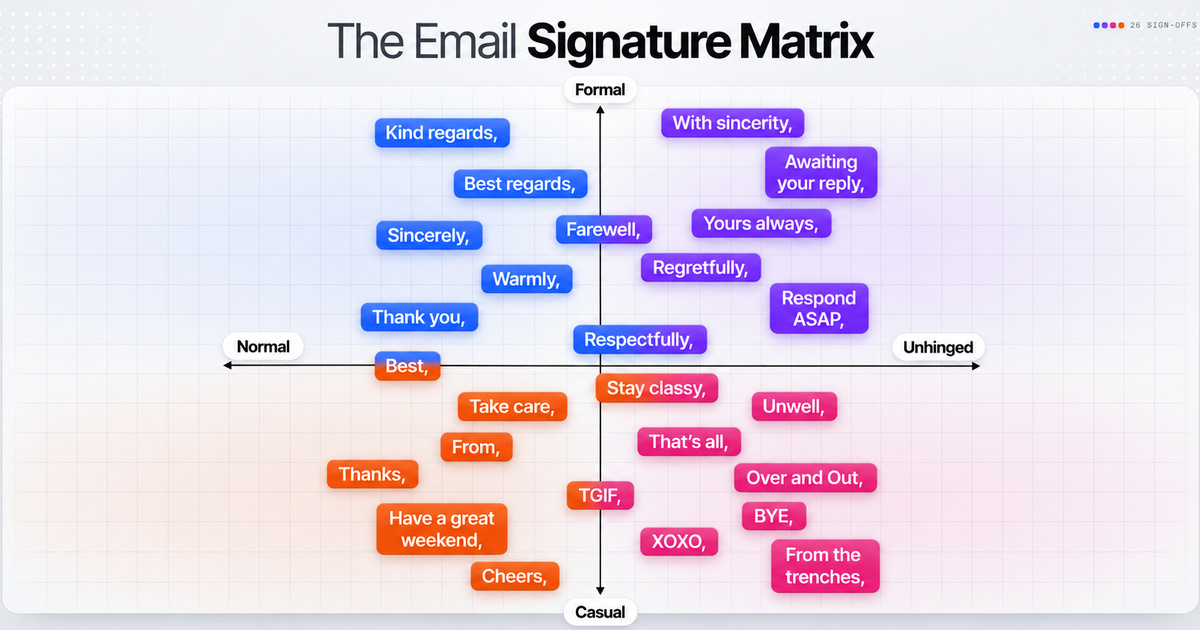
The image at the top is the map from today's post: 26 cold email sign-offs placed from formal to casual and from normal to unhinged. It closes the article too, because the sign-off is the one line we never measured.
 in
“We sent 7,561 cold emails and counted every reply. Here are the 7 rules the numbers forced on us:”
What Is the Average Cold Email Response Rate in 2026?
There is no single average. The three biggest public studies give 3.43%, 4.5% and 0.45%. All three are honest. They just divide different things.
Instantly counts all replies, follow-ups included, per email sent. Saleshandy counts total replies per email delivered. Belkins counts unique replies per email sent and removes auto-replies and bounces. We count per person contacted, with out-of-office replies removed. Counting per person always gives a bigger number than counting per email, because one person gets several emails.
| Source | Data and formula | Average reply rate | Positive or top tier |
|---|---|---|---|
| Instantly, Cold Email Benchmark Report 2026 | Billions of cold email interactions, Jan 1 to Dec 18, 2025; all replies per email sent | 3.43% | Top quarter 5.5%, top 10% above 10.7% |
| Saleshandy, Cold Email Statistics | 30.3 million cold emails, July to October 2026; total replies per email delivered | 4.5% | Positive replies 3% to 5% |
| Belkins, B2B Cold Email Response Rates | 7.5 million B2B emails, 2025; unique replies per email sent | 0.45% | Founders and owners 0.57% |
| Growth Cab, 17 Instantly campaigns | 7,561 people contacted; human replies per person, out-of-office removed | 4.3% (326 replies) | Yes 2.3% (174), calls 1.7% (131) |
My verdict: I ignore any benchmark that does not publish its formula. Before you compare your number to anyone's, write yours down: all replies or unique ones, per email or per person, sent or delivered. We track the yes rate most, because a reply that says "remove me" is a reply, and it books nothing.
If your rate is near zero, check inboxing first. My cold email deliverability guide covers the setup that decides whether anyone sees the email at all.
What Is a Good Cold Email Response Rate?
A good cold email response rate is above 5.5%, which puts you in Instantly's top quarter. Above 10% is elite. For positive replies, 3% or more is solid: Saleshandy's average positive rate sits between 3% and 5%. Our overall 2.3% yes rate per person, a more generous formula, still sits below that line, and our best campaign, at 5.3%, sits well above it.
| Your rate | What it usually means | First thing to change |
|---|---|---|
| Under 1% replies | Emails are not landing, or the list is off | Deliverability and list |
| 1% to 3.4% replies | Below the market average | Audience: go smaller, write to owners |
| 3.4% to 5.5% replies | Average | Length and one true fact about the person |
| Above 5.5% replies | Top quarter | Keep it, test an offer |
| 3% or more yes | Strong positive rate | Speed of reply to book the call |
My verdict: a rate under 1% positive usually means the list or the offer is wrong. Better copy will not fix it. Look at who you wrote to before you touch a single word.
Does Role or Company Size Change Cold Email Response Rate?
Yes, and a lot. CEOs, founders and owners said yes 3.8% of the time across 3,236 contacts. Sales managers said yes 1.5% across 1,510, and marketing 2.1% across 861. Companies with 1 to 10 people said yes 3.5% across 824 contacts. Companies with 51 to 200 people said yes 1.2% across 603.
| Our audience | Our yes rate | People contacted | Closest Belkins segment |
|---|---|---|---|
| CEO, founder or owner | 3.8% | 3,236 | Founders and owners, 0.57% |
| Marketing | 2.1% | 861 | Not reported |
| Sales manager | 1.5% | 1,510 | VPs, 0.32% |
| Company of 1 to 10 people (the post says under 10) | 3.5% | 824 | 0 to 10 employees, 0.72% |
| Company of 11 to 50 people | 2.3% | 1,941 | 11 to 50 employees, 0.49% |
| Company of 51 to 200 people | 1.2% | 603 | No 51 to 200 row; 10,000+ at 0.22% |
Belkins found the same direction on 7.5 million emails. Founders and owners replied at 0.57%, C-level at 0.42% and VPs at 0.32%. Companies with 0 to 10 employees replied at 0.72%, companies with 11 to 50 at 0.49%, and companies with 10,000 or more at 0.22%.
My verdict: before you write a single line, filter the list to people who can buy alone. The owner of a small company reads their own inbox and can say yes without asking anyone. It is also the cheapest change you can make, because it happens in the spreadsheet.
How Long Should a Cold Email Be?
Short. Our campaign of about 18 words, one personal sentence and one easy question, got a 2.4% yes rate across 3,369 contacts. A 109-word campaign got 1.1%. A 221-word campaign got zero yes out of 162 people. Instantly's report points the same way: it recommends fewer than 80 words for the first email.
Eighteen words feels too short when you write it. It is enough for one true fact about them and one easy question. Everything else, the case study, the logo list, the second offer, belongs in the reply after they say yes.
Need help cutting the long version? My sample cold emails to a potential client show six short templates and the test we run before every send.
How Many Cold Emails Until You Get a Reply?
At the 3.43% average, you get about one reply every 29 emails sent. In the top quarter, at 5.5%, it is about one every 18. Per person, our numbers give one human reply every 23 people contacted, one yes every 43 and one booked call every 58.
The same math sizes a campaign before it starts. Want 10 calls a month at our 1.7% call rate? You need about 580 people on the list. If the list is too small for that, fix the audience or the offer first. Volume will not save a weak rate.
Do Open Rates Still Matter for Cold Email?
Only as a warning light. Apple Mail loads tracking pixels on its own servers, so Smartreach estimates that close to half of tracked opens are machines. A high open rate can hide a campaign nobody reads. A reply is something a person chose to do, so we judge every campaign on replies, yes and booked calls.
How to Increase Your Cold Email Response Rate: The 7 Rules
These are the 7 rules from today's post, in the same order. The numbers behind rules 1 to 5 are in the sections above, with the number of people behind each one.
- Write to the owner: CEOs, founders and owners of the company.
- Go small: companies under 10 people say yes most.
- Keep it to 18 words: one true fact about them and one easy question.
- Offer something: an invite to a founders community was our best email ever.
- Use one true fact about them: never the same text for everyone.
- Reply within minutes and propose a time: replies left waiting were lost.
- Let every campaign read the others: what works on email gets rewritten for LinkedIn.
Rule 4 is the one I would copy first. An invite to a community of tech founders got 5.3% yes and 5.0% booked calls across 1,059 people. The reader does not have to buy anything to say yes, so the yes is easy.
Rule 5 is the cheapest fix after rule 1. On the same client's list, emails with one specific fact about the company got 2.4% yes across 208 people. The same text for everyone got 0.7% across 874. The personal sample is small: its cautious lower bound is 1.2%, still above 0.7%. I read it as a direction, and we keep testing it.
Writing one true fact for hundreds of people is the hard part. My guide to cold email personalization at scale shows how we research each contact without writing every line by hand.
Rule 6 is where we lost meetings we had already earned. The replies we left waiting were lost. So the rule is to answer within minutes and put a time in the first reply.
Follow-ups matter too. Instantly says 42% of all replies come after the first email. Saleshandy says 57% of positive replies do. On Instantly's numbers, stopping after one email throws away 42% of the replies a list can give you.
When Should You Send Cold Emails for More Replies?
Mid-week mornings. Belkins found the highest reply rate for emails sent between 8 AM and 12 PM, at 0.54%, and the lowest late in the evening, at 0.40%. Wednesday and Thursday got 0.48% each. Instantly names Wednesday as its peak engagement day.
My verdict: timing is a small lever. The gap between morning and evening in Belkins' data is about a third. The gap between generic and personal emails in our yes rates is more than three times, on a small sample. Fix who and what first, then pick the hour.
Can a Campaign Improve Its Own Response Rate?
I approve the first 5 sequences of every new campaign. Then the campaign improves itself and refills its own list. Rule 7 belongs to the same loop: campaigns read each other, and what works on email gets rewritten for LinkedIn.
This is the reason our numbers exist. Every reply is counted and classified, so every rule above has a number and a sample size. If you run outbound without counting yes replies by audience, length and offer, you are guessing which part of the email works.
Does the Sign-Off Change Your Reply Rate?
We do not know, and I will not pretend we do. The sign-off is the only line we never measured. On the map at the top, "Best," sits at the normal end and "From the trenches," at the unhinged one. Pick yours, then measure it.
Choosing the tool that sends and counts all this? My Smartlead pricing breakdown shows what each plan includes and what you really pay.
Want campaigns like these built and run for you, with every reply counted? Our B2B lead generation service writes, sends and books the calls.
Frequently asked questions
What is the average cold email response rate?
Instantly's 2026 benchmark, built on billions of cold email interactions in 2025, puts the average cold email reply rate at 3.43%. Saleshandy measured 4.5% of delivered emails in 2026, and Belkins 0.45% per email sent. The gap comes from the formula: all replies or unique ones, per email or per person, and whose campaigns are in the sample.
What is a good cold email reply rate?
A reply rate above 5.5% puts a campaign in the top quarter on Instantly, and above 10% is elite. For positive replies, 3% or more is solid. In our 7,561 contacts, the segments at 3.5% yes or more were CEOs and founders, companies under 10 people and the founders community invite.
How many words should a cold email have?
Fewer than 80 words for the first email, as Instantly's report recommends, and often far fewer. In our campaigns an 18-word email got a 2.4% yes rate across 3,369 contacts, 109 words 1.1% and 221 words zero. Use the space for one true fact about them and one easy question.
Do follow-ups increase cold email response rate?
Yes. Instantly reports that 42% of all replies come from follow-ups, with the first email producing the other 58%. Saleshandy found that 57% of positive replies came from follow-ups. Instantly puts the useful sequence length at 4 to 7 emails.
Sources
Federico Donatone, We sent 7,561 cold emails and counted every reply, LinkedIn post, October 28, 2026.
Instantly, Cold Email Benchmark Report 2026, updated January 12, 2026, read October 28, 2026.
Saleshandy, Cold Email Statistics, updated October 7, 2026, read October 28, 2026.
Belkins, B2B Cold Email Response Rates (2026 Study), updated June 26, 2026, read October 28, 2026.
SmartReach, Cold Email Statistics 2026, updated September 9, 2026, read October 28, 2026.
Growth Cab campaign data: 17 Instantly campaigns, 7,561 people contacted, 326 human replies, 174 positive (Interested, Meeting or Won in Instantly), 131 calls, out-of-office replies excluded. About 3,274 of the contacts were tech and IT companies, the bulk of our history. Segment figures from our campaign log, updated October 23, 2026.


