
Here is a sample cold email to a potential client that I would send: "Hi Dana, saw Northwind hired its first two SDRs last week. Most teams at that stage lose the first month to list building. We set up the list and sending side so reps start on day one. Worth a 30-minute look at how that would work for your two hires?" It names one fact, one likely problem and one specific ask.
That shape is the whole method. Our outbound motion booked 689 meetings between January and August 27, 2026, and every email passed one test first: swap the name and company with another prospect. If it still makes sense, it does not get sent. Below are six samples you can adapt, what each line does, and the checks that keep them out of spam.
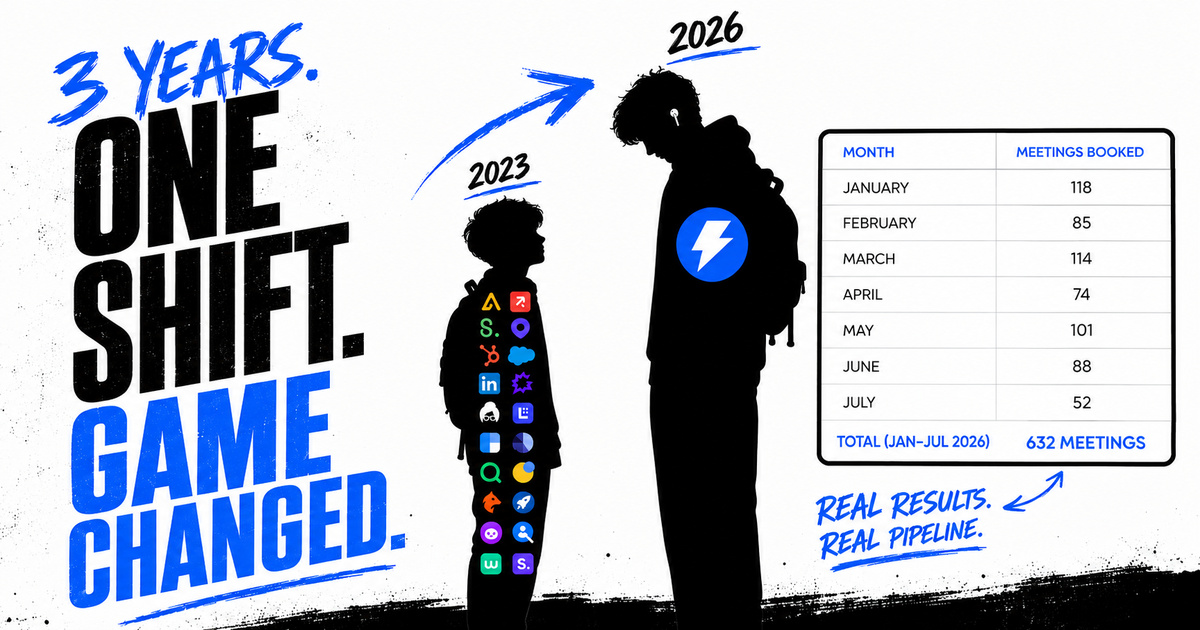
The visual of that post shows the month by month count: 118 meetings in January, 114 in March, 52 in July, 632 by the end of July. Some months were weaker. The rule never changed. Every email that went out had passed the swap test first.
- A good cold email to a potential client has four parts: a fact about them, the problem that fact suggests, what you do about it, and one small ask.
- Keep the first email short. Instantly's 2026 benchmark found elite senders average fewer than 80 words in the first touch.
- The first email carries the sequence. In the same report, 58% of all replies came from step one.
- Run the swap test on every email. If another company's name fits, rewrite it.
- In the US, B2B cold email is legal under CAN-SPAM if headers and subject lines are honest, the message is identified as an ad, it carries a postal address and opt-outs are honored within 10 business days.
 in
in
“Our outbound motion booked 689 meetings so far this year. The unfair advantage is HOW we booked them: Every email is written for exactly one person.”
What Is a Good Sample Cold Email to a Potential Client?
A good sample cold email to a potential client is one that only works for that client. It opens with something true and recent about them, connects it to a problem you solve, and asks for one small next step. A template with a first name on top fails that bar, however polished it reads.
The sample above works because every line depends on the prospect. The hiring news is theirs. The problem follows from the news. The offer answers the problem. The ask names their two hires. Swap in another company and three of the four lines break. That is exactly what you want.
| Part | Sample text | Why it is there |
|---|---|---|
| Subject | Your two new SDRs | Specific to them, 3 words, no hype |
| Fact | Saw Northwind hired its first two SDRs last week. | Proves the email was written for this company |
| Problem | Most teams at that stage lose the first month to list building. | A likely cost of that fact, stated as a pattern |
| Offer | We set up the list and sending side so reps start on day one. | What you do, in one sentence, tied to the problem |
| Ask | Worth a 30-minute look at how that would work for your two hires? | One small step, with a reason specific to them |
Northwind and Dana are placeholders. This sample and the five below are illustrations I wrote for this guide. None of them is a copy of a live email with a measured reply rate. Treat them as structures, and fill every bracket with facts you have checked.
How Do You Write a Cold Email to a Potential Client?
Write it in five steps: research one fact, name the problem it suggests, state your offer in a sentence, add proof they can check, and ask for one small thing. The research takes longer than the writing. That is the right ratio.
- Find one fact from the last 30 days: a hire, a funding round, a launch, a new market, a job post, a public statement.
- Name the problem that fact usually creates. Say it as a pattern you see. Do not diagnose their business from the outside.
- Say what you do about that problem in one sentence. Cut every feature that does not touch it.
- Add one piece of proof they can verify: a named client who agreed to be named, a public case study, a number with a date.
- Ask for one thing, and say why it is worth their time. A reply, a yes or no, or a short call with a stated purpose.
This is how our own emails get built. Before anything goes out, an AI research agent inside Instantly finds company and prospect news from the last few days, reads the website to estimate the likely return and time to value, and ties our offer to what it found. The agent does the reading nobody has time for. The swap test decides what goes out.
If AI drafts your emails, my guide to the AI email writer review shows how to check one draft line by line before it goes out.
What Are 6 Sample Cold Emails You Can Copy?
Each sample fits one situation. Pick the one closest to your reason for writing, then replace every bracket with a fact you checked. If you cannot fill a bracket with something true, that prospect is not ready for this email. Every name and company in the filled examples is invented to show the shape. Numbers stay in brackets until you can prove them.
| Part | Sample text |
|---|---|
| Subject | [Company]'s [event] |
| Template | Hi [Name], congrats on [event, with date]. Teams that [event] usually hit [specific problem] within [time frame]. We help [type of company] fix that by [one-sentence offer]. For [similar company], that meant [verified result]. Worth a short call to see if the same applies to [Company]? |
| Filled example (invented) | Hi Marco, congrats on the Series A you announced on September 9. Teams that raise usually hit a hiring gap in sales within a quarter. We help B2B software companies fill the pipeline while reps ramp. For Acme, that meant [verified number] held meetings in the first 60 days. Worth a short call to see if the same applies to Brightpath? |
| Part | Sample text |
|---|---|
| Subject | Question about [page or feature] |
| Template | Hi [Name], I was on [exact page] and noticed [specific, checkable issue]. On pages like this, that usually costs [what it costs, stated as a pattern]. I fix this for [type of client]. Happy to send a 3-point teardown of that page for free. Want it? |
| Filled example (invented) | Hi Sara, I was on your pricing page and noticed the demo button sits below three screens of text on mobile. On pages like this, that usually costs a share of demo requests from phone visitors. I fix this for SaaS teams. Happy to send a 3-point teardown of that page for free. Want it? |
| Part | Sample text |
|---|---|
| Subject | [Peer company] and [their problem] |
| Template | Hi [Name], [peer company] had the same [problem] you likely have with [their situation]. We [what you did] and they [verified result, with time frame]. They are happy to talk about it. Is [problem] on your list this quarter, or is it handled? |
| Filled example (invented) | Hi Tom, Ledgerly had the same no-show problem you likely have with demos booked two weeks out. We moved reminders to SMS plus a one-line agenda and their show rate rose by [verified %] in six weeks. They are happy to talk about it. Is demo no-show on your list this quarter, or is it handled? |
Sample 3 only works with a client who agreed to be named and a result you can back up. If you do not have both, use sample 1 or 2. A vague "we helped companies like yours" line fails the swap test on its own.
| Part | Sample text |
|---|---|
| Subject | [Referrer's name] suggested I write |
| Template | Hi [Name], [referrer] mentioned you are working on [project]. I helped [referrer's company] with [related work], which is why they thought of me. If [project] needs [what you do], I can share how we approached it. Open to a quick call next week? |
| Filled example (invented) | Hi Priya, Luca from Northfield mentioned you are rebuilding your outbound team. I helped Northfield with their list and sending setup, which is why he thought of me. If the rebuild needs a data layer, I can share how we approached it. Open to a quick call next week? |
| Part | Sample text |
|---|---|
| Subject | Who owns [area] at [Company]? |
| Template | Hi [Name], I help [type of company] with [problem]. Given [fact about their company], I suspect it is on someone's plate at [Company]. Is that you, or could you point me to the right person? Either answer helps. |
| Filled example (invented) | Hi James, I help logistics software companies with outbound pipeline. Given you just opened a Chicago office, I suspect new-market pipeline is on someone's plate at Freightline. Is that you, or could you point me to the right person? Either answer helps. |
| Part | Sample text |
|---|---|
| Subject | Re: [original subject] |
| Template | Hi [Name], one thing I left out: [new, useful fact, e.g. a public benchmark, a short teardown, a relevant change in their market]. If [problem] is not a priority right now, tell me and I will stop here. |
| Filled example (invented) | Hi Marco, one thing I left out: [a public stat you can source] on how fast companies in your category hire their first SDR after a round. If sales hiring is not a priority right now, tell me and I will stop here. |
The follow-up adds something new each time. A line like "just bumping this" asks for attention and gives nothing back. A new fact or a free piece of work earns the second read.
Freelancers and small agencies can use the same six shapes. Sample 2 fits designers, developers and SEO consultants best, because the free teardown is proof of skill. Sample 4 fits anyone with past clients. Replace the company result with a portfolio piece the prospect can open, and keep the ask small: a yes to the teardown beats a request for a call.
How Long Should a Cold Email to a Potential Client Be?
Keep the first email under about 80 words. Instantly's Cold Email Benchmark Report 2026, built on campaigns run on its platform in 2025, found that elite senders average fewer than 80 words in the first touch. All six samples above sit between roughly 40 and 60 words once the brackets are filled.
Short is a side effect of specific. When you know why you are writing to this person, you need one fact and one ask. Long cold emails usually come from not knowing, so the sender lists every service and hopes one lands. The benchmark also put the average reply rate at 3.43% and the top 10% of senders at 10.7% or more.
When Should You Send a Cold Email to a Potential Client?
Launch on Monday, send follow-ups midweek, and expect Friday to bring the most out-of-office replies. Instantly's 2026 report says Wednesday consistently delivers the highest engagement, and that timing matters almost as much as copy. Relevance still comes first: a Wednesday send cannot rescue a generic email.
A new sending domain needs warmup before any of this matters. Instantly advises starting at 5 to 10 emails a day and ramping over 4 to 6 weeks, with bounces under 2%. Google asks senders to keep spam rates below 0.1% and never reach 0.3%, so one careless batch can undo weeks of warmup.
What Subject Line Should You Use?
Use a subject line of two to five words that names something about them. Their company, their event, their page, or the person who referred you. It should read like an internal email from a colleague. Avoid claims, urgency, emojis and fake reply prefixes on a first email.
| Subject line | Specific to them? | Honest about the content? | Verdict |
|---|---|---|---|
| Your two new SDRs | Yes | Yes | Send |
| Question about your pricing page | Yes | Yes | Send |
| Quick question | No | Vague | Weak |
| Re: our conversation (with no conversation) | No | No | Never: deceptive |
| Boost your revenue 300%!! | No | No | Never: spam signals |
A fake "Re:" on a first email is more than bad manners. The FTC's CAN-SPAM guide lists deceptive subject lines among the rules a commercial email must not break, and it makes no exception for business-to-business email.
Subject lines only matter if the email reaches the inbox. My cold email deliverability checklist covers the Gmail, Yahoo and Outlook rules to pass first.
How Do You Follow Up on a Cold Email to a Potential Client?
Follow up three to six times over two to three weeks, and add something new each time. Instantly's 2026 report puts the sweet spot at 4 to 7 touchpoints in a sequence. It also found that follow-ups produced 42% of all replies, so stopping after one email leaves a large share on the table.
My rule: every follow-up must pass the same swap test as the first email. The last one gives an easy exit. "If this is not a priority, tell me and I will stop" gets honest answers, and a clear no saves both of us the next three emails.
Is It Legal to Cold Email Potential Clients?
Yes, in the United States cold email to business contacts is legal if you follow the CAN-SPAM Act. The FTC says the law makes no exception for business-to-business email. Each email that breaks it can cost up to $53,088 in penalties. Rules differ in the EU, the UK and Canada, so check local law before you email there.
- No false or misleading header information: the From name and address must be real.
- No deceptive subject lines.
- Identify the message clearly as an ad, and include a valid physical postal address.
- Tell people how to opt out, and honor opt-outs within 10 business days.
- You stay responsible for emails an agency or tool sends on your behalf.
This list summarizes the FTC's compliance guide. It is not legal advice. For EU prospects, GDPR and national rules on electronic marketing apply and can be stricter.
How Do You Check a Sample Before You Send It?
The swap test is the one check I would never skip. Replace the name and company with another prospect's. If the email still makes sense, it is a template, and it does not get sent. It takes seconds and catches generic emails before they cost you a domain.
- Swap the name and company. Does any line break? At least two should.
- Is the opening fact true, recent and checkable? Open the source again.
- Is the problem stated as a pattern, without claiming to know their numbers?
- Is there exactly one ask, and does it say why the time is worth it for them?
- Is any result in the email real, dated and approved by the client it names?
- Would you be comfortable if they forwarded this email to their CEO?
The test has limits. A made-up detail can make an email specific and wrong at the same time. An invented acquisition passes the swap test and ruins your credibility. So the fact check in step two matters as much as the swap.
Writing hundreds of these a week? My guide to cold email personalization at scale shows how to keep the same review standard across a whole batch.
What Mistakes Kill a Cold Email to a Potential Client?
Most cold emails fail for the same few reasons. None of them is about wording. They come from writing before researching.
- Opening with yourself: your company, your founding story, your awards.
- A compliment that fits anyone, like "love what you are building".
- Three asks in one email: a call, a demo and a download.
- "Do you have 30 minutes?" with no reason why those minutes are worth it for them.
- Results with no date, no client and no way to check them.
- Sending to addresses nobody verified, which burns the domain before the copy gets a chance.
On that last point, my guide to catch-all email explains which addresses to keep out of the first send.
If you would rather not build this machine yourself, this is the work we run for B2B companies selling contracts of $50,000 or more. See how our B2B lead generation service works.
Comparing providers first? My cold email agency guide lists what to check before you hire anyone.
Frequently asked questions
How do you start a cold email to a potential client?
Start with one true, recent fact about them: a hire, a launch, a funding round or something you noticed on their site. Skip the introduction of yourself. The first line should prove the email was written for this person. Your name and company are already in the From field and the signature.
What should I say in a cold email to a potential client?
Say four things in under about 80 words: a fact about them, the problem that fact suggests, what you do about that problem in one sentence, and one small ask with a reason. Add one piece of proof they can check if you have it. Leave everything else for the call.
How do you end a cold email to a potential client?
End with one clear question they can answer in a line: a yes or no, a pointer to the right person, or a short call with a stated purpose. Then your name, role, company and a real postal address. In the US, CAN-SPAM also requires a clear way to opt out.
What is a good response rate for a cold email?
Instantly's Cold Email Benchmark Report 2026 puts the average reply rate at 3.43%, the top quartile at 5.5% or more and the top 10% at 10.7% or more. Those are platform averages from 2025 campaigns. Your own rate depends far more on list quality and relevance than on wording.
Can I use a template for cold emails to potential clients?
Use a template for the order of the lines. The six samples in this guide give you that order. Every bracket still needs a fact you checked about that specific prospect. If the email survives a name swap unchanged, the template is doing too much of the work.
Sources
Instantly, Cold Email Benchmark Report 2026: average reply rate 3.43%, top quartile 5.5%+, top 10% at 10.7%+, elite first touches under 80 words, 58% of replies from step one, 4 to 7 touchpoints, Wednesday highest engagement, warmup at 5 to 10 emails a day over 4 to 6 weeks, bounces below 2%; data January 1 to December 18, 2025, updated January 12, 2026, read September 29, 2026.
Federal Trade Commission, CAN-SPAM Act: A Compliance Guide for Business: no exception for business-to-business email, opt-outs within 10 business days, penalties up to $53,088 per email, read September 29, 2026.
Google, Email sender guidelines: authentication requirements and spam rates below 0.1% and never 0.3% for sending to Gmail accounts, read September 29, 2026.
Federico Donatone, LinkedIn post of August 27, 2026: 689 meetings booked, the swap test and the research steps before each email, published in partnership with Instantly.
Disclosure: Growth Cab sells outbound services, including cold email, so read this guide knowing we are one of the options. The source post was an Instantly partnership, and Instantly also published the benchmark quoted here, which reflects campaigns sent on its own platform. The six sample emails are illustrations written for this guide.


