








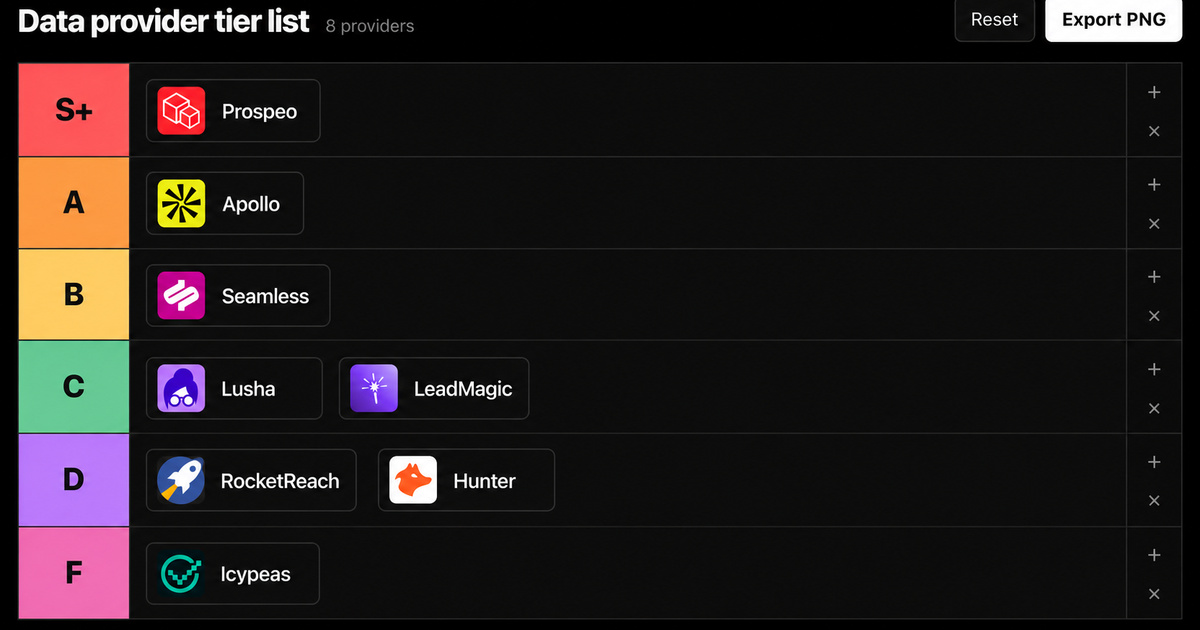
I tested eight lead generation database companies head to head in 2026: Prospeo, Apollo, Seamless.AI, RocketReach, Lusha, LeadMagic, Hunter and Icypeas. Same 600 leads, same day. Prospeo won the weighted score. Apollo found the most verified emails. Your own list decides the rest.
Most provider rankings you will find are written by one of the providers. Ours had a sponsor too: Prospeo paid for the benchmark, and I partner with the company. So every raw number is on this page. At Growth Cab we run outbound for B2B companies. A dead email costs us domain reputation before it costs us a credit.
You can disagree with my ranking and still use the data to run your own test. ZoomInfo, Cognism, UpLead, Clay and Sales Navigator were outside the test. I cover them further down.
- Prospeo: 394 verified emails, 1 dead email, mobile numbers for 35 of the 50 leads in the mobile sample (70%), $5 per 1,000 emails.
- Apollo: the most verified emails (408 of 600), with 24 dead addresses inside its valid label.
- A valid label is a vendor claim. Only an outside verifier turns it into data.
- Compare cost per usable record. Price per credit hides the bounces.
- Retest a small sample every quarter, because databases and prices change.
 in
in
“We tested 600 leads on 8 tools and verified every email ourselves.”
Which Lead Generation Database Companies Did We Test?
We tested eight providers: Apollo, Prospeo, Seamless.AI, RocketReach, Lusha, LeadMagic, Hunter and Icypeas. Each one received the same 600 leads. That kills the biggest source of noise. No vendor got the easy US software contacts while another got the hard small companies.
Every lookup ran on the same day. Contact data rots. People change jobs, companies change domains. A test from March and a test from August measure two different databases. Same-day runs give a clean snapshot. They still describe one sample on one date.
An email counted as verified only when the provider marked it valid and BounceBan confirmed it. Catch-all and guessed addresses did not count. A high finding rate means nothing if half the finds bounce.
Why did catch-all addresses count as misses? My guide to catch-all email explains what that verification result means and what to do with those addresses.
| Provider | Verified emails (of 600) | Valid label that passed | Dead emails marked valid |
|---|---|---|---|
| Prospeo | 394 (65.7%) | 99.7% (394 of 395) | 1 |
| Apollo | 408 (68.0%) | 94.4% (408 of 432) | 24 |
| Seamless.AI | 387 (64.5%) | 99.0% (387 of 391) | 4 |
| RocketReach | 377 (62.8%) | 85.7% (377 of 440) | 63 |
| Lusha | 339 (56.5%) | 87.4% (339 of 388) | 49 |
| LeadMagic | 261 (43.5%) | 98.9% (261 of 264) | 3 |
| Hunter | 236 (39.3%) | 98.7% (236 of 239) | 3 |
| Icypeas | 163 (27.2%) | 98.2% (163 of 166) | 3 |
| Provider | Mobile hits (of 50 leads) | List price per 1,000 emails |
|---|---|---|
| Prospeo | 35 (70%) | $5 |
| Apollo | 34 (68%) | $14 |
| Seamless.AI | 31 (62%) | $175 |
| RocketReach | No comparable result | $75 |
| Lusha | 33 (66%) | $78 |
| LeadMagic | 19 (38%) | $9 |
| Hunter | No comparable result | $8 |
| Icypeas | No comparable result | $7 |
Here is what each provider was best at in this sample, using only the numbers above:
- Apollo: widest verified email reach (408 of 600), with 24 dead emails to filter out.
- Prospeo: most precise valid label (99.7%), best mobile hit rate (70%) and lowest list price ($5).
- Seamless.AI: 99% precision and wide reach (387), at the highest list price ($175).
- LeadMagic, Hunter and Icypeas: 98% precision or better, lower reach, low list prices ($7 to $9).
- RocketReach and Lusha: mid reach with the most dead emails marked valid (63 and 49).
Read the table on two axes. Verified emails tells you reach: how much of your list you can actually contact. The valid-label column tells you precision: how often the provider was right when it said an address worked. One percentage cannot describe both, and most vendor pages only show you the flattering one.
Which Lead Provider Has the Most Accurate Data?
In Growth Cab's 600-lead benchmark of August 3, 2026, Prospeo had the most accurate valid label: 394 of the 395 emails it marked valid passed BounceBan verification (99.7%). Seamless.AI, LeadMagic, Hunter and Icypeas were also above 98%. The difference is reach. Those four found between 163 and 387 verified emails.
Apollo found the most BounceBan-verified emails in the same test: 408 of 600 (68%). It also shipped 24 dead addresses marked valid. RocketReach shipped 63 and Lusha 49. Those failures matter before copy quality, because a message cannot persuade an inbox that does not exist. Every bounce also counts against the domain you send from.
Here is what that means for a campaign. Take 1,000 emails each provider marked valid and apply the failure rate from this sample. Prospeo would send about 3 to dead inboxes, Seamless.AI about 10, Apollo about 56, Lusha about 126 and RocketReach about 143. That is a projection from one batch. It is also the difference between a clean domain and a warning.
If your bounce rate is already climbing, fix the sending side before you buy more data. Our email deliverability work starts from the same rule: verify first, send second.
Want the sending side of this math? The cold email deliverability guide turns these dead-email rates into bounces per 1,000 sends and lists the Gmail, Yahoo and Outlook rules to check first.
How Do I Compare Lead Providers?
Run a blind test on a slice of your next real campaign, then score only the records that survive an outside verifier. These are the six steps I use.
- Pull 200 to 600 records from your next campaign: easy and hard titles, large and small companies, every target country.
- Send the identical file to every provider on the same day.
- Write the acceptance rule before you look: provider says valid and an outside verifier agrees. Catch-all and guessed addresses count as misses.
- Score reach and precision separately: verified emails found, dead emails inside the valid label, direct mobiles versus switchboards.
- Divide the total cost by accepted records, then add the hours spent fixing fields, removing duplicates and suppressing dead addresses.
- Keep the raw failures and retest a smaller sample every quarter.
Watch the sample. A list built around one provider's strengths produces a tidy ranking that breaks the day your live list changes. Include the records that usually hurt: small companies, regions outside the US, senior titles and people who changed jobs recently.
Your channel decides the trade-off. High-volume email needs precision first, because bounces damage sender reputation. Founder-led account work may value one hard-to-find direct dial more than a hundred extra emails. Pick the weights before you see the scores.
Once you pick a provider, the B2B lead list workflow shows how to turn an ICP into accepted records with a quality gate before outreach.
How Much Does a Lead Generation Database Cost?
In our benchmark, list prices ran from $5 per 1,000 emails at Prospeo to $175 at Seamless.AI, at the annual spend level we used. Icypeas was $7, Hunter $8, LeadMagic $9, Apollo $14, RocketReach $75 and Lusha $78. These are benchmark inputs dated August 3, 2026. Current plans may differ.
The benchmark recorded list price per 1,000 emails at one spend level. It does not adjust for how each vendor counts a credit, so check what one credit buys before you compare. What you pay for is a usable record. As a round-number illustration, $10 per 1,000 lookups with 60% passing verification means about $16.70 per 1,000 usable emails. Add the time your team spends cleaning, and cheap credits can produce an expensive file.
For what Prospeo's plans and credits cost today, plan by plan, read my Prospeo pricing breakdown.
The B2B data enrichment guide picks up from here: how to enrich only the rows your team will actually work, and in what order.
What About ZoomInfo, Cognism, UpLead, Clay and Sales Navigator?
We did not test ZoomInfo, Cognism, UpLead, Clay or LinkedIn Sales Navigator. They show up in almost every list on this query, so here is what we know about each one, and what the vendors claim. Treat every line below as a vendor claim until it passes the same six steps on your own records.
- ZoomInfo: outside our sample. We have no measured numbers for it.
- Cognism: says a routine process calls its Diamond Data mobile numbers to confirm the right person picks up.
- UpLead: advertises a 95% data accuracy guarantee and real-time email verification on export.
- Clay: runs several data providers in sequence until one returns a valid match, a method it calls waterfall enrichment.
- LinkedIn Sales Navigator: a search tool for finding people and accounts on LinkedIn. It helps you pick the right people. For verified emails you still need one of the databases above.
Clay is a different category. It sits on top of the databases instead of replacing them, which is useful when one provider leaves gaps. A provider that refuses a trial on your own records is also giving you information. Put the answer in your scorecard.
Contact data is one job in a larger stack. Our best GTM tools page covers the others, from research and sequencing to deliverability and the CRM.
What Should I Check Before Buying Lead Data?
Accuracy is the first filter. It is also only one of five questions I ask before I sign. The other four decide whether the data is safe to use and easy to move into your stack.
- Sourcing: ask how the vendor collects contacts and how often records are refreshed.
- Compliance: ask how it handles GDPR and CCPA opt-outs and whether it honors suppression requests.
- Trial: use a free trial or paid pilot where one exists, and run it on your own records.
- Export: check that fields map cleanly into your CRM and sequencer before you commit to an annual plan.
Where This Benchmark Does Not Apply
One 600-lead test cannot crown a universal winner. Coverage changes by country, company size, seniority, industry and profile age. Provider databases and prices change too. The ranking describes this sample, on this date, under this verification rule. Run the method on your own ICP before signing a large contract.
The global score combined coverage at 40%, deliverability at 30%, price at 15% and mobile at 15%, after a fixed pre-scoring rule applied to every tool. Prospeo scored 98.8, Apollo 88.1 and Seamless.AI 81.1. Change the weights and the order can change. That is exactly why the raw numbers stay visible in the table above.
Mobile results need extra caution. The comparable sample was 50 leads, and three providers had no comparable result. Treat 70% versus 68% as directional evidence from this batch. It says nothing about every market, and a found number is a different thing from a connected call.
The Buying Rule I Use
Shortlist two or three lead generation database companies. Run a blind test on your next real batch. Verify the output with a tool none of them owns, and keep the raw failures. Then choose the provider with the lowest cost per record your team can actually use.
In this benchmark, Prospeo won the weighted score and four measured categories: valid-label precision, fewest dead emails, mobile coverage and list price. Apollo found the most verified emails. That is more useful than calling one database the best for everyone. The winner for your pipeline is the one that survives your list, your verifier, your channel and your economics.
If you want the provider test, the waterfall and the campaign handoff built for you, see how we work as a Clay consultant for B2B teams.
Frequently asked questions
What is a lead generation database?
A lead generation database is a searchable set of B2B records: names, job titles, work emails, phone numbers and firmographics. Some hold companies only, others hold people. Outbound needs both. The quality question is simple: how many returned records survive an independent check for your specific market.
Is a bigger lead database always better?
No. Database size tells you how many records a vendor stores. It does not tell you how many of your target accounts it covers, or how many returned emails pass verification. In Growth Cab's 600-lead benchmark, Apollo found the most verified emails and also shipped 24 dead addresses marked valid.
How often should I retest a lead data provider?
Retest a smaller sample every quarter, around 50 to 100 records from your current campaign. Contacts change jobs, domains change and providers update their sources. A quarterly check keeps a slow decline in accuracy from staying invisible until your bounce rate tells you first.
Should I use more than one lead data provider?
Often, yes. The first provider rarely finds everyone. A second provider on the misses can raise coverage, and tools like Clay automate that sequence. Put the most precise provider first, verify everything that comes back, and track cost per accepted record across the whole sequence.
Are the prices in this benchmark current?
They are the list prices used as benchmark inputs on August 3, 2026, at one annual spend level. Vendors change plans, credit rules and discounts often. Check each provider's pricing page on the day you buy, and compare cost per usable record, which is the number that reaches your pipeline.
Source: Federico's original LinkedIn post on the 600-lead benchmark (August 31, 2026), with the headline results. The post rounds Prospeo's 394 of 395 to 100%. The exact figure is 99.7%.
Source: BounceBan, checked September 23, 2026, the outside email verifier used in the benchmark.
Source: Cognism Diamond Data page, checked September 23, 2026, for its phone-verification claim.
Source: UpLead homepage, checked September 23, 2026, for its 95% accuracy guarantee claim.
Source: Clay waterfall enrichment page, checked September 23, 2026, for how its provider sequence works.
Disclosure: Prospeo sponsored the source benchmark and I partner with the company. All eight providers received the same leads, the same verification rule and the same scoring formula. The raw counts, weights and limits are on this page so you can disagree with the conclusion or rerun the method. Every Wednesday, AI Frontier shares one practical AI and go to market play in under five minutes.


